
What Can You Do With a Tokenized Stock After You Buy It?
Task guide Last verified 2026-10-19 8 min read
Many people buy an on-chain stock and then simply watch the balance move. Yet one of the useful things about bringing a stock on-chain is that buying does not have to be the end of the journey. You can keep holding it, request a live quote when you are ready to sell, or use it in an LP to earn trading fees when a suitable pool is available.
Take DeGate as an example. You can view, trade, and hold Ondo stock tokens in the wallet. When you sell, DeGate looks for a live quote for your actual order size. If the route is available, a solver partner integrated with DeGate can send a Request for Quote (RFQ) through Ondo’s official API. An eligible Ondo asset on Ethereum can also move into Turbo Range through the same stock/USDC position flow.
What you can do next still depends on the product you bought. Ondo and xStocks, for instance, may both offer tokens linked to Tesla, but different companies issue them. Their dividend treatment and supported networks also differ. The exact token determines where you can trade it, how you check a dividend, and whether a DeFi market accepts it.
Keep the stock in a wallet you control
Keeping an on-chain stock in a self-custody wallet is more than choosing another place to view a balance. You have an on-chain account that you manage yourself, rather than a position recorded only inside a platform’s database.
That control becomes useful over time. You can restore the same wallet on a new phone, use it to sell or provide liquidity later, and connect it to other on-chain applications. For long-term storage, you can pair it with a hardware wallet so that signing stays separate from the device you use every day. You do not have to request a withdrawal from a custodian before taking any of those steps.
DeGate provides the asset information, market data, and transaction flow. Your signature decides what happens to the assets in the wallet. As long as you keep the recovery method safe, the same on-chain account remains yours even if you change devices or applications.
This freedom comes with one new habit: back up the recovery method before moving a large balance. A platform usually cannot reset it like a website password. Someone else who gets it may also be able to control the wallet.
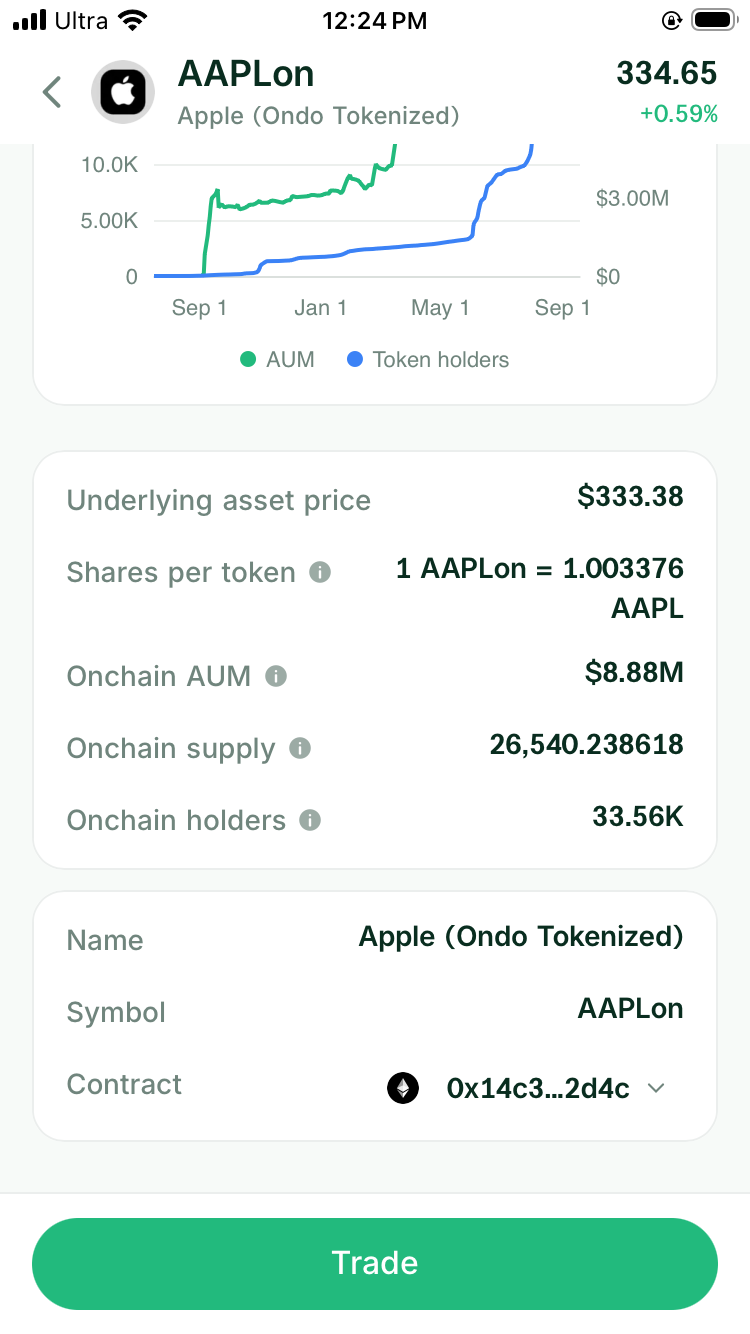
Check exactly which stock token you bought
Suppose you search for Tesla. The results may include one version issued by Ondo and another issued by xStocks. Both relate to Tesla’s price, but they are separate products. The issuer, network, eligibility rules, dividend treatment, and contract address can all differ.
Open Token Info in DeGate and check:
- the issuer and token name
- the network and contract address
- the underlying stock or ETF
- the issuer’s documents
- how the token handles dividends and stock splits
The ticker helps you find the asset. The contract address tells you which token you hold.
For a full check, use How to Verify a Tokenized Stock Before You Buy and How to Choose Between xStocks and Ondo Tokenized Stocks. The Playbook’s tokenized-stock issuance model comparison explains why similarly named stock tokens can have different ownership structures and holder rights.
Sell it when you want to reduce or exit the position
When you are ready to sell, enter the actual amount first and then read “You receive” in the trade preview. This result is calculated for that order at that moment, so it is closer to a real trade than the market price on the asset page.
The asset-page price is useful for following the market. The final quote also accounts for the bid and ask spread, fees, available liquidity, and the size of your order.
DeGate compares the routes available for the token. For an Ondo asset, a solver partner integrated with DeGate may request an RFQ through Ondo’s official API. The quote is for your specific order and draws on the price and available liquidity of the corresponding stock in the traditional US market. This means the order does not have to rely only on the money already sitting in an on-chain pool. When the RFQ route is available, it can offer more depth than a route limited to one such pool, especially for a larger order.
Before signing, read the final amount you will receive, the fee and network cost, and the time left on the quote. A quote can change or expire while the underlying US market is closed or when the available trading limit changes.
The separate guide How to Check a Tokenized-Stock Quote Before You Buy explains each number on the trade preview.
Follow dividends and stock splits
A company may pay a dividend, split or consolidate its shares, or change its ticker. These changes are commonly called corporate actions. For a stock-token holder, the practical question is how the issuer reflects each change in the token.
The result is not always a cash payment. You may see a different token balance, a change in the value represented by each token, or another asset arrive. The current documents for xStocks, Ondo, Robinhood Stock Tokens, Coinbase Tokenized Stocks, and bStocks all describe dividend reinvestment through a multiplier or shares-per-token value, but their contracts and wallet displays differ. Other issuers may use a separate distribution instead.
Start with the issuer’s dividend or stock-split notice. Then compare it with the balance, token value, and transaction history in your wallet. A dividend does not necessarily appear as a separate USDC transfer.
For worked examples, read How Tokenized-Stock Dividends Show Up in Your Wallet and the Playbook reference How Tokenized Stock Dividends Work.
Earn trading fees through a stock liquidity pool
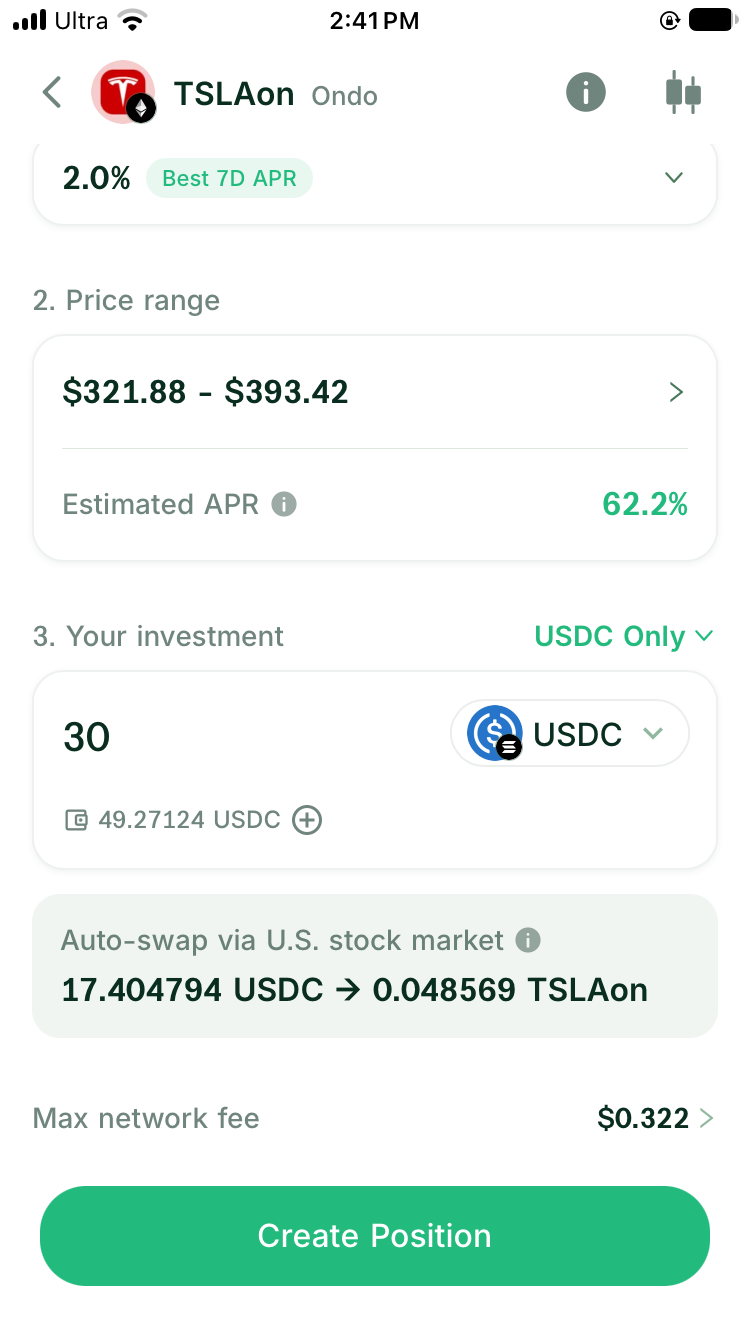
Some holders want income from trading activity around the stock token. A stock liquidity pool pairs the stock token with another asset so traders can exchange between them. In DeGate Turbo Range, currently listed stock pools pair a supported token with USDC. Liquidity providers receive a share of the fees when their active position serves those trades.
An LP automatically exchanges assets with traders as the price moves, so the mix of stock and USDC changes over time. You may close with more stock and less USDC than you deposited, or the other way around.
In DeGate, open Turbo Range and search for the stock. For an eligible Ondo asset on Ethereum, you can open a stock/USDC LP position, choose a fee tier and price range, monitor the position, claim fees, and close it from the same wallet. You do not have to make a separate swap before opening the position. Choose USDC Only to review the auto-swap needed to prepare the pool ratio when a quote is available. Choose the two-asset mode to enter both assets already in your wallet.
Before confirming, check the amount or amounts you are depositing, the price range, the network cost, and any conversion details shown in the current flow. This is more useful than treating the displayed historical estimate as a promise.
The beginner guide What Is a Tokenized-Stock Liquidity Pool? explains why the stock and USDC amounts change inside the position.
Explore DeFi from the same wallet
DeGate also works as an entry point to other on-chain applications. Hyperliquid is integrated in the app, while the Web3 browser provides quick access to services such as Aave and Kamino. You do not need to create another wallet just to explore perpetuals, lending, or another DeFi market.
The same wallet can therefore hold and trade stocks, manage Turbo Range positions, and connect to other on-chain applications. When you open a third-party service, you still connect and sign with your DeGate wallet.
Whether you can deposit the stock token itself depends on the market offered by that application. Search for the exact token name or contract address and look for a corresponding deposit, lending, or liquidity-pool page.
Choose the next step from your original plan
| Your goal | A sensible next step | Check first |
|---|---|---|
| Hold the stock exposure | Keep it in self-custody and follow issuer notices | Recovery setup, issuer, and contract |
| Sell part or all of it | Enter the amount and read the final trade quote | Amount received, fee, network cost, and quote time |
| Earn LP fees | Open the stock in Turbo Range | Available pool, price range, APR period, and closing assets |
| Try another DeFi use | Open the application from DeGate’s browser | Whether the application supports the exact token |
You do not need to decide all of this on the day you buy. You should know how you would sell the token and where you would check dividends. The rest depends on whether you want a simple holding or an active on-chain position.
FAQ
Can I keep a tokenized stock in a self-custody wallet?
Yes, if the token and network allow transfers to your address. Self-custody lets you control the wallet and move or connect the asset without asking a custodial platform to process a withdrawal. The issuer’s eligibility and transfer rules still apply.
Can I sell a tokenized stock at the price shown on the asset page?
The asset page usually shows a reference price. Enter your order amount and check the final quote. An Ondo order may receive an RFQ requested through Ondo’s official API by a solver partner integrated with DeGate, or it may use another available route. The amount you receive can change with the route, order size, fee, and trading session.
Can I earn both dividends and LP fees?
The issuer handles dividends, while traders in the pool generate LP fees. Both may affect the same position, but they come from different activities. Check how the pool handles the token’s corporate-action mechanism before depositing.
What can I do with an Ondo stock in DeGate?
Eligible users can inspect the asset in Token Info, request a live trade quote, hold it in the self-custody wallet, and follow the issuer’s records. If Turbo Range supports the exact asset for LP use, it can also be used in a liquidity position. Eligible Ondo assets on Ethereum use the same Turbo Range position flow regardless of the underlying pool state.
Sources
- DeGate FAQ
- DeGate Turbo Range documentation
- DeGate Playbook: What Is the Tokenized Stock in Your Wallet?
- DeGate Playbook: How Tokenized Stock Dividends Work
- Ondo Global Markets API overview
- xStocks documentation
- Robinhood Chain: Stock Tokens
- Coinbase Tokenize
- Binance bStocks FAQ
- SEC staff statement on tokenized securities
Facts on this page were last verified on October 19, 2026. Product capabilities, supported assets, and fees can change; the linked sources are the current record.