
How Tokenized Stock Dividends Work: xStocks Rebasing, Ondo Total-Return Pricing, and Dinari Stablecoin Distributions
On-chain Stocks · Updated 2026-09-22 · 17 min read
On this page
- Opening
- Section 1: The three wallet-level outcomes
- Section 2: Comparison at a glance
- Section 3: xStocks — rebasing, multiplier, and the EVM/Solana split
- Section 4: Ondo Global Markets — total-return tracking and the Scaled UI overlay
- Section 5: Dinari dShares — stablecoin distribution to verified wallets
- Section 5.5: Binance bStocks — multiplier via BEP-677, with less public detail
- Section 5.6: Robinhood Stock Tokens (July 2026) — a multiplier on the issuer’s own chain
- Section 5.7: Coinbase Tokenized Stocks on Base
- Section 6: What holders need to track
- Closing
- FAQ
TL;DR: Tokenized-stock dividends do not all arrive as cash. xStocks, Ondo, Binance bStocks, Robinhood Stock Tokens, and Coinbase Tokenized Stocks use multiplier-based dividend reinvestment. Dinari sends a separate stablecoin distribution to eligible verified wallets. The issuer mechanism, chain, and wallet display determine what the holder sees. Each mechanism creates a different recordkeeping trail.
Opening
A dividend does not always mean cash entering your wallet.
For a traditional brokerage holder of a US stock, a dividend is straightforward: cash hits the brokerage account, sometimes a few days after the ex-date. For a tokenized stock holder, “dividend” describes a moment in the underlying company’s calendar, but the event arriving in the wallet can take very different forms depending on the issuer and the chain.
This reference is the dividend-mechanics companion to the On-chain Stocks for Self-Custody Wallet Users pillar. It covers three major issuer models relevant to self-custody wallets in 2026 — Backed Finance / xStocks, Ondo Global Markets, and Dinari dShares — and the specific mechanisms each uses to translate a corporate dividend payment into a wallet-level change. The aim is not to recommend one mechanism over another. The three serve different design priorities, and each has cost basis and tax tracking implications that the holder, not the issuer, has to manage.
Robinhood Classic Stock Tokens, the separate product held inside Robinhood’s EU app, are not part of the self-custody comparison. Robinhood says cash dividends for that product are paid into the account in euros as a cash distribution. Its transferable Stock Tokens on Robinhood Chain use a different, publicly documented mechanism: an onchain multiplier adjusts the shares-per-token ratio for dividends and stock splits. That product is covered below, alongside bStocks and Coinbase Tokenized Stocks.
Section 1: The three wallet-level outcomes
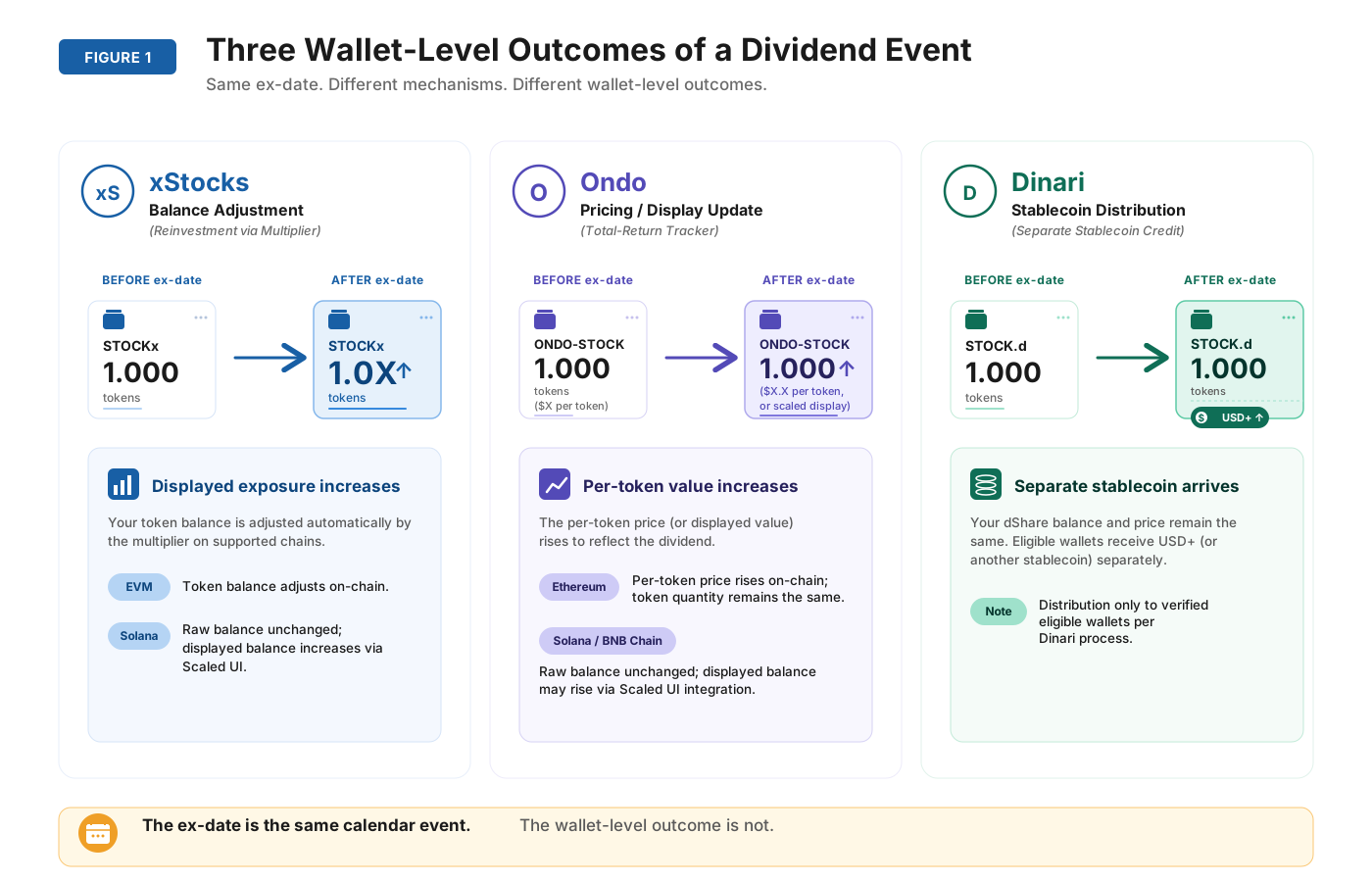
When a US company pays a dividend, the cash first reaches the brokerage or custody layer connected to the issuer’s underlying shares. What happens next, from the token holder’s perspective, falls into one of three patterns.
Balance adjustment. The displayed exposure to the same ticker rises. The implementation differs by chain: on EVM chains, the token contract adjusts the balance directly; on Solana, the raw on-chain balance is constant and the increase appears through a display-layer multiplier. This is the xStocks pattern.
Pricing or multiplier update. The token’s per-share representation grows, and depending on the chain the holder sees either a higher per-token price or a higher displayed balance. Ondo, Binance bStocks, Robinhood Stock Tokens, and Coinbase Tokenized Stocks all use a multiplier in some form, but the contract standard and wallet display differ by product.
Stablecoin distribution. A separate token arrives in the wallet — USD+ or another stablecoin in Dinari’s case — representing the dividend amount after the issuer’s distribution process and applicable fees. The dShare balance and price are unchanged by the dividend itself.
The three are not interchangeable. A holder reading their wallet on the day after an ex-date may see the displayed token quantity rise (with on-chain quantity changing on EVM but not on Solana), the per-token price rise (Ondo on Ethereum), or a new stablecoin balance appear (Dinari) — and each tells a slightly different story for cost basis tracking.
This is the framing that holds the rest of the guide together: mechanism + chain environment = what the holder actually sees. Two issuers using different economic mechanisms can produce visually similar wallet behavior on Solana; two issuers using the same broad mechanism (reinvestment) can produce different on-chain artifacts depending on the chain.
Section 2: Comparison at a glance
The shortest answer is: xStocks reinvests dividends through a multiplier, Ondo reflects dividends through total-return pricing via its sValue multiplier, and Dinari distributes a separate stablecoin to verified wallets. Binance bStocks, Robinhood Stock Tokens, and Coinbase Tokenized Stocks also use multiplier-based reinvestment.
| Issuer | Dividend mechanism | What holder receives or sees | Chain-specific note | Tracking implication |
|---|---|---|---|---|
| xStocks (Backed) | Reinvestment via multiplier; net of 30% US withholding tax. Multiplier updated ~8:00 PM EST the day prior to ex-date. | More displayed exposure to the same xStock; on EVM this appears as an adjusted balance, while on Solana it appears through Scaled UI. | EVM: token contract adjusts balances automatically. Solana: raw on-chain balance constant; displayed balance = raw amount × multiplier via the Scaled UI extension. | Each reinvestment event may shift cost basis per token, depending on jurisdiction’s treatment of in-kind reinvestment. |
| Binance bStocks | Reinvestment via a Multiplier / rebase (per Binance support docs); net dividend reinvested after applicable US withholding (described using a 30% assumption). Precise rebase formula and timing window not detailed in public materials reviewed. | An adjusted displayed token balance in Scaled-UI-aware wallets, rather than a separate cash distribution. | BNB Chain: Multiplier implemented via BEP-677 (Scaled UI Amount); displayed balance reflects the multiplier at the UI layer, with raw on-chain accounting to be checked against the token contract and issuer / venue documentation. | Same multiplier-tracking concern as xStocks/Ondo: a record of the multiplier before and after each event is what supports cost-basis reconstruction; treatment depends on jurisdiction. |
| Ondo Global Markets | Reinvestment via the SyntheticSharesOracle multiplier (sValue); net of 30% US withholding tax. Trading typically paused 7:50–8:10 PM ET the day before the ex-date. | A higher per-token price (Ethereum) or a higher displayed balance (Solana / BNB Chain in Scaled-UI-aware wallets). Economic exposure is unchanged; only the display differs. | Solana / BNB Chain: Scaled-UI-aware wallets may display increased token units; wallets without Scaled UI may display balances and prices closer to the Ethereum total-return presentation. Economic exposure is unchanged. | Holders reading the same Ondo position on different chains or different wallets may see different surface behavior for the same economic event. |
| Robinhood Stock Tokens (July 2026) | Cash dividends are automatically reinvested to purchase more shares of the underlying stock. An onchain multiplier adjusts the shares-per-token ratio; the same mechanism handles stock splits. Robinhood’s chain documentation does not specify a dividend formula or update schedule. | No separate cash payout. The raw token balance stays fixed until redemption, while the multiplier increases to represent more shares per token. | Standard ERC-20 tokens on Robinhood Chain; applications can read the ERC-8056 multiplier through uiMultiplier(). | Keep the multiplier value and the related corporate-action record; treatment depends on jurisdiction. |
| Coinbase Tokenized Stocks | Eligible dividends are reinvested after applicable withholding and fees. An onchain multiplier increases to reflect the added share-equivalent value; the same mechanism supports stock splits. | Raw B20 token units stay fixed while each token represents more share-equivalent value. A compatible interface can show the adjusted amount. | B20 tokens on Base expose an onchain multiplier separately from the raw token balance. | Keep the multiplier value and issuer event record alongside the wallet transaction history. |
| Dinari dShares | Stablecoin distribution to verified wallets; 5% service fee per Dinari’s fee documentation. Snapshot of holdings at 4 AM ET on the ex-dividend date; minimum distribution amount $0.10 USD. | USD+ (or another stablecoin) appears in the wallet; the dShare balance and price are unchanged by the dividend itself. Wrapped dShare holders receive underlying dShare deposited into the wrapped position instead. | Multiple chains; examples as of June 2026 include Ethereum, Arbitrum, Avalanche, Base, Hyperliquid, and Plume — see Dinari docs for current list. Eligibility requires registered wallet + KYC. | Each distribution is a discrete wallet event with a date and amount; treatment for tax purposes depends on the holder’s jurisdiction. |
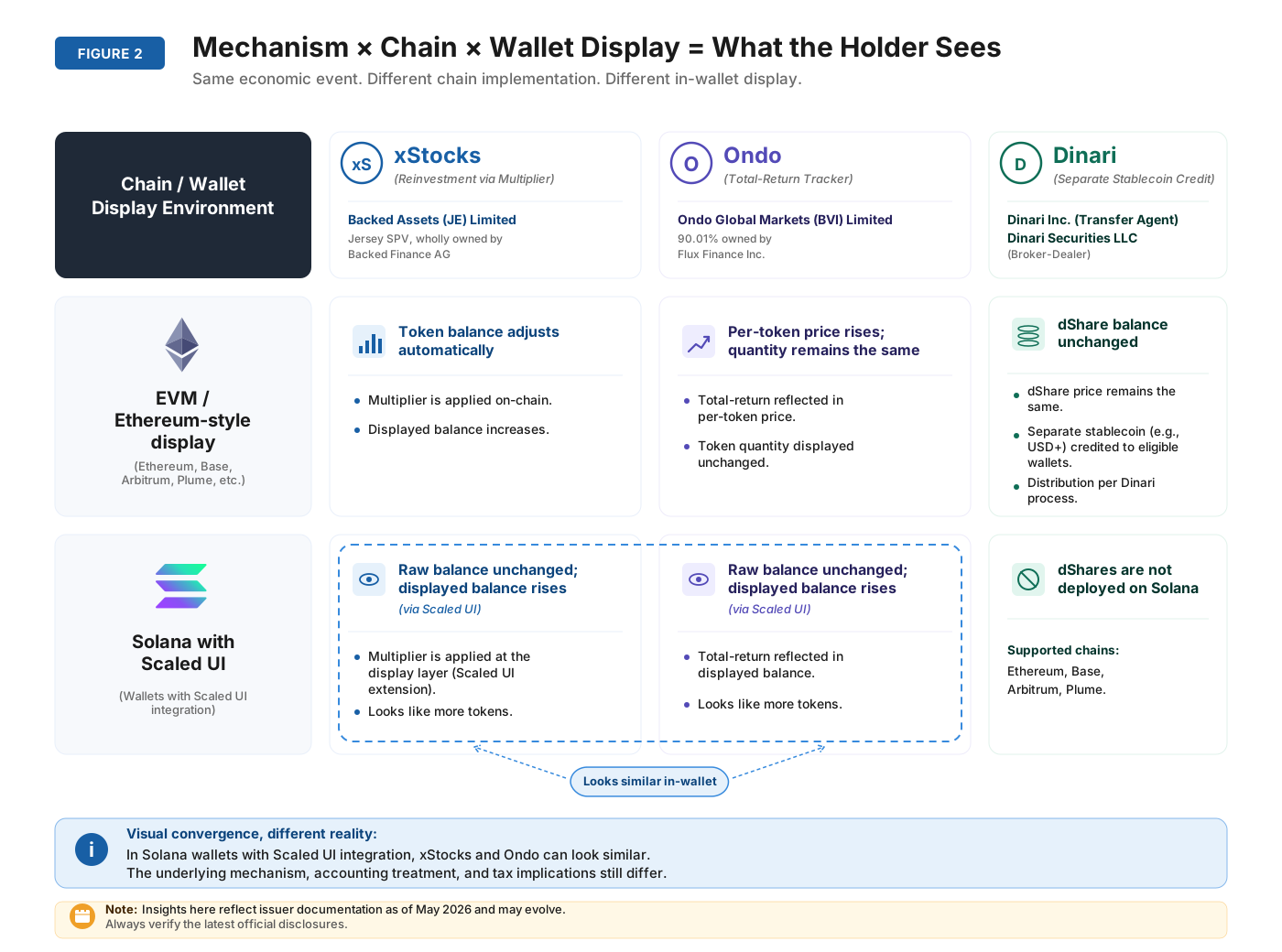
The table summarizes the core differences. The figure below maps xStocks, Ondo, and Dinari across chain environments. Binance bStocks, Robinhood Stock Tokens, and Coinbase Tokenized Stocks are compared in the table and covered in shorter sections below.
Section 3: xStocks — rebasing, multiplier, and the EVM/Solana split
Per Kraken’s xStocks FAQ, dividends on xStocks are not paid as cash. Instead, the token issuer (Backed Assets (JE) Limited) reinvests the net dividend into more of the same underlying asset and updates a per-asset multiplier. The mechanism applies to dividends, stock splits, and reverse splits — all corporate actions are handled through the same lever.
The rebasing calculation, per the FAQ, is: Net Dividend (after 30% US withholding tax) ÷ closing price of the underlying share on the prior day. The multiplier is updated at approximately 8:00 PM EST on the day prior to the ex-date. From the holder’s perspective, no action is required.
The implementation differs by chain. Per the official xStocks documentation:
- On EVM chains, the token contract adjusts balances automatically. For example, if a token’s multiplier moved from 1.0 to 1.1, the contract-adjusted balance would scale accordingly; this mirrors the documentation’s simplified example.
- On Solana, the raw on-chain balance remains constant, and the multiplier is applied at the display layer using the Scaled UI extension. The underlying token quantity does not change; the wallet displays the scaled amount.
This is a meaningful distinction for anyone integrating with on-chain data. A block explorer that does not support the Scaled UI extension will display Solana xStock balances at their raw on-chain quantity, not the scaled amount. The economic exposure is the same in both cases — only the way the balance is presented to the holder changes.
For wallet users, the practical takeaway is that the xStock balance on Solana is a derived figure, not a direct one-to-one ledger entry. On EVM, the on-chain balance and the displayed balance match.
Anchor: xStocks reinvestment shows up as a balance increase on EVM and as a display adjustment on Solana — the economic event is one, the on-chain artifact differs.
Section 4: Ondo Global Markets — total-return tracking and the Scaled UI overlay
Ondo is the easiest mechanism to misread, because the economic treatment and the wallet display can diverge by chain.
Per Ondo’s documentation, Ondo Global Markets tokens are designed as total-return trackers. The token reflects both price movements in the underlying equity and reinvested dividends, net of applicable withholding tax. The reinvestment is tracked through a multiplier called sValue, sourced from Ondo’s SyntheticSharesOracle contract. Dividends declared by the underlying company are converted into additional shares per token via this multiplier.
The contract enforces two update paths, per Chainlink’s documentation for Ondo Global Markets data feeds:
- Small updates (≤1% per 24-hour period) are applied automatically. These handle routine dividend reinvestments.
- Large updates (>1%) require a scheduled pause window and manual confirmation. These handle major corporate actions like stock splits, where the price needs to be held continuous through the event.
For dividends specifically, per Ondo’s corporate actions documentation, trading may be paused 7:50:00 PM – 8:10:00 PM ET on the day before the dividend ex-date, while the system incorporates the dividend amount and updates the shares-per-token figure. The exact pause window may change as Ondo shortens it. For ETF distributions whose exact amount is announced very close to the ex-date, the trading halt can be longer than the standard window — until the system can incorporate the figure.
What the holder sees depends on the chain:
- On Ethereum, the dividend reinvestment shows up as a higher per-token price. The token quantity in the wallet is unchanged.
- On Solana and BNB Chain, in wallets and explorers that have integrated Scaled UI, the same reinvestment shows up as a higher displayed token balance. The underlying on-chain balance is unchanged; the displayed number is the on-chain balance multiplied by the current sValue.
- In wallets and explorers that have not integrated Scaled UI on Solana or BNB Chain, balances and prices may be displayed closer to the Ethereum total-return presentation — higher per-token price, stable quantity. The economic exposure is the same; only the display layer differs.
The shares-per-token multiplier is published on-chain for each asset.
This is where the Ondo mechanism and the xStocks Solana implementation visually converge — both can show up as a displayed balance increase in a Scaled-UI-aware wallet, even though the underlying token contracts behave differently and the economic mechanisms are framed differently in each issuer’s documentation. The Ondo issuing entity, Ondo Global Markets (BVI) Limited, is a BVI entity; Ondo documentation indicates that dividends from US underlyings are reflected net of applicable withholding tax, and its fees and taxes materials describe a 30% US withholding rate for Ondo Global Markets as a non-US entity.
Section 5: Dinari dShares — stablecoin distribution to verified wallets
Dinari is the only one of the three issuers covered here that distributes a separate token in response to a dividend. The mechanism is governed by Dinari’s dividends documentation and is structurally different from xStocks and Ondo.
Per Dinari’s dShares product page, dividends are distributed in the form of USD+ or other stablecoins to verified wallets only; Dinari’s dividends documentation describes standard dShare dividends as USD+ specifically. Per Dinari’s dividends documentation, eligibility requires:
- The dShare token must be held in the wallet at 4 AM ET on the ex-dividend date.
- The wallet must be registered with an account.
- The account must be registered with an entity.
- The entity must be qualified with a valid KYC.
- The distribution amount must be at least $0.10 USD.
Per the same documentation, the distribution form depends on how the dShare is held: a standard dShare holder receives USD+, while a wrapped dShare holder receives underlying dShare deposited into the wrapped dShare position — preserving the wrapped structure rather than breaking it with a stablecoin payout.
A fee applies. Per Dinari’s fee documentation, Dinari charges a 5% service fee of the total dividend payment. (Note: the 5% figure comes from Dinari’s fee schedule pages, not the dShares product page or the dividends mechanics page — they are separate documents within Dinari’s docs.)
dShares are available across multiple chains; examples as of June 2026 include Ethereum, Arbitrum, Avalanche, Base, Hyperliquid, and Plume. Check Dinari’s current blockchain documentation for the latest supported set.
The wallet-level effect of the distribution is distinct from anything in the xStocks or Ondo flow: the dShare position itself does not change in quantity or per-token price as a result of the dividend. What changes is the appearance of a separate stablecoin balance.
For a holder, this has two practical consequences:
- The dShare unit count does not change as a result of the dividend, so holders may be able to track the original position separately from the stablecoin distribution. Whether the distribution affects basis or income reporting depends on local rules.
- The stablecoin distribution creates a discrete wallet event with a date and amount. Whether and how that event is treated for tax purposes depends on the holder’s jurisdiction.
Anchor: Dinari dividends arrive as a separate token in a separate transaction — the dShare position itself is unchanged by the dividend.
Section 5.5: Binance bStocks — multiplier via BEP-677, with less public detail
bStocks, which Binance launched in June 2026, fall on the same broad side as xStocks and Ondo: dividends are reinvested through a multiplier rather than paid as a separate cash or stablecoin distribution. They are included here because that mechanism is squarely this guide’s subject, but the public documentation is thinner than for the other three, so this section is deliberately bounded by what the materials state.
Per Binance’s support documentation, dividends and stock splits on bStocks are handled through a Multiplier, with the net dividend reinvested after applicable US withholding tax (described using a 30% assumption). The Multiplier is implemented on BNB Chain through BEP-677 (Scaled UI Amount) — an updatable displayed-balance multiplier, the same broad display-multiplier family seen in xStocks on Solana and Ondo on Solana / BNB Chain. In a Scaled-UI-aware wallet, the holder sees an adjusted displayed balance; the event is a reinvestment, not a separate token arriving.
What the public materials reviewed here do not spell out, in contrast to the other three:
- The precise rebase formula (xStocks publishes net dividend ÷ prior-day closing price; no equivalent published formula was found for bStocks in the materials reviewed).
- The exact timing window for the multiplier update (xStocks documents ~8:00 PM EST the day before ex-date; Ondo documents a 7:50–8:10 PM ET pause; no equivalent precise window was found for bStocks).
- Whether the on-chain raw balance versus displayed balance behaves identically to the Scaled-UI patterns documented for Solana, beyond the general BEP-677 description.
For a holder, the practical implication is the same multiplier-tracking discipline that applies to xStocks and Ondo: record the multiplier value before and after each corporate action, because “more displayed bStock than last month” does not, by itself, separate a dividend reinvestment from a stock-split adjustment. Until Binance publishes formula- and timing-level detail, those specifics should be confirmed against current issuer / venue documentation rather than assumed to match xStocks.
Anchor: bStocks reinvest dividends through a BEP-677 multiplier on BNB Chain — the same display-multiplier family as xStocks and Ondo, but with less published formula and timing detail.
Section 5.6: Robinhood Stock Tokens (July 2026) — a multiplier on the issuer’s own chain
Robinhood’s onchain Stock Tokens are tokenized debt securities issued by Robinhood Assets (Jersey) Limited on Robinhood Chain. Robinhood says cash dividends are automatically reinvested to purchase more shares of the underlying stock instead of being paid out to the holder. The token’s onchain multiplier increases, while the raw token balance stays fixed until redemption. Applications can read the multiplier from the token contract through the uiMultiplier() function defined by ERC-8056. Robinhood’s chain documentation does not specify a dividend formula or update schedule.
Robinhood’s Stock Tokens belong to the same broad multiplier family as xStocks, Ondo, and bStocks. The issuer, formula, timing, and tax profile differ by program. Multiplier updates may be treated as taxable events depending on jurisdiction, so holders need records that preserve the event history. The holder-level treatment of the product, including how it differs from Robinhood’s EU app Classic Stock Tokens, is in Robinhood Stock Tokens: What You Hold and What You Can Withdraw.
Section 5.7: Coinbase Tokenized Stocks on Base
Coinbase Tokenized Stocks use the B20 standard on Base. Coinbase says eligible dividends are reinvested after applicable withholding and fees. The raw token balance stays fixed, while a multiplier increases so that each token represents more share-equivalent value. Stock splits use the same multiplier mechanism.
For a holder, this means the dividend does not arrive as a separate cash or stablecoin transfer. A compatible wallet or application needs to read the onchain multiplier for the B20 token to show the adjusted share-equivalent amount. If an interface shows only the raw token units, the position may look unchanged even though the multiplier has moved.
The cited Coinbase FAQ does not publish a multiplier formula or update schedule.
Section 6: What holders need to track
These mechanism families produce different tracking trails. Self-custody does not simplify the tracking; it places the trail in the holder’s records rather than a broker statement.
For xStocks, the artifact to track is the multiplier change. On EVM, the holder’s balance number changes; on Solana, the displayed amount changes without the raw on-chain balance moving. Either way, a record of the multiplier value before and after each corporate action is what allows cost basis to be reconstructed. Consider a hypothetical record that shows 1 AAPLx in January and 1.04 AAPLx in June. The balance change alone does not show whether a dividend reinvestment, a stock split, or both caused the difference. The events may receive different tax treatment in some jurisdictions.
For Ondo, the artifact depends on the chain and the wallet. On Ethereum, the token quantity is stable but the per-token price reflects accumulated reinvestments — tracking value across periods requires knowing both the on-chain balance and the sValue at each reference point. On Solana / BNB Chain in Scaled-UI-aware wallets, the displayed balance rises while the raw on-chain balance stays the same, so the holder needs to be aware of which figure their wallet is showing.
For Binance bStocks, the artifact is the BEP-677 multiplier value, tracked the same way as for xStocks and Ondo: a record of the multiplier before and after each corporate action is what lets a displayed-balance change be separated into dividend reinvestment versus split. Because the public formula and timing detail are thinner than for the other issuers, holders should capture the displayed balance and any multiplier figure their wallet exposes at each event date, and confirm the mechanics against current issuer / venue documentation.
For Robinhood Stock Tokens, the artifact is the onchain multiplier read from the token contract. A record of the multiplier value before and after each corporate action helps distinguish a dividend reinvestment from a stock split. The raw token balance stays fixed until redemption, so the multiplier record carries the event history.
For Coinbase Tokenized Stocks, keep the onchain multiplier value for the B20 token together with the issuer’s dividend or split record. The raw token balance stays fixed, so the multiplier shows how the share-equivalent value changed.
For Dinari, the artifact is the stablecoin transaction. Each distribution is its own transfer record with its own date and amount. The 5% fee has already been deducted by the time the holder sees the credit, so the recorded amount is net. The original dShare position is unchanged by the event, which means the dShare unit count and the stablecoin distribution can be tracked as separate records. Whether either or both affect basis or income reporting depends on local rules.
Across these mechanisms, holders should retain:
- Acquisition records for each tokenized stock position (date, amount, contract address, transaction hash)
- A snapshot or note of the multiplier / sValue / distribution event at each corporate action date
- Any stablecoin distributions received (Dinari)
- Records of cross-chain moves, especially where multipliers or display behavior differs between source and destination chains
How any of the above is treated for tax purposes depends on the holder’s jurisdiction. Self-custody changes the path of recordkeeping; it does not change the obligation. For the EU context specifically, see the related Pillar references on DAC8 and Italian tokenized-stock classification.
Closing
The issuer programs covered here produce several distinct wallet-level outcomes. None should be assumed to behave like a traditional brokerage cash dividend, and each requires records that match its own mechanism.
If the high-level question is “do tokenized stocks pay dividends?”, the answer is that many do, but the useful follow-up is how each issuer delivers the economic value. xStocks, Ondo, bStocks, Robinhood Stock Tokens, and Coinbase Tokenized Stocks use different multiplier designs. Dinari distributes a stablecoin. For deeper background on what each token represents in a self-custody wallet, see the Pillar reference. Tax treatment depends on the holder’s jurisdiction and is outside the scope of this mechanics guide.
FAQ
Do tokenized stocks pay dividends as cash? The self-custody products covered here do not send broker-style cash to the wallet. xStocks, Ondo, Binance bStocks, Robinhood Stock Tokens, and Coinbase Tokenized Stocks use multiplier-based dividend reinvestment. Dinari sends a separate stablecoin distribution to eligible verified wallets.
Why does the same dividend look different in different wallets? Because each product and chain uses different balance and display rules. On EVM chains, xStocks adjusts the token balance directly. xStocks and Ondo in Scaled-UI-aware Solana wallets may show a higher displayed balance, while Ondo on Ethereum appears as a higher per-token value. Ondo and bStocks may also show scaled balances in supporting BNB Chain wallets. Coinbase Tokenized Stocks on Base and Robinhood Stock Tokens on Robinhood Chain keep the raw token balance fixed. An interface needs the relevant multiplier to show adjusted share-equivalent units. For Robinhood Stock Tokens, the oracle price already incorporates the multiplier, so an interface may still show the updated market value without reading uiMultiplier() directly.
How are xStocks dividends different from Dinari dividends? They are different event types. xStocks reinvests the net dividend by updating a multiplier, so your displayed exposure to the same xStock rises and no separate token arrives. Dinari distributes a separate stablecoin (USD+) to verified wallets, with a 5% service fee per Dinari’s fee documentation, and leaves the dShare position’s quantity and price unchanged. One changes the position; the other adds a new balance next to it.
How do Binance bStocks handle dividends? On the multiplier side, like xStocks and Ondo. Per Binance’s support documentation, dividends and stock splits are processed through a Multiplier implemented via BEP-677 (Scaled UI Amount) on BNB Chain, with the net dividend reinvested after applicable US withholding (described using a 30% assumption), so in Scaled-UI-aware wallets the holder sees an adjusted displayed balance rather than a separate distribution. The precise rebase formula and timing window are not detailed in the public materials reviewed here the way xStocks’ and Ondo’s are, so those specifics should be confirmed against current issuer / venue documentation.
How do Robinhood’s July 2026 Stock Tokens handle dividends?
Robinhood says cash dividends are automatically reinvested to purchase more shares of the underlying stock. The token’s onchain multiplier increases, while the raw token balance stays fixed until redemption. Applications can read the multiplier from the token contract through uiMultiplier(). Robinhood’s chain documentation does not specify a dividend formula or update schedule.
How do Coinbase Tokenized Stocks handle dividends? Coinbase says eligible dividends are reinvested after applicable withholding and fees. The raw balance of the B20 token remains fixed while an onchain multiplier increases, so each token represents more share-equivalent value. A compatible wallet or application needs to read that multiplier to display the adjusted amount.
Why do xStocks and Ondo sometimes look identical in a Solana wallet? Because both surface a reinvestment as a higher displayed balance through the Scaled UI extension, even though the underlying token contracts and economic framings differ. The visual convergence is a display-layer artifact; the mechanisms (xStocks’ balance multiplier versus Ondo’s sValue total-return tracker) are still distinct under the hood.
What should I keep records of for tax and cost basis? Retain acquisition records for each position; a snapshot of the multiplier or sValue at each corporate-action date for xStocks, Ondo, bStocks, Robinhood Stock Tokens, and Coinbase Tokenized Stocks; and the individual stablecoin transfer records for Dinari distributions. How any of this is treated depends on your jurisdiction; confirm with a qualified adviser.
Questions this reference answers
The specific questions this page is written to address — useful as a jump-off for what to look up next.
- How does an xStocks dividend appear in a self-custody wallet, and how does the EVM vs Solana implementation differ?
- How does Ondo Global Markets' sValue total-return multiplier work, and why does the same Ondo position display differently across chains?
- How does Dinari dShares distribute dividends, and what eligibility rules and fees apply?
- Why can two issuers using different economic mechanisms produce visually similar wallet behavior on Solana?
- How do Binance bStocks handle dividends, and which mechanism family do they fall into?
- How do Robinhood's July 2026 Stock Tokens handle dividends on Robinhood Chain?
- How do Coinbase Tokenized Stocks use an onchain multiplier to reflect dividends in B20 tokens on Base?
- What should a tokenized stock holder track for cost-basis reconstruction across dividend events and corporate actions?
Sources
Primary statutes, official guidance, and dashboards cited above. Each links to the canonical source so you can verify what we’ve said.
Administrative guidance
- xStocks Frequently Asked Questions (docs.xstocks.fi)
- Kraken — xStocks FAQ (rebasing calculation, 8:00 PM EST timing, 30% withholding)
- Kraken — Corporate Actions with xStocks
- Ondo Global Markets — Corporate Actions (7:50–8:10 PM ET trading pause window)
- Ondo Global Markets — Token & Quote Pricing (total-return tracker; Scaled UI on Solana / BNB Chain)
- Chainlink — Ondo Global Markets data feeds (SyntheticSharesOracle / sValue mechanism)
- Dinari — dShares product page (USD+ distribution to verified wallets)
- Dinari — Dividends documentation (4 AM ET ex-date snapshot; $0.10 minimum; wrapped dShare handling)
- Dinari — Fees
- Dinari — dShare Fees (5% service fee on total dividend payment)
- Dinari — Blockchain / supported networks documentation (current list of chains where dShares are deployed; Kinto deprecated)
- Binance Support — Introducing bStocks: Tokenized Securities 1:1 Backing with 24/7 Trading (dividends and splits via Multiplier; BEP-677 / Scaled UI Amount; net dividend after applicable US withholding, 30% assumption)· ADGM
- BNB Chain Docs — BEP-677 (Scaled UI Amount): updatable display multiplier for BEP-20 tokens enabling RWA / split-style balance adjustments
- bStocks.finance — bStocks overview (corporate-actions language; Multiplier / rebase)
- Robinhood Stock Tokens product page (automatic dividend reinvestment and multiplier)
- Robinhood Chain — Stock Tokens (dividend and stock-split multiplier; ERC-8056 Scaled UI Amount)
- Robinhood — Corporate Actions for Classic Stock Tokens (cash dividends paid in euros)
- Coinbase Tokenize: B20 tokens and the onchain multiplier for dividends and splits
Last updated on September 22, 2026. Written by DeGate Editorial Team.
Corrections and primary-source updates welcome at corrections@degate.com .
Related references
On-chain Stocks for Self-Custody Wallet Users: A 2026 Reference
A 2026 reference on tokenized stocks in self-custody — issuer structures (xStocks, bStocks, Ondo, Dinari), the wallet-native path, risk layers, and reporting.
What Is the Tokenized Stock in Your Wallet? Four Issuance Models Compared
What a tokenized stock legally is depends on its issuer, not the ticker: xStocks, Ondo, Dinari, Binance bStocks, and Robinhood Classic compared.
Why 24/7 Tokenized Stocks Do Not Mean 24/7 Price Discovery
Tokenized stocks trade on-chain 24/7, but the underlying US market — and its price discovery — does not. Where the off-hours gap matters.
Tokenized Stocks Issuer Failure: Recovery Paths for xStocks, Ondo, and Dinari
How recovery works if a tokenized stocks issuer fails: Jersey SPV (Backed), BVI SPV (Ondo), SEC transfer agent (Dinari), bStocks, and Robinhood Stock Tokens.
How Arbitrage Keeps Tokenized Stock Prices in Line — and Why It Can't Work Perfectly 24/7
Who keeps tokenized stock prices close to the underlying — the arbitrage loop, what it needs to run, and the structural limits that cap 24/7 alignment.
Italian Crypto Tax in 2026: A Reference on Quadro RW, Quadro RT, and DAC8
A pre-commercialista reference for Italian crypto holders: the 2026 capital-gains rate, Quadro RW, Quadro RT, ravvedimento operoso, DAC8, and records.