
How to Verify a Tokenized Stock Before You Buy
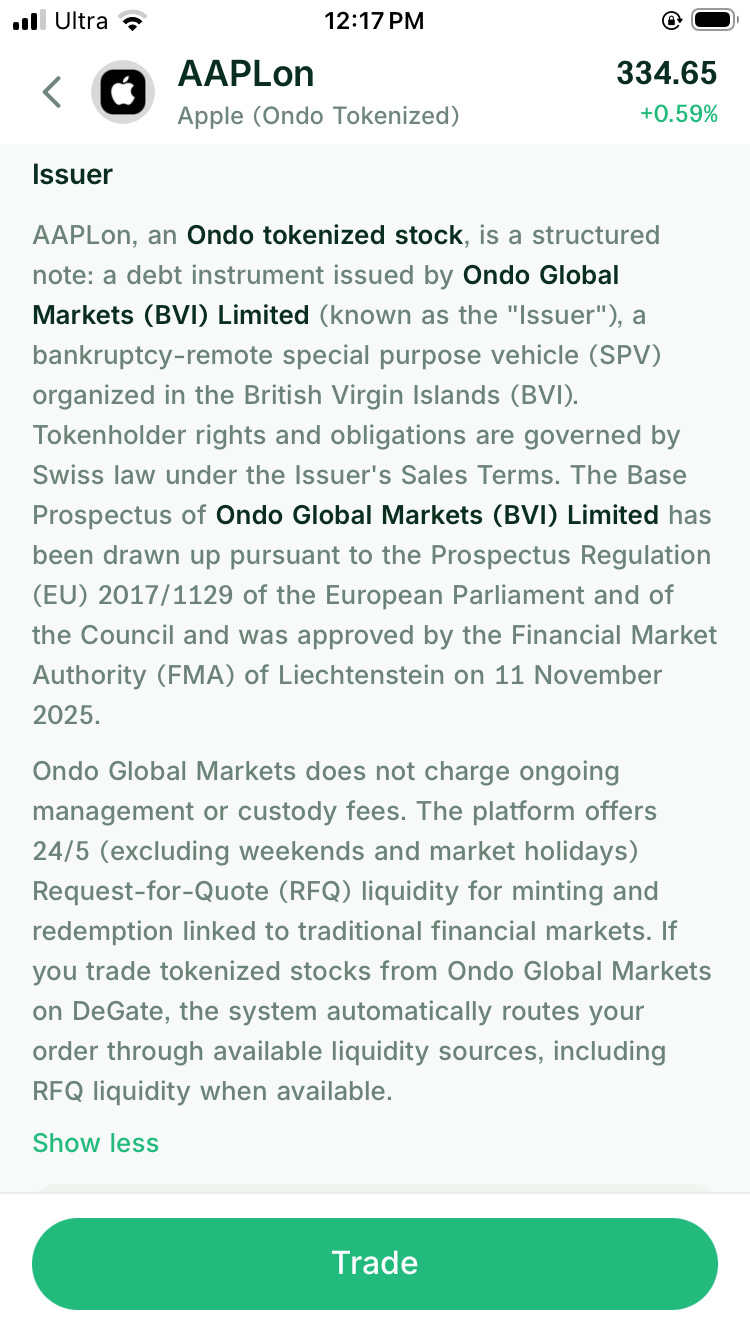
Task guide Last verified 2026-09-30 5 min read
TSLAon from Ondo and a Tesla-linked xStocks token may both follow the price of Tesla stock. They are not the same token. Each has a different issuer, contract, network, dividend treatment, and route into the market.
You do not need to read every legal document before making a small trade. The seven checks below take only a few minutes once you know where to look.
1. Who issued this token?
Start with the issuer name, not the wallet or exchange where you found the asset.
DeGate is the self-custody wallet and trading interface in this example. It does not issue Ondo or xStocks tokens. Ondo Global Markets uses its own issuing structure. Backed Assets (JE) Limited issues xStocks.
This distinction matters if a dividend, redemption, transfer restriction, or product failure needs to be resolved. The issuer’s documents govern those questions.
2. Is the contract address genuine?
Copy the full contract address and compare it with the issuer’s official asset list. Check the network at the same time.
This is more reliable than the logo or ticker. Anyone can create a token with a familiar name, while the official contract points to the product that the issuer recognizes.
An Ethereum contract and a Solana mint address also identify different assets and networks. Even if both refer to Tesla, one cannot be sent directly into a pool made for the other.
3. What does the token represent?
Open the product description and legal documents. Look for the plainest answer to this question: what obligation does the issuer owe to the token holder?
Many third-party stock tokens follow the price of a listed share. The token holder is usually not registered as a shareholder of that public company, so similar price performance does not include the full rights of an ordinary shareholder, such as voting rights. The token’s own legal documents define what rights you have.
The Playbook reference What Is the Tokenized Stock in Your Wallet? explains the main issuance structures in more detail.
4. What supports the token’s value?
Issuers may describe a token as backed by shares held through a custodian or brokerage arrangement. Read beyond the phrase “1:1 backed.”
Find the named custodian or broker, the issuing entity, any proof-of-reserves or reconciliation page, and what the documents say about assets held for token holders. A backing statement explains the intended connection to the stock. It does not answer every question about ownership or recovery by itself.
For a normal purchase, you can turn this into a simple test: can you name the issuer, the entity holding or arranging custody of the shares, and the document that describes your claim? If not, pause before signing.
5. Who can hold, transfer, or return it to the issuer?
Eligibility rules can differ by country and product. Some issuers allow only approved participants to buy newly issued tokens or return tokens directly to the issuer. Their documents often call these steps issuance and redemption. The same tokens may still trade between eligible users on secondary markets.
Check:
- whether your region is eligible
- whether the token can move to another self-custody address
- whether a retail holder can return the token directly to the issuer
- what asset the issuer returns after that process
- whether minimum amounts or trading sessions apply
Selling through DeGate and returning a token directly to its issuer are not the same process. In DeGate, you accept a live trading quote. Going directly to the issuer normally requires its own account checks and follows its minimum-size and settlement rules.
6. How are dividends and stock splits handled?
Look for the issuer’s dividend and corporate-action page. Do not assume that a dividend always appears as a stablecoin transfer.
Ondo and xStocks use different token designs. Depending on the product and network, you may see the value represented by each token change, the displayed balance change, or another payment method. The wallet also needs to understand the issuer’s display mechanism.
Before buying, write down where the issuer publishes these notices. Later, if a dividend or split occurs, you will know which record to compare with your wallet. How Tokenized-Stock Dividends Show Up in Your Wallet walks through that reconciliation.
7. Is there a real route for the next thing you want to do?
Finish by checking the action that brought you to the token.
If you want to buy or sell, enter the actual amount and request a live quote. When the route is available for an Ondo order, a solver partner integrated with DeGate can send a Request for Quote (RFQ) through Ondo’s official API. That quote refers to the price and available liquidity of the corresponding stock in the traditional US market. This means your order does not have to rely only on one on-chain pool. A reference price on the asset page is useful context, while the quote tells you what this order can receive.
If you want to provide liquidity, search for the exact contract in Turbo Range or the intended protocol. Check that a pool exists or that the product lets you create one. Then look at the paired asset, current liquidity, recent trades, range, and closing flow.
If you want to lend the token, find its actual market page in the lending application. A genuine, transferable token has been issued on-chain. A lending application must open a separate market before users can supply or borrow it.
A seven-line note to keep before buying
Save these answers with the transaction:
Pre-purchase verification note
- Issuer:
- Token name and ticker:
- Network and contract:
- What the token represents:
- Backing and custody document:
- Eligibility, redemption, and corporate-action links:
- Live route for buying, selling, or using it in DeFi:
This note takes only a few minutes once you know where to look. It also makes later questions about dividends, transfers, and exits much easier to answer.
FAQ
Is checking the ticker enough?
No. The same company can have tokens from more than one issuer. Confirm the issuer, network, and contract address.
Does “1:1 backed” mean I am a registered shareholder?
Not necessarily. It describes the backing arrangement claimed for the token. Shareholder registration and holder rights depend on the legal structure in the issuer’s documents.
Can DeGate verify the legal rights for me?
DeGate Token Info can show product and on-chain information and link to issuer materials. The issuer’s current legal documents remain the source for holder rights, eligibility, and redemption.
Why should I check the sell route before buying?
Because finding a token is easier than exiting it. A live quote for your intended amount shows whether there is a workable market now and what the trade would return.
Does a genuine token always work in DeFi?
No. The intended application must support the exact token and network. LP and lending markets need their own live product pages.
Sources
Facts on this page were last verified on September 30, 2026. Product capabilities, supported assets, and fees can change; the linked sources are the current record.