
How to Read and Compare On-Chain Stock LP Positions
Task guide Last verified 2026-10-19 8 min read
Do not start with APR when you open a stock LP position. First check whether it remains in range and how much of the stock token and USDC it now holds. Then read the fees. Finally, compare the result with the original deposit and with holding the same opening assets outside the pool.
This separates three different sources of change: the stock price, LP fees paid by swaps, and the exchanges between stock tokens and USDC that occur inside the range.
DeGate Turbo Range supports this review through its position details. The AAPLon/USDC example below is hypothetical. Its figures explain the method and do not represent a real price, fee, or return.
Find the opening baseline
Suppose you use one-sided funding to deposit 1,000 USDC into an AAPLon/USDC position:
| Opening item | Hypothetical input |
|---|---|
| AAPLon price | $200 |
| Price range | $180 to $220 |
| Fee tier | 0.3% |
| Wallet input | 1,000 USDC |
| Assets after opening | AAPLon and USDC shown under After auto-swap |
| Opening costs | Any spread in the auto-swap quote and the network cost shown on the page |
DeGate lists the original input under Review Investment. If an auto-swap occurs, After auto-swap shows the resulting quantities of both assets. After opening, Position Details retains Initial entry price as a separate long-term field. The details and history also let you review the range, pair, fee tier, network, deposited assets, and auto-swap. Use those records instead of assuming that the position began with 500 USDC and 500 USDC worth of AAPLon. The current price’s location inside the range affects the starting ratio.
Auto-swaps within Turbo Range do not incur DeGate’s 0.02% Swap fee, including those used for later increases. When calculating costs, include network fees and any quote spread, and avoid adding the waived fee or counting a spread twice if the recorded asset amounts already reflect it. A separate trade after closing follows its own fee preview.
Each later increase also creates a separate history entry. When reviewing performance, find every increase in Position History and separate that added capital from the position’s growth. Otherwise, your own later deposit can look like earnings.
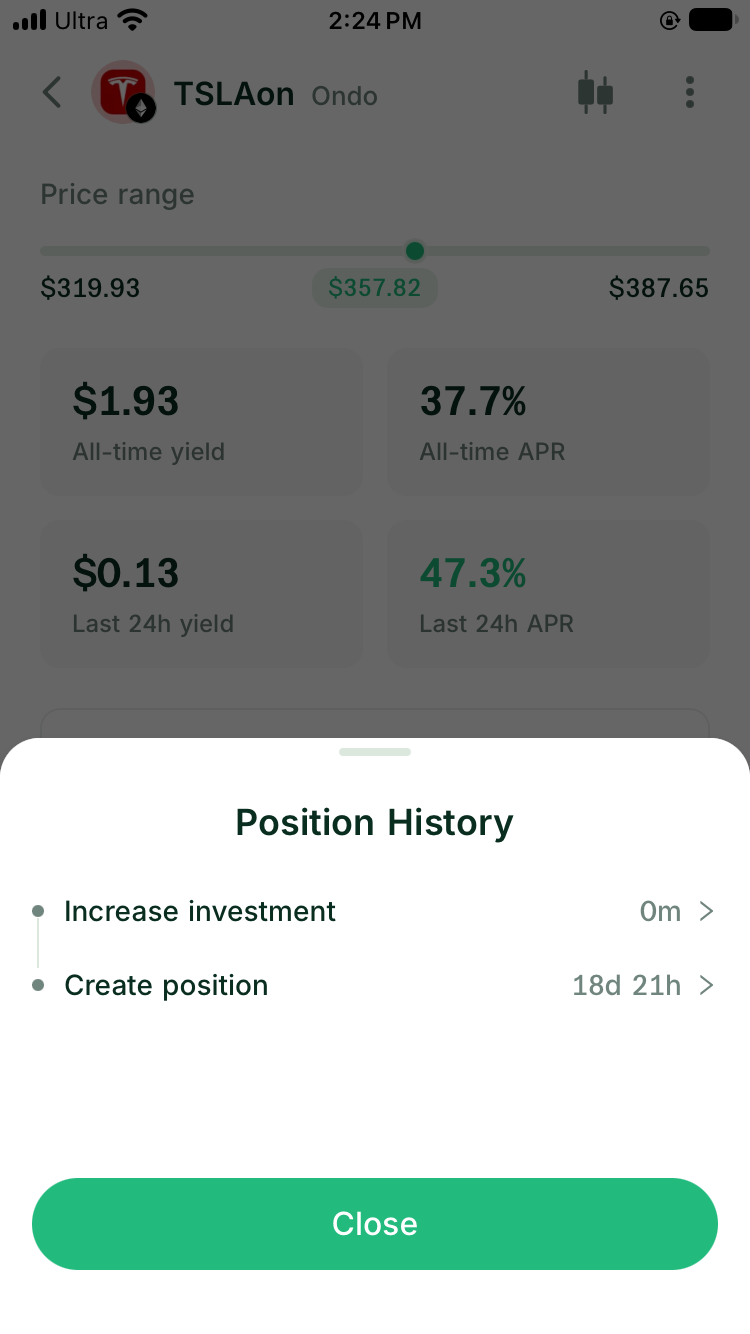
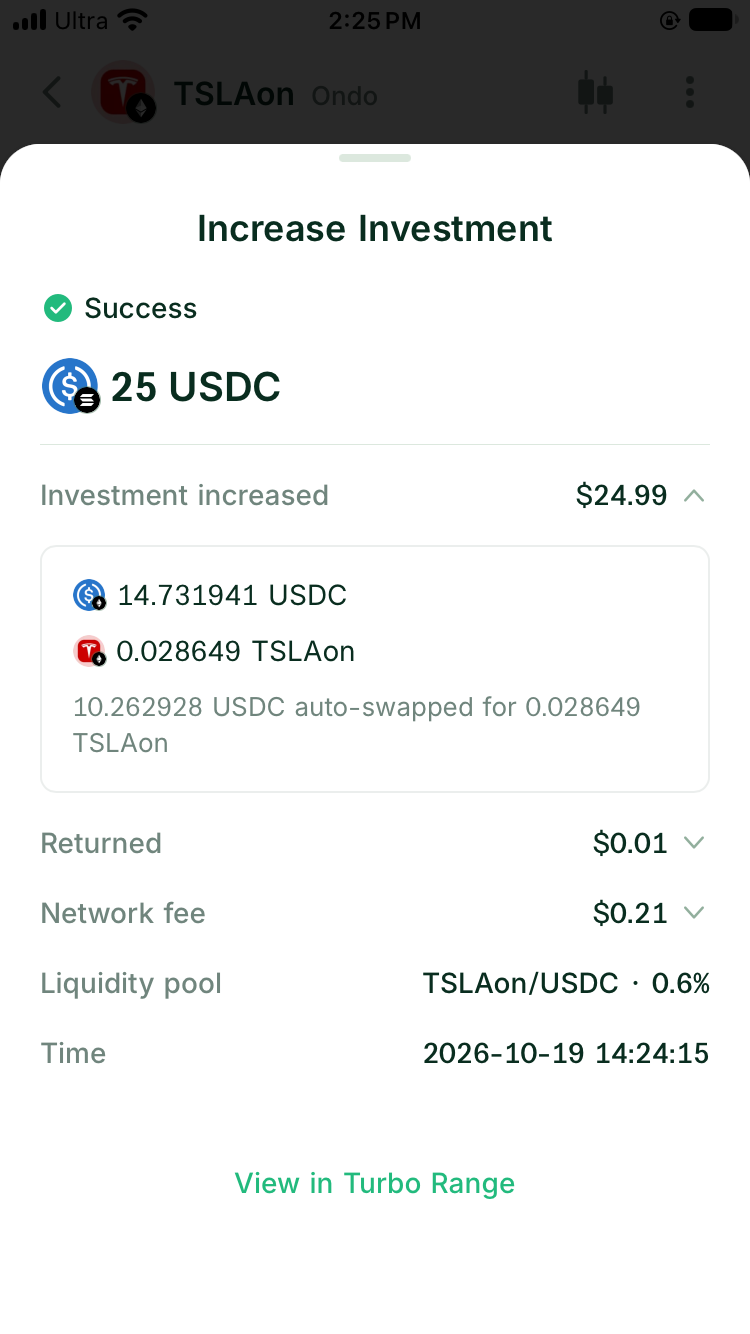
Step 1: Confirm the position identity
Open the DeGate position details and check:
- full stock-token name, issuer, and network
- USDC as the paired asset
Initial entry price- fee tier
- lower and upper prices
- pool and on-chain transaction record
Two positions may both include AAPL in their names while using different issuers, contracts, networks, or fee-tier pools. Confirm these fields before comparing APR, fees, or asset values.
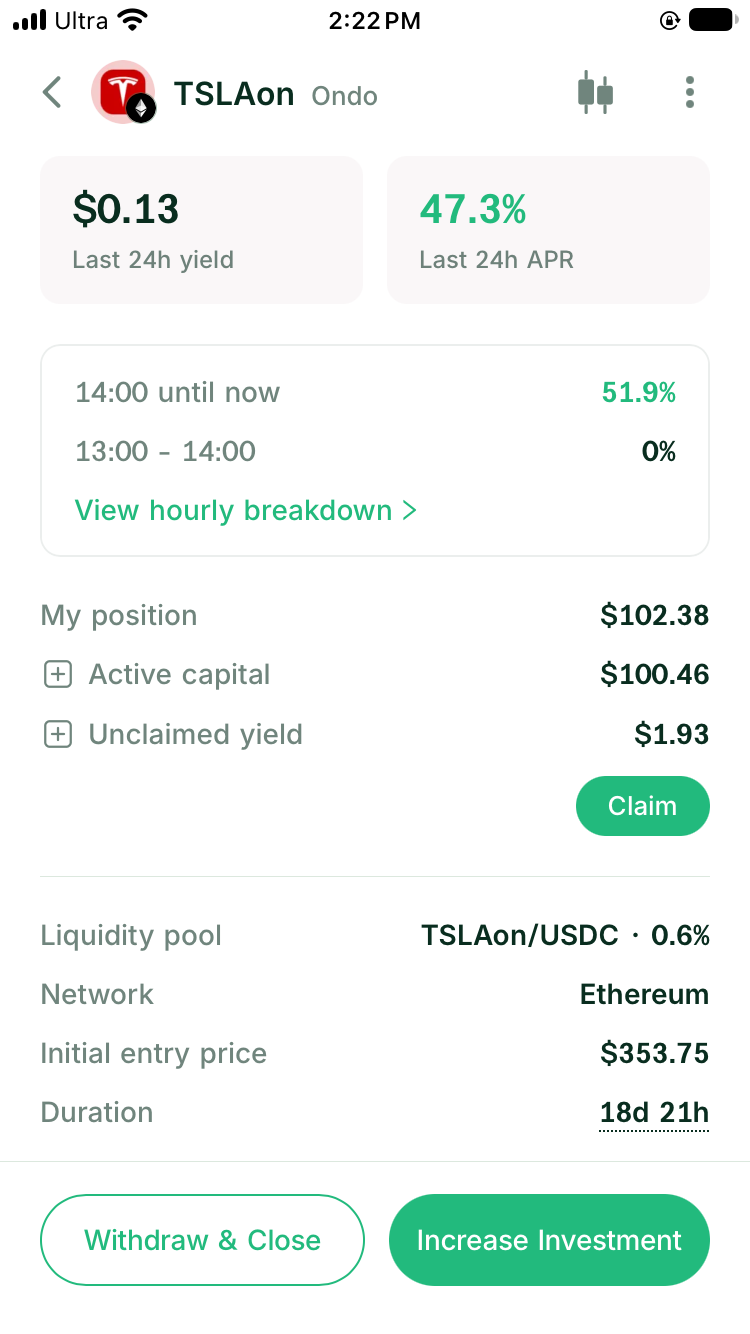
Step 2: Read In Range or Out of Range
In Range means that the current pool price sits between your bounds. The position can serve swaps near that price and receives fees when completed trades use its liquidity.
Out of Range means that the pool price crossed one of the bounds. The funds have not disappeared, and the position is not liquidated merely because it left the range. It will usually hold mostly one asset and stop participating in new swaps until the price returns.
Status only tells you whether the position is active at the current price. LP fees require real trades through the pool. Even when a position shows In Range, time alone adds no fees if no swaps use it.
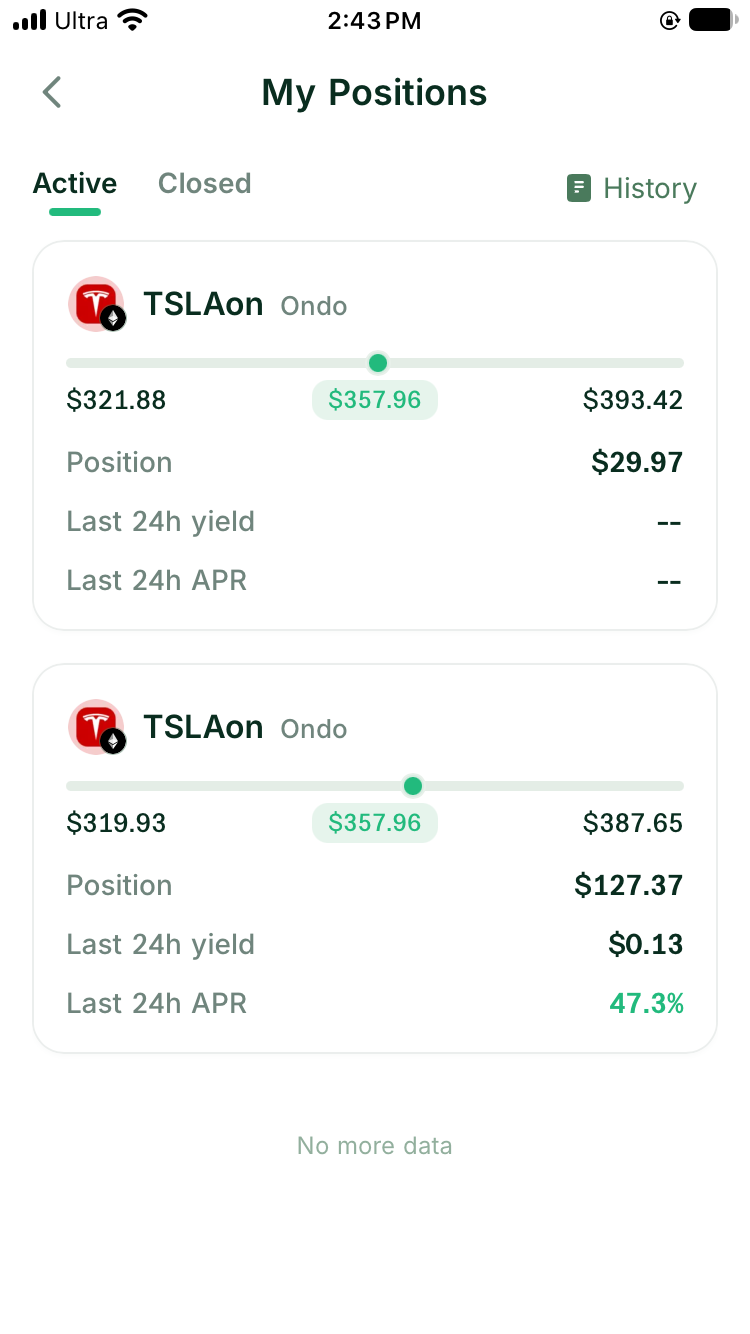
Step 3: Follow the two assets
Continue with the example. AAPLon opened at $200 and later reaches $214, still inside the $180 to $220 range.
During that rise, the position gradually sells AAPLon and adds USDC. The details may therefore show fewer AAPLon and more USDC than the opening record. That change is not a fee or a missing token. The pool exchanged the assets under the range you selected.
The direction reverses if AAPLon falls. The position uses USDC to acquire more AAPLon. Do not judge the position from the stock-token count alone. Value both assets at the same point in time.
Step 4: Separate the fees
Position assets and LP fees are different numbers.
- Use
Active capitalfor the AAPLon and USDC held as principal. If you useMy position, check whether the total already includes unclaimed fees before adding them. - Unclaimed fees came from completed swaps but have not been claimed.
- Claimed fees have returned to the wallet. The current DeGate Turbo Range still includes them in cumulative yield.
Claiming leaves the position open. The unclaimed fee balance goes down because those assets moved to the wallet, while cumulative yield does not restart from zero. When checking the result yourself, include claimed fees and subtract the costs of opening, claiming, increasing, and closing the position.
Complete one comparison with numbers
Suppose your records later show:
| Item | Hypothetical amount |
|---|---|
| Original deposit | 1,000 USDC |
| Active capital: current principal assets, excluding unclaimed fees | 1,060 USDC |
| Unclaimed LP fees | 8 USDC equivalent |
| LP fees claimed earlier | 12 USDC equivalent |
| Costs paid so far | 4 USDC equivalent |
| Current result after those costs | 1,076 USDC |
| Value if you had only held the opening assets | 1,090 USDC |
The calculation is 1,060 + 8 + 12 - 4 = 1,076 USDC. The position is up 76 USDC from the original deposit. LP fees account for 20 USDC: 8 USDC remains unclaimed and 12 USDC was claimed earlier. The rest comes from the AAPLon price and the changing quantities of the two assets.
If the opening AAPLon and USDC had stayed in the wallet, they would now be worth 1,090 USDC. The LP result is 14 USDC lower. As the price rose, the pool gradually sold part of the AAPLon, and the 20 USDC in fees did not fully offset that difference.
Another period can produce a different result. More pool activity and repeated movement through the range can raise fees. A falling stock price can also leave the LP holding more AAPLon than the holding baseline. The comparison method stays the same: value both assets at one time, then add fees and subtract costs separately.
What APR and ROI tell you
ROI means return on investment. It shows the percentage gained or lost from opening the position to the present. ROI is usually cumulative rather than annualized.
For the simple example above:
ROI = (active capital + unclaimed fees + claimed fees - original deposit - costs) / original deposit × 100%
Using the figures above, ROI is (1,060 + 8 + 12 - 1,000 - 4) / 1,000 = 7.6%. If you added capital later, include those deposits in the invested amount so that your own added funds do not appear as returns.
APR means annual percentage rate. It converts the rate earned over a shorter period into a one-year rate, usually without compounding. If a position returned 7.6% over 180 days, simple annualization would produce about 15.4% APR. That conversion does not mean the following 180 days will deliver the same result.
The Historical APR Estimate on the DeGate opening page comes from a backtest. It estimates the annualized result that the selected range might have produced under past prices and trading activity. Realized ROI uses the position’s actual results after it opens. An 18% Historical APR Estimate at opening and a 7.6% ROI several months later are not contradictory. One is an annualized historical estimate; the other is the position’s cumulative result so far.
Compare two stock LP positions
Use the same timestamp and unit, such as current USDC value, then compare:
| Item | Why it must be aligned |
|---|---|
| Net deposits | Prevents added capital from appearing as earnings |
| Opening time | Two days and two months cannot be ranked by cumulative fees alone |
| Stock token and fee-tier pool | Different assets and pools face different market conditions |
| Range and current status | A narrow range can concentrate fees and also become inactive sooner |
| Current assets | Shows which side the position moved toward |
| Claimed and unclaimed fees | A previous claim should not make one position look weaker |
| All costs | Network and conversion costs affect the actual result |
To compare range management, use the same stock token and fee tier with similar opening times where possible. Otherwise, the stock’s own price move can dominate the difference.
Review a position in DeGate
- Open the Turbo Range position list and select the position.
- Confirm the stock token, USDC, network, fee tier, and bounds.
- Read the current price and In Range or Out of Range status.
- Compare the current assets with the opening record.
- Review unclaimed fees and cumulative yield. Current DeGate cumulative yield includes fees claimed earlier.
- Open Position History and review increases, claims, and other earlier actions.
- Value the current assets at one timestamp, then compare them with net deposits and the holding baseline.
If the position is out of range, continue with What to Do When a Stock LP Position Goes Out of Range. To collect fees or end the position, use How to Claim Fees and Close a Tokenized-Stock LP Position.
FAQ
Does a lower stock-token balance mean the position lost money?
The token count alone cannot answer that. As the price rises, an LP gradually exchanges stock tokens for USDC. Value both assets, fees, and costs together.
Does In Range mean the position is earning fees?
It means the position can participate in trades near the current price. Fees increase only when real swaps use that liquidity.
Does cumulative yield restart after I claim?
Not in the current DeGate Turbo Range. Previously claimed fees remain part of cumulative yield. Claiming reduces the unclaimed fee balance because those assets moved to the wallet. You can check cumulative yield, current unclaimed fees, and the wallet receipt separately.
What baseline should I use when comparing the LP with holding?
Use the stock-token and USDC amounts that actually entered the position after opening. Compare them with the current value those same assets would have had if they had remained in the wallet.
Sources
Facts on this page were last verified on October 19, 2026. Product capabilities, supported assets, and fees can change; the linked sources are the current record.