
How Tokenized-Stock Dividends Show Up in Your Wallet
Task guide Last verified 2026-09-30 9 min read
You hold a stock token when the company pays a dividend. A few days later, no cash transfer appears in your wallet. That can be the expected result.
xStocks, Ondo, Robinhood Stock Tokens, Coinbase Tokenized Stocks, and bStocks all describe a dividend-reinvestment mechanism in their current documentation. After applicable withholding and fees, the issuer uses the net dividend to increase the stock exposure represented by the token. The change is recorded through a multiplier or shares-per-token value, depending on the product. Your wallet may then show more tokens, a higher value per token, or an unchanged raw balance alongside an updated issuer value.
The easiest way to check a dividend is to start with the issuer’s event record. After that, compare the multiplier or shares-per-token value with the wallet balance, token price, and total position value. Looking only for a USDC transfer will miss how these programs handle the event.
First, identify the issuer
AAPLx is an xStocks product. AAPLon is an Ondo product. Robinhood Stock Tokens, Coinbase Tokenized Stocks, and bStocks use their own names and contracts. The company name may be the same across several results, but each issuer controls its own dividend record and reinvestment mechanism.
Open the asset in DeGate Token Info and record:
- the complete token name and issuer
- the network and contract address
- the token balance before the event, if you have it
- the current price and total wallet value
Then open the corporate-action or dividend record published by that issuer. The record should identify the affected asset, event date, and updated multiplier or shares-per-token value.
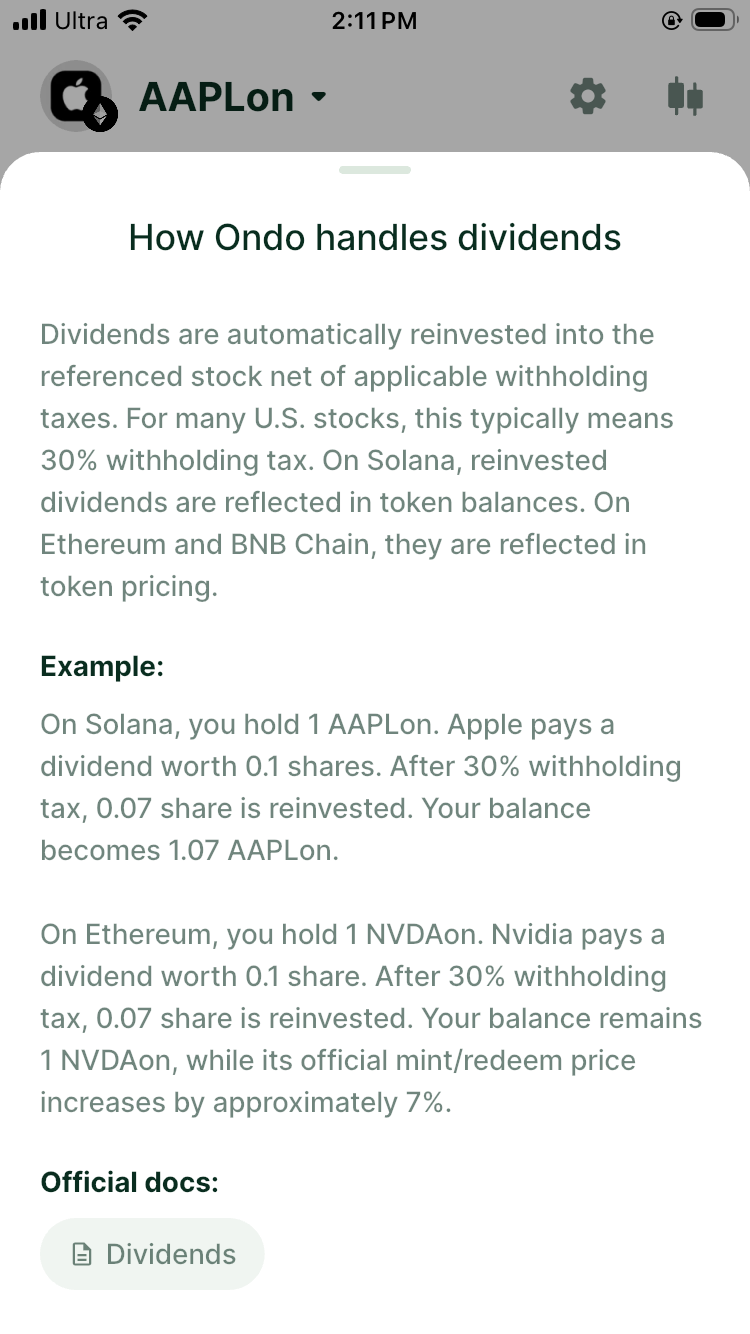
The screenshot records DeGate’s in-app explanation. It does not define how every wallet displays an Ondo token. Use the issuer documentation for the token mechanism, then check the balance, price, and total value shown by the wallet on the selected network.
Compare the five dividend-reinvestment models
The current programs covered here reinvest dividends rather than sending a separate cash payment to a self-custody wallet. Their display methods differ.
| Product | How the dividend enters the product | Raw token amount | What a compatible wallet may show |
|---|---|---|---|
| xStocks | The issuer reinvests the net dividend and updates its multiplier | Depends on the network implementation | An adjusted balance on EVM; a scaled displayed balance on Solana or TON |
| Ondo Global Markets | The issuer reinvests the net dividend and increases shares per token | Scaled UI changes the displayed amount, not the underlying token holding | A higher value per token in a standard display, or a higher displayed balance on Solana and BNB Chain when the wallet supports Scaled UI |
| Robinhood Stock Tokens | The issuer reinvests the dividend and updates an on-chain shares-per-token multiplier | Stays fixed | A wallet supporting uiMultiplier() can show the adjusted share-equivalent balance |
| Coinbase Tokenized Stocks | The issuer reinvests the dividend after applicable withholding and fees and updates the B20 multiplier | Stays fixed | An interface that reads the multiplier can show the updated share-equivalent value |
| bStocks | The issuer generally reinvests the net dividend and updates the Multiplier | Stays fixed | A Multiplier-aware interface shows a larger displayed balance |
The table describes issuer mechanisms. A wallet must also read the relevant multiplier or shares-per-token value correctly to display the adjusted quantity or value. A wallet that supports only holding and swapping may still show the unadjusted raw amount.
How an xStocks dividend appears
xStocks starts each product with a multiplier. When the referenced company pays a dividend, the issuer reinvests the net amount into more shares and raises that multiplier. Stock splits and reverse splits use the same mechanism.
On EVM networks, the token contract returns the adjusted balance. A holder may therefore see the number of tokens increase without a separate transfer in transaction history. On Solana and TON, the raw on-chain amount remains fixed. A compatible wallet reads the multiplier and calculates the balance shown on screen.
Suppose the multiplier moves from 1.000 to 1.008. A position that began with 1 token now represents the economic value of 1.008 shares. The issuer did not send 0.008 tokens in a normal transfer. It changed the multiplier used to represent the position.
To reconcile an xStocks event:
- Find the asset in the xStocks dividend record.
- Note the old multiplier, new multiplier, and activation time.
- Check whether your wallet balance changed around that time.
- If it did not, confirm whether the wallet supports the display multiplier on that network.
How an Ondo dividend appears
Ondo calls its stock tokens total-return trackers. When a dividend is due, Ondo reinvests the net proceeds and increases the number of shares represented by each token.
On Ethereum, your token count stays fixed. The quote and token price reflect the updated shares-per-token value. This means one AAPLon can become worth more than the price of one Apple share over time, because that token represents more than one share’s worth of economic exposure.
Ondo documents Scaled UI support on Solana and BNB Chain. This is a token and display capability, not proof that every wallet currently renders a scaled balance. A wallet that has integrated the standard can show a larger token balance and a token price closer to the underlying share price. A wallet without that integration can use a presentation closer to Ethereum: fewer displayed tokens at a higher price per token. Your total economic exposure does not change merely because the display changes.
DeGate’s in-app explanation currently describes the Solana result through the balance and the Ethereum and BNB Chain result through pricing. That product-specific wording should not be generalized to every BNB wallet. In DeGate, compare the issuer record with the balance, token price, and total value actually shown on the selected network. On Solana, confirm how the current App version displays the multiplier before using the visible token count for reconciliation.
How a Robinhood Stock Token dividend appears
Robinhood’s transferable Stock Tokens on Robinhood Chain use an on-chain multiplier. The issuer reinvests the dividend into more shares of the referenced stock, while the raw token balance stays fixed. The token exposes uiMultiplier() through the ERC-8056 Scaled UI Amount Extension, so an integrated wallet can display the larger share-equivalent position.
Robinhood also has a separate product called Classic Stock Tokens inside its European app. Those positions are not the self-custody tokens discussed above. Robinhood says cash dividends for Classic Stock Tokens appear in euros as a cash distribution in the account. If a search result says only “Robinhood stock token,” check which of the two products it refers to before using its dividend instructions.
How a Coinbase Tokenized Stock dividend appears
Coinbase Tokenized Stocks are issued on Base under the B20 token standard. Coinbase says the raw token count stays fixed while an on-chain multiplier changes for dividends and splits. After applicable withholding and fees, the issuer reinvests the dividend, so each token represents more share-equivalent value.
When searching for its records, use the full name “Coinbase Tokenized Stocks.” “B20” by itself can be confused with an unrelated crypto token on market-data sites. A wallet or DeFi application also needs to read the Coinbase multiplier before it can present the adjusted share-equivalent value correctly.
How a bStocks dividend appears
bStocks on BNB Chain use a Multiplier for dividends and stock splits. Binance says the issuer generally reinvests the net dividend after applicable deductions. The raw token amount remains fixed, while the Multiplier raises the balance shown by an integrated interface.
Binance says BNB Chain explorers support this Multiplier display. That does not establish the behavior of every wallet. If the issuer record shows an update but your wallet balance looks unchanged, compare the raw amount, Multiplier, displayed price, and total value before treating it as a missing dividend.
A dividend can also pause trading
An issuer may pause buying and selling while it updates the event. xStocks publishes a multiplier activation time and advises venues to pause around the update. Ondo may pause an affected asset around the start of its ex-dividend date. Some ETF distributions take longer because the final amount becomes available close to the event.
A paused quote does not mean the token disappeared from your wallet. Check the issuer’s status page before assuming that the wallet or route has failed. You may need to wait until the issuer has applied the new shares-per-token value.
Check total value, not one field
To check whether a dividend has reached your position, read the balance and unit price together. Consider this simplified hypothetical example. It explains the display method only and leaves out market movement, differences in tax, and trading costs.
Suppose the issuer has processed a dividend and published a multiplier of 1.01. At that time, the referenced share trades at $100. Your position might appear in either of these ways:
- The balance remains 1 token, but that token represents the economic value of 1.01 shares and is therefore worth about $101.
- The balance rises to 1.01 tokens, while each token remains worth about $100.
In both cases, the displayed position value is about $101. An unchanged balance does not mean that the dividend was missed. A larger balance does not mean that an unexplained token transfer took place.
First check the issuer’s event record to see whether it has processed the dividend and what multiplier or shares-per-token value now applies. Then use this relationship to check the total shown by the wallet:
displayed token balance × displayed token price = displayed position value
Do not expect the stock token chart to match an ordinary share-price chart at all times. A standard share-price chart usually does not add a paid cash dividend back into the line. The five programs compared above reinvest eligible net dividends and record the result through their documented multiplier or shares-per-token mechanism. The two charts can therefore begin to differ after a dividend without indicating an error.
Keep the issuer’s event record with your wallet history. The issuer may deduct withholding before reinvestment, while your own tax treatment depends on your jurisdiction.
Checking the event in DeGate
- Open the exact asset in Token Info.
- Confirm the issuer. DeGate currently provides issuer-level stock information for xStocks and Ondo.
- Follow the issuer document or event record linked from the asset information.
- Compare the updated multiplier with your displayed balance and token price.
- Check the total position value and the transaction history.
For bStocks, Coinbase Tokenized Stocks, and Robinhood Stock Tokens, DeGate’s general Trade route can return a quote when an executable route is available. Issuer information and multiplier display require separate confirmation. Check the issuer’s own record as well as the DeGate preview.
No transfer is required for a multiplier update to change what the position represents. If the issuer record shows an update but the wallet value still looks wrong, save the contract address, network, multiplier, and a screenshot before contacting support. Those details make the display issue easier to diagnose.
FAQ
Will a stock-token dividend arrive as USDC?
Not under the five self-custody mechanisms described here. Their current documents describe reinvestment through a multiplier or shares-per-token value rather than a separate cash payment. Robinhood Classic Stock Tokens are a different account-based product and may distribute dividends in euros inside the Robinhood account.
Why did my balance change without a transaction?
The issuer may have updated the multiplier for a dividend or stock split. Some token contracts and wallet display systems can change the reported balance without sending a normal token transfer.
Why is my Ondo token priced above the underlying stock?
On an unscaled display, one token can represent more than one share after dividend reinvestment. Multiply the underlying share price by shares per token before treating the difference as a pricing error.
Does a higher token balance mean I received free money?
No. The balance adjustment records a corporate action that changed how much underlying equity value the position represents. Check the total position value rather than the token count alone.
Does DeGate already display every issuer’s adjusted dividend balance?
Do not assume so. DeGate has issuer-level information for xStocks and Ondo, while other stock tokens may be reached through a general trade route. Multiplier display support must be checked for the exact token, network, and current App version.
Sources
- xStocks Dividends and Stock Splits
- xStocks Multiplier Documentation
- Ondo Corporate Actions
- Ondo Token and Quote Pricing
- Ondo Asset Status API
- Robinhood Chain: Stock Tokens
- Robinhood: Corporate Actions for Classic Stock Tokens
- Coinbase Tokenize
- Binance: Frequently Asked Questions on bStocks
- DeGate Playbook: How Tokenized-Stock Dividends Work
Facts on this page were last verified on September 30, 2026. Product capabilities, supported assets, and fees can change; the linked sources are the current record.