
How to Choose a Price Range for a Tokenized-Stock LP
Task guide Last verified 2026-10-19 6 min read
Setting a price range does not require you to predict the stock’s exact high and low. You are deciding where the position should begin exchanging stock tokens for USDC as the price rises, and where it should use USDC to acquire more stock tokens as the price falls.
A narrow range concentrates more capital near the current price. With other conditions held constant, it will usually receive more fees from nearby trades, but a small price move can take it out of range. A wide range remains active across a larger move. The same capital covers more prices, so it provides less liquidity near the current price and will usually receive less of the fees generated by the same trading activity there.
In DeGate Turbo Range, you choose the stock token, fee tier, and bounds before reviewing the Historical APR Estimate and deposit preview. The estimate compares different ranges. Your choice still depends on which asset you are willing to hold at either boundary.
Start with the asset at each end
Consider a hypothetical AAPLon/USDC position with AAPLon at $200.
- As the price rises, the position gradually exchanges AAPLon for USDC. Above the upper bound, it will usually hold mostly USDC.
- As the price falls, the position gradually uses USDC to acquire AAPLon. Below the lower bound, it will usually hold mostly AAPLon.
The upper bound is not a simple take-profit order, and the lower bound is not a stop loss. Trades change the asset mix throughout the range. Ask whether more USDC after a rise fits your plan and whether you would still hold more AAPLon after a decline.
If either outcome is unacceptable, moving the bounds may not solve the problem. Reconsider whether this stock LP fits your objective.
Compare three ranges
Keep AAPLon at $200 and use the same deposit and fee tier:
| Hypothetical range | What happens near the current price | Result after a price move | The view it may fit |
|---|---|---|---|
| $195 to $205 | Capital is most concentrated and can usually receive more fees from the same nearby activity | The position goes out of range at $206 or $194 | You expect a small near-term range and will check the position often |
| $180 to $220 | Concentration and price coverage sit between the other two examples | The price has more room, but an earnings move can still reach a bound | You want a middle ground between fee efficiency and management frequency |
| $160 to $240 | The same capital covers more prices and provides less liquidity near $200 | A larger move can remain inside the range | You do not want ordinary price moves to force frequent reopening |
These figures compare range mechanics. They are not a current AAPLon quote or investment advice. A higher historical APR for the narrow range can come from greater capital concentration. It does not guarantee higher fees during the next market move.
Check where the current price sits inside the range
Ranges with the same width do not necessarily begin with a 50/50 asset split.
With AAPLon still at $200, a $180 to $220 range sits roughly around the current price and usually needs both AAPLon and USDC. Change it to $180 to $205, and the current price sits near the upper bound, so the position needs more USDC and less AAPLon. A $195 to $240 range places the current price near the lower bound and needs more AAPLon.
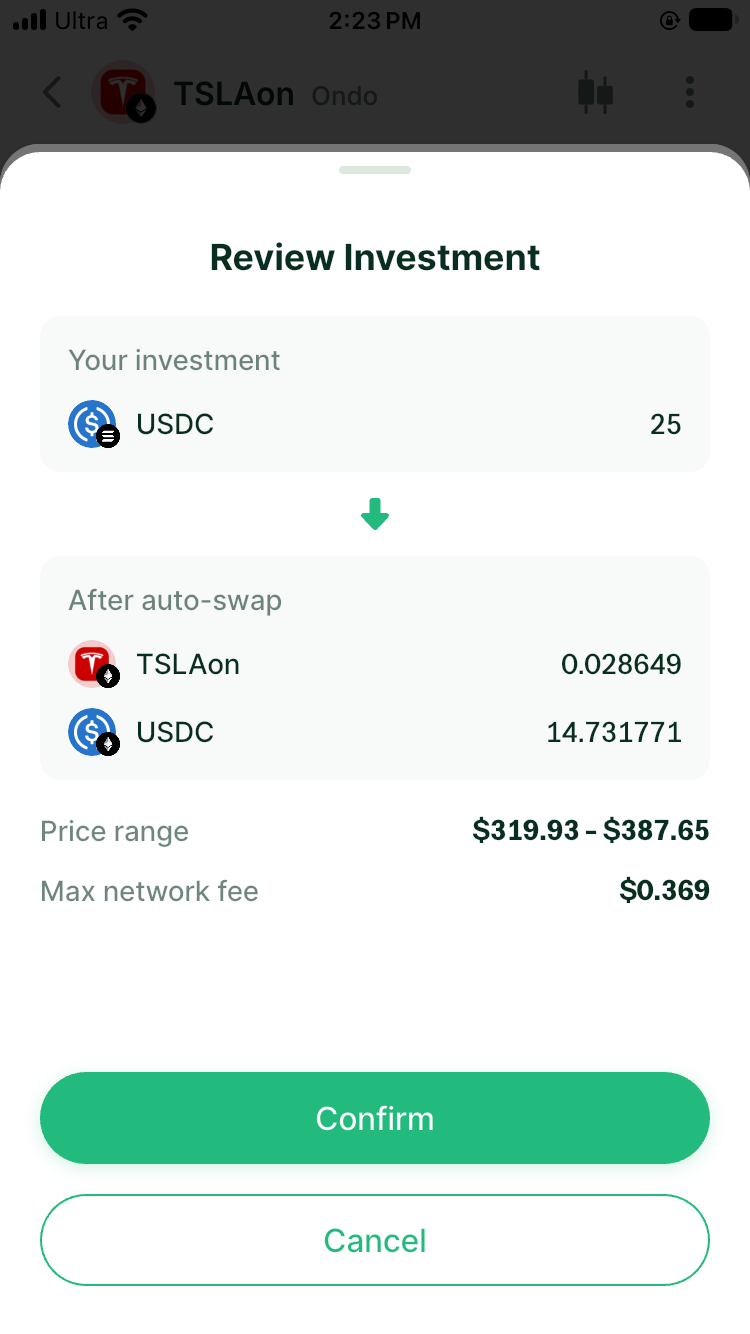
That directly changes the auto-swap amount for a one-sided deposit. Set the range before reading After auto-swap, and do not assume the position must begin 50/50.
Account for stock events
The corresponding stock’s price still affects the stock token. Before choosing a range, check the next earnings date, ex-dividend date, announced company events, and known US-market closures.
Suppose AAPLon closes at $200 and the outside market opens next at $212. A $195 to $205 position may sit outside its range before you check it again. The on-chain pool still moves through actual trades, but the outside-market gap gives arbitrageurs and traders a larger price difference to address.
This does not mean every earnings event requires a wide range. It means that a quiet few days should not be the only reason to compress the range around the current price. If you do not plan to check the position around an event, a wider range will usually fit a lower management frequency.
Use the Historical APR Estimate as a comparison
Hold the stock token, deposit amount, and fee tier constant, then compare ranges. That makes the range the main variable behind the difference.
For each result, check:
- how much of the historical window the price stayed in range
- where the price touched or crossed either bound
- whether the modeled ending position held more AAPLon or USDC
- which data window and fee assumptions the estimate used
A route with no realized pool history can still receive an APR backtest. That number describes a model applied to a historical price path. It is not a record of fees already earned by the pool and does not show how much real trading the position will receive.
Continue with How to Read a Historical APR Estimate for a Tokenized-Stock LP.
Make the choice in DeGate
- Select the exact Ondo stock token, USDC, and fee tier.
- Check the current price.
- Set lower and upper bounds whose asset outcomes you accept, then enter the planned deposit.
- Check which asset the position holds more of near each bound.
- Compare Historical APR Estimates for several ranges instead of keeping only the highest one.
- Review the estimated assets after one-sided or two-sided funding.
- Confirm the range, costs, and deposit result before submitting.
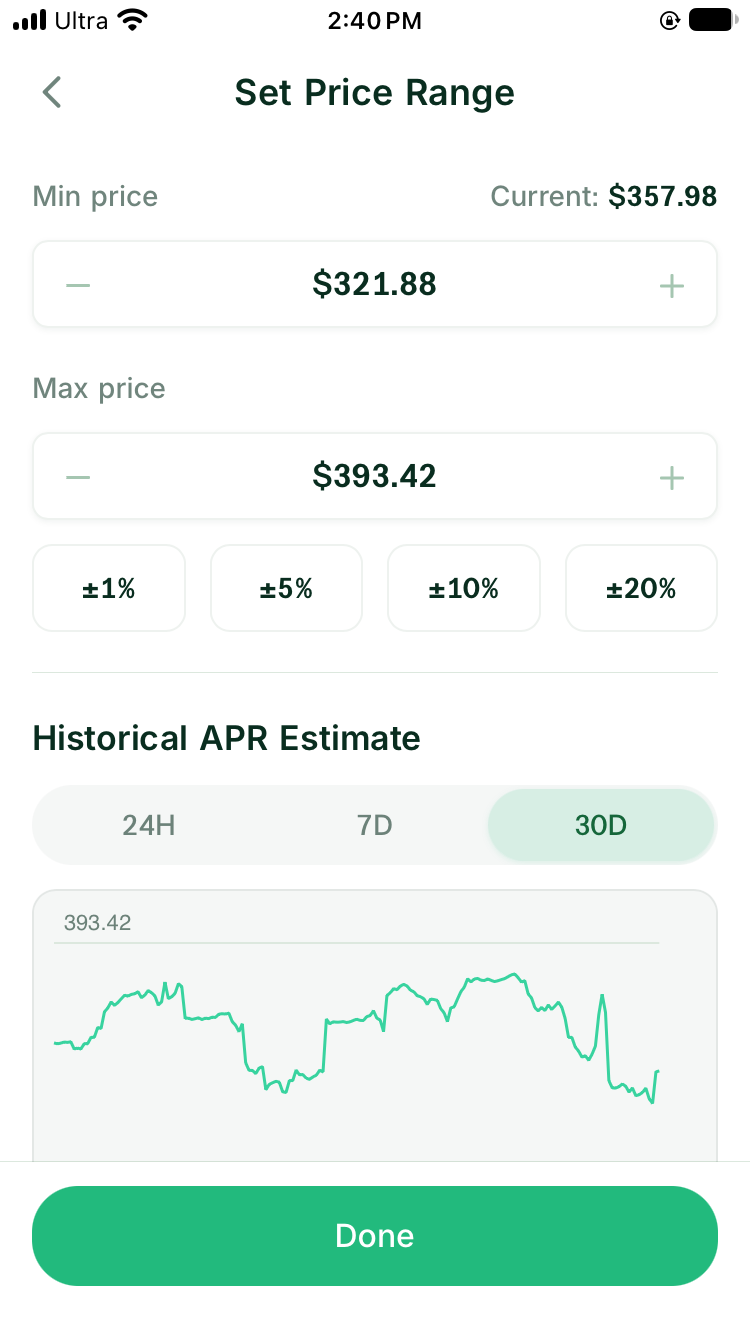
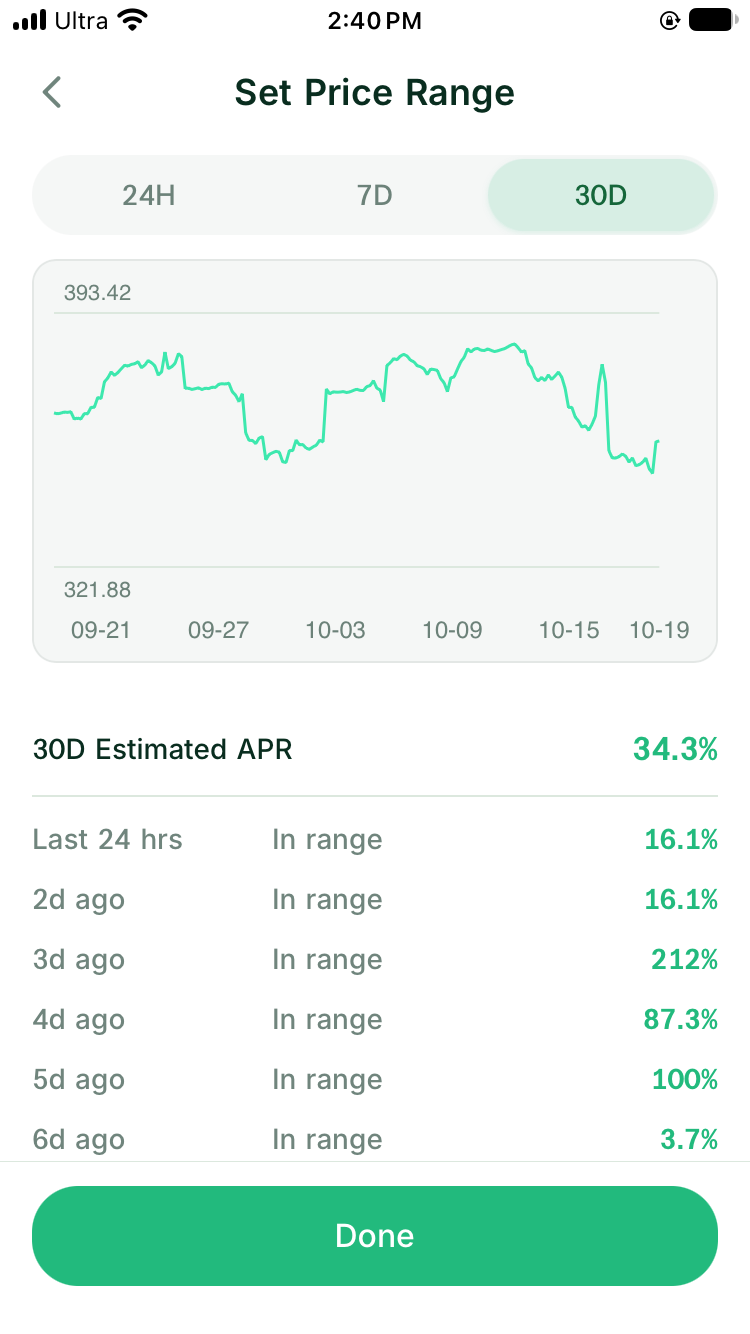
DeGate keeps these choices in one continuous record. The range screen places the current price, lower and upper bounds, and Historical APR Estimate together. Before submission, Review Investment lists the original deposit. If an auto-swap occurs, it also shows the resulting stock-token and USDC amounts.
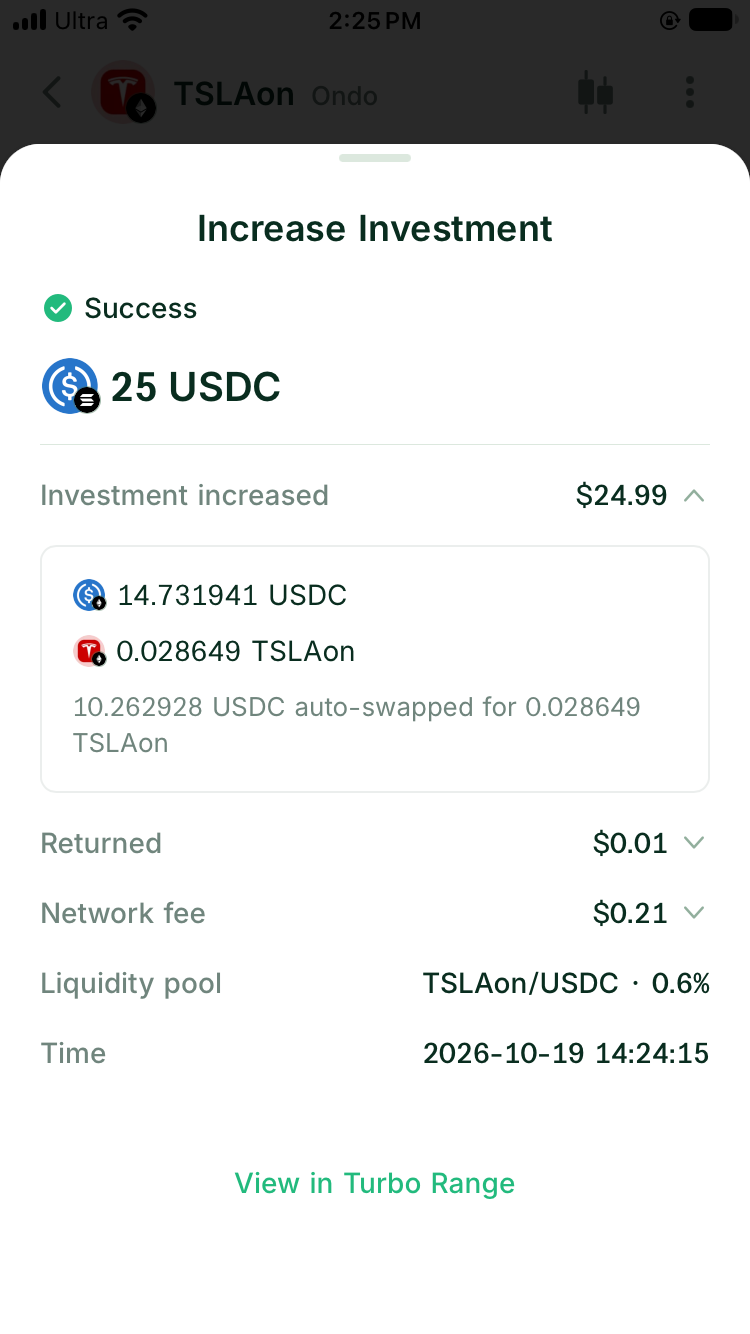
After an opening or increase completes, the position details and history let you review the range, network, stock/USDC pair, fee tier, assets deposited in each transaction, and any auto-swap. Position Details retains Initial entry price as a separate field. Weeks later, you can return to that entry price and the original asset amounts to identify which capital came from a later increase.
Can you edit the range after opening?
In the current version of Turbo Range, an open position cannot change its bounds in place and does not rebalance automatically. If the original range no longer fits, close the position and open another one with new bounds.
In the current version, closing returns the stock token, USDC, and unclaimed fees held by the position without automatically swapping the full result into USDC. Review the new asset ratio, any auto-swap, and the network fee before reopening.
FAQ
Does a narrower range always earn more?
No. While active, a narrow range puts more capital near the trading price, so it may receive more fees from the same trade. The price can also cross its boundary sooner. Once out of range, the position stops participating in new swaps until the price returns. The final fee amount depends on real swaps, competing liquidity, and time spent in range.
How can I tell if the lower bound is too low?
Picture the position holding more stock tokens near that bound. If you would not want more exposure to the stock-linked asset at that price, the lower bound may not fit your plan.
How can I tell if the upper bound is too low?
The position gradually reduces stock tokens and adds USDC near the upper bound. If you want to keep the full stock-token amount through a larger rise, the bound may sit too close to the current price.
Is an out-of-range position liquidated?
No. The position remains yours, usually holding mostly one asset. It stops participating in new swaps and earning the corresponding LP fees until the price returns to the range.
Sources
Facts on this page were last verified on October 19, 2026. Product capabilities, supported assets, and fees can change; the linked sources are the current record.