
Tokenized Stocks in Europe: How EU Reporting and National Tax Rules Classify the Wrapper
DAC8 Compliance · On-chain Stocks · Updated 2026-08-13 · 16 min read
Also available in: Italiano Español Français
On this page
A note on “EU”. MiCA, MiFID II and DAC8 are EU-level frameworks — though MiFID II and DAC8 reach you through each country’s implementing laws, so details can differ at the edges. Income tax isn’t EU-level at all: there is no EU tokenized-stock tax rate. Your country decides that, and Italy is worked through below as the clearest example.
And a note on us. This is DeGate’s research — what we found by reading the rules and the issuers’ own documents. It is not tax advice.
TL;DR
You bought TSLAx — or a tokenized stock from Ondo or Robinhood; the shelf is wider than one brand. It shows up in your wallet next to your ETH, and it moves on-chain much the same way. So it’s crypto, and you’ll report it as crypto.
Maybe not — and the difference is worth real money.
“Tokenized stock” is a marketing term, not a legal one. Underneath, the products we examined are structured by their own issuers as debt securities, tracker certificates or structured notes — a contract with an issuer, not direct ownership of a share, and not a coin. In Italy and France, that difference can move the product outside the ordinary crypto tax rules. In Spain a similar argument exists, but the official position is less clear — and, as you’ll see, it may point the other way.
That sounds like good news. It usually isn’t. Here’s what changes:
- The rule — where your country has one — that lets you swap one crypto for another without triggering tax may not cover you
- The declaration form you’d use for crypto may be the wrong form — and in Spain, a different form may catch you instead
- Your exchange may still pass your data to the tax office through the crypto channel — while you file it as something else
And the thing people get wrong most often: being outside the crypto tax rules doesn’t put you outside the declaration rules. Those are separate laws. They have to be checked separately.
Why we’re writing this
We’re DeGate. We make a self-custody wallet, and our app lists tokenized stocks — xStocks from Backed, and products from Ondo Global Markets. We’re not tax advisers or securities lawyers, and we’d obviously prefer these things to be simple to hold.
So read this for what it is: our research — a wallet team writing down what it found — not tax advice. The right answer depends on your country and your situation, and it belongs to your adviser, not to us.
We wrote this because what’s out there doesn’t help. Issuer documents describe the contract precisely but usually say little about holder-level tax treatment. Crypto tax guides treat every token as crypto and apply the crypto rules — which, for these products, may be the wrong starting point. We found little retail-facing material that connects the two.
What’s here: what you’re actually holding; the four separate questions that get mashed into one; one Italian holder’s year, worked through as far as the published rules allow; and where France and Spain differ.
What’s not here: whether your token is a financial instrument. That’s decided product by product, and it isn’t ours to decide.
Same ticker, different contract
Look at the token in your wallet and you learn almost nothing. TSLAx gives you economic exposure to Tesla. So does a Tesla CFD at a broker. So does holding a Tesla share. Three completely different legal relationships behind similar-looking exposure. And within the token category alone, Backed, Ondo and Robinhood each build their stock tokens as a different kind of contract — three more differences a wallet balance will never show you, which is what the table below is for.
The EU regulator has been blunt about this. ESMA has guidelines on when a token counts as a financial instrument — finalised in December 2024, published in all EU languages in March 2025, and applicable from 18 May 2025. Three ideas run through them:
- What it does beats what it’s called. The rights you actually get matter. The name on the product page doesn’t.
- Blockchain doesn’t change what something is. Put a bond on-chain and it’s still a bond.
- One product at a time. No blanket rulings. Each token gets assessed on its own terms.
So you can’t work out your tax position from a ticker. You work it out from the contract.
What you’re actually holding
Three products, described the way their own issuers describe them.
| xStocks (Backed) | Ondo Global Markets | Robinhood Stock Tokens (2026) | |
|---|---|---|---|
| What the issuer calls it | A bearer debt instrument, classified as a tracker certificate — the issuer’s words are “a structured financial instrument, not direct equity ownership” | A structured note — a debt instrument | A tokenized debt security; debt, not equity |
| Who issues it | Backed Assets (JE) Limited, Jersey | Ondo Global Markets (BVI) Limited, a bankruptcy-remote SPV | Robinhood Assets (Jersey) Limited |
| Paperwork behind it | A base prospectus approved by Liechtenstein’s financial regulator; each product has its own Final Terms and KID | Structured-note terms issued by the SPV | Issued under the Robinhood Assets (Jersey) programme |
| What you get | Exposure to the share price. Collateralised 1:1 by the underlying, according to the issuer. No voting rights. | The right to redeem at the underlying’s current value. The note is supported by a first-priority security interest in the collateral, held by Ankura Trust Company, LLC as Security Agent for the benefit of tokenholders. No voting or information rights. | A debt security. No shareholder rights. |
| What the issuer says out loud | These are issued as securities under Jersey and EU rules — but other countries may classify them as crypto | Whether you count as the beneficial owner of the underlying depends on your situation and local law | The tokens give no legal or beneficial rights in the underlying shares |
None of the three gives you the share itself. Each is described by its own issuer in debt-security or structured-note terms: you hold a claim against an issuer, and the issuer holds or tracks the stock.
Three things to keep apart as you read on:
- What the issuer calls it — the table above
- What EU law would call it — a separate test, done case by case
- What your country’s tax office does with it — a step further again
A debt label in a prospectus is evidence. It isn’t the verdict. If you want to check your own product, the three things that matter most are the issuer, what the issuer says it legally is, and who’s on the other side of your trade — if the platform itself is your contractual counterparty rather than just an intermediary, that’s an important clue the product may be derivative-structured, which is a third category again.
A different animal. Robinhood’s earlier European product — officially Classic Stock Tokens — was built as a derivative contract with Robinhood itself as your counterparty: in Robinhood’s own words, derivative contracts tracked on a blockchain. Contracts about a stock’s price, recorded as tokens. Many national tax systems treat derivative gains under their own separate rules — neither securities nor crypto. Italy, for example, is explicit that derivatives follow their own tax rules even when the thing they track is crypto. (One boundary to keep straight: that “third box” is a tax box. For Question 1 below, a derivative is still a financial instrument — outside MiCA just the same.) Two tokens can look identical in a wallet and land in completely different boxes.
Four questions that get mashed into one
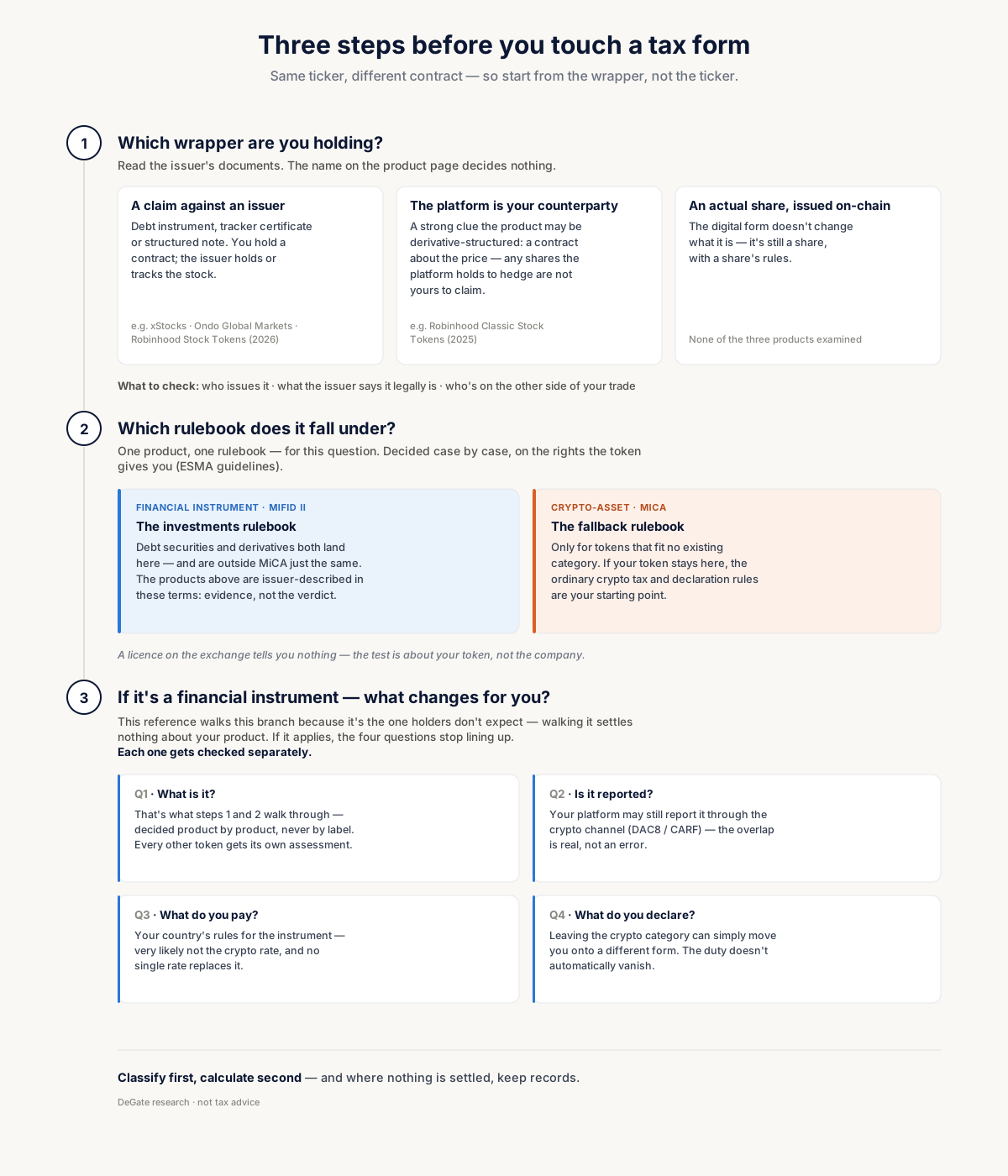
Hold or sell one tokenized stock — TSLAx or an Ondo or Robinhood counterpart — and four separate legal questions may apply to the same product. They don’t line up with each other, and they aren’t supposed to.
1. What kind of thing is it?
Europe has two rulebooks. One for crypto — that’s MiCA. One for traditional investments like shares, bonds and derivatives — that’s MiFID II and the rules around it.
For this question — what the product is — a token gets one rulebook, not both. If your token is really a financial instrument, it belongs in the investments rulebook; the crypto rulebook was only ever meant for things the old rules didn’t cover. The EU regulator, ESMA, has published guidance on how to decide, and the test comes down to one thing: what rights the token gives you, not what name it’s sold under.
(Question 2 plays by different rules — there, as you’ll see, the categories can overlap. That’s not a contradiction: what a product is, and what gets reported about it, are decided separately. Which is the whole point of counting four questions instead of one.)
Why this matters: this sort is where most of what follows starts — though reporting and declarations still get checked on their own. In France, it single-handedly decides whether the crypto capital-gains rules even apply to you.
One trap: your exchange holds both a crypto licence and a securities licence, so you figure your token is covered either way. No — licences describe the company. They say nothing about which rulebook your token is in.
2. Will your exchange tell the tax office?
From the 2026 reporting period, crypto-asset service providers that fall within the rules have to collect information about reportable users and relevant transactions, under each country’s implementation of DAC8. The first annual reports covering 2026 activity are filed in 2027, and tax authorities exchange the information after that. France, for example, implemented this through arts. 1649 AC bis to sexies of the tax code, with the detail set out in a decree of 19 December 2025.
So it isn’t a live feed, and it isn’t everything. Two questions get confused here:
Is this type of asset on the list? Possibly — even for a tokenized stock that counts as a financial instrument. The reporting rulebook, CARF, tests what a thing does rather than what it’s called, and it expressly anticipates overlap with the CRS. The OECD gives shares issued in crypto form as an example of something that may count both as a reportable crypto-asset under CARF and a financial asset under the CRS.
That example proves the overlap is real. It doesn’t settle these products, which aren’t shares issued in crypto form — they’re debt instruments tracking a share. Each one still has to meet CARF’s own definition on its own terms.
Does this platform have to report this transaction, for you? A different question, turning on the platform (is it an in-scope provider?), on you (are you a reportable user?), and on what happened (is this a relevant transaction?).
So here’s the odd result, and it doesn’t necessarily mean anyone made a mistake: securities law may classify your product under MiFID II while the tax-reporting framework separately brings the same token, or transactions in it, within CARF. Your platform may report your tokenized stock — whichever issuer’s — through the crypto channel while your accountant files it as a financial instrument.
That mismatch isn’t your doing, but you may be the one who has to explain it. It’s worth asking an adviser what to say, and where.
And a word on what these reports actually contain, because it changes how to prepare. A DAC8 file is identity plus yearly totals: who you are and, per asset, the gross amounts you bought, sold and transferred — not your cost basis, and not a computed gain. A DAC8 file does not, by itself, hand a tax office a completed gain calculation or a complete cost history. What it does show is that activity happened — data the administration can reconcile against your filings. The first files cover 2026 and reach tax authorities in 2027 — an information-flow change, not a punishment mechanism, but reconciliation runs on exactly this kind of information. The practical conclusion is the same in every country in this reference: keep the complete record now, while it’s one click, rather than later, when it’s a reconstruction.
3. What do you pay when you sell?
Your country decides, and if the product counts as a financial instrument, it very likely isn’t the crypto rate.
But there’s no single replacement rate either. What you pay depends on how the money reached you — a periodic payment, handing the product back to the issuer, or selling it on can all be treated differently, with different rates, different rules on offsetting losses, and different timing.
4. What do you tell the tax office while you’re just holding it?
Also your country. And — this is the part almost everyone skips — it’s a different law from question 3.
The reasoning that trips people up goes: it’s not crypto, so the crypto declaration doesn’t apply, so I don’t have to declare it. The first two steps may be right. The third doesn’t follow. Each of the three countries below separates disposal taxation from at least some form of account, asset or holdings declaration — and coming out of the crypto category can simply move you onto a different form.
Custody can matter at this stage, even though it barely matters at the others: some national declaration rules turn on whether an account, an intermediary or a third party safeguarding your keys exists at all. Spain is the clearest example, below.
Marco’s year
Marco is made up, and nothing here is advice — every question below goes to his commercialista. But his year shows what all of the above means in practice.
It’s 2026. In January he buys some ETH and one AAPLx. In June, Apple pays a dividend and the amount of AAPLx shown in his wallet quietly increases. In November he swaps the ETH for USDC and sells the AAPLx for USDC too.
Two swaps, same wallet, same day, indistinguishable in a block explorer. Marco assumes they’re the same thing for tax. Neither works the way he expects.
The ETH-to-USDC swap: taxable, which surprises people. Italy’s crypto guidance splits stablecoins by their legal type: exchanging into an e-money token — one that gives you a claim to get its face value back from the issuer — is a taxable exchange. USDC is exactly that, under Circle’s own MiCA documentation for European holders, so Marco’s swap lands on the taxable side. In practice, the rule treats this move as locking in his ETH gain, not as a neutral crypto-to-crypto trade. (One narrow exception exists since 2026, and it’s currency-based: converting between euros and a qualifying euro stablecoin, or redeeming one at face value, doesn’t count as a disposal. Marco’s USDC isn’t covered.)
→ What Marco does: flags the swap to his commercialista as a likely taxable sale, not a neutral crypto-to-crypto trade.
The AAPLx sale: it may not be a crypto sale at all. Italy’s tax authority has said the rule plainly (Circolare 30/E): a token that is really a financial instrument is taxed as a financial instrument. Putting it on a blockchain changes nothing, and the crypto rules are only the fallback box for things that fit nowhere else. Whether Marco’s token crosses that line is a product-by-product call that no tax authority has yet made for these products — but if his AAPLx qualifies, three of his assumptions break at once:
- This sale doesn’t get the crypto-specific treatment — it moves into the ordinary financial-instrument tax rules applicable to the product. How much depends on how the money arrived: selling it on, redeeming it with the issuer, and receiving a payout can each be taxed differently.
- “I swapped token for token, so it’s tax-free” doesn’t work here. That escape only exists inside the crypto rules — and on this reading, this sale isn’t inside them.
- The annual crypto-holdings tax may stop being the right starting point — but another holding tax could apply instead. Which one depends on how the instrument is classified and how it’s held.
None of this is special to Marco’s issuer. Had he held the Ondo or Robinhood version of the same exposure, the question would be identical — with a different contract underneath it each time (a structured note; a Jersey debt security), which is exactly why it stays a per-product call rather than a per-category one.
→ What Marco does: separates the two swaps in his records and tells his commercialista: one of these is crypto, the other may not be. That one sentence changes which rulebook gets opened.
The June balance change: no ruling we could find, so keep the evidence. Marco never received a dividend. Under the issuer’s documented mechanism, the dividend was reinvested into more underlying shares, and Marco’s token amount adjusted to match. No ordinary token transfer touched his wallet — so a normal transaction export may not even show it — and we found no published guidance from any of the three tax authorities on whether, when, or how that adjustment counts as income.
→ What Marco does: exports his balance history regularly, flags the June adjustment to his commercialista, and doesn’t let tax software quietly book the extra units as free coins. This is the one thing in this article worth starting today.
Year-end: leaving the crypto rules doesn’t mean leaving the declaration. Italy’s foreign-holdings section of the tax return (Quadro RW) covers foreign financial assets in general, crypto included. If the AAPLx isn’t crypto, that doesn’t end the question — whether and how it belongs on the form, and which holding tax applies, still has to be worked out for the instrument he actually holds.
→ What Marco does: asks his commercialista whether AAPLx belongs in Quadro RW and, if so, under which category — instead of assuming it dropped off.
That’s the whole article in one wallet: transactions that look the same can follow different rules; classify first, calculate second; and where nothing is settled, keep records.
France and Spain: just the conclusions
Each has a country reference of its own — a walk-through of that country’s whole crypto-tax system, in which the tokenized-stock question is one chapter rather than the whole book. Here’s where each country lands on that chapter:
| If a tokenized stock counts as a financial instrument | How settled | |
|---|---|---|
| Italy | Taxed as a financial instrument, not as crypto — the tax authority has said so | Solid |
| France | Outside the crypto capital-gains rules — French law now defines its crypto tax scope by MiCA, and MiCA excludes financial instruments | Solid, but the law only tells you what doesn’t apply |
| Spain | No official answer yet — it may drop out of the crypto declaration (Modelo 721) but need checking under the foreign-securities one (Modelo 720) | Open — practitioner reading, no ruling |
France, in two sentences. A token that qualifies as a financial instrument falls outside France’s crypto capital-gains regime (art. 150 VH bis, as amended with effect for disposals from 2026); what applies instead depends on the product. And leaving the crypto rules doesn’t cancel foreign-account declarations — France requires them for certain foreign financial accounts and, under a separate provision with its own penalties, for foreign crypto-asset wallets.
Spain, in three sentences. Spain’s tax authority has confirmed that crypto held purely in self-custody doesn’t by itself trigger the crypto declaration, Modelo 721. But a tokenized stock may not be “crypto” for that form at all — and one interpretation we came across in Spanish practice is that it belongs instead on the older foreign-assets declaration, Modelo 720, which covers securities. No official ruling says so yet, so the question to bring an adviser is “which of the two forms, if either” — not “am I exempt”.
FAQ
Is a tokenized stock a crypto-asset?
For MiCA’s purposes, no — if it qualifies as a financial instrument, it’s outside MiCA. Whether it qualifies is decided product by product. For tax reporting, the same token may still fall within CARF. Both can be true at once.
Do I pay the crypto tax rate on it?
If your country treats it as a financial instrument, the crypto-specific rate may not be the operative one. But no single rate takes its place — the treatment can depend on whether the return reaches you as a periodic payment, a redemption, or a sale.
If it’s not crypto, do I still have to declare it?
Possibly — and often under a separate foreign-asset or financial-asset regime rather than the crypto one. Spain is a clear example: falling outside Modelo 721 doesn’t end the analysis — Modelo 720 may need to be tested separately. Check it independently of the disposal question.
Will my exchange report my tokenized stocks?
Possibly. The asset type may be within scope even where the product is a financial instrument. Whether a particular platform reports a particular transaction is a separate question about the platform, about you, and about what happened.
My platform reports it as crypto but my accountant files it as a financial instrument. Is that a problem?
It’s a mismatch, and not necessarily an error — the two frameworks are answering different questions. But it’s worth asking your adviser in advance how to explain it, and where in your filing that explanation belongs.
Are all tokenized stocks the same?
No — the label stretches further than you’d think. The products examined here are debt or structured-note instruments built to give exposure to real underlying shares, without direct ownership of them. Robinhood’s earlier European product, Classic Stock Tokens, shows how slippery the label is: Robinhood itself describes them as derivative contracts tracked on a blockchain, with no ownership of the underlying — which is why this reference treats them as a different animal rather than one more kind of tokenized stock. The label has no legal definition, which is exactly why you have to read what your product actually is.
Glossary
- Tracker certificate — a certificate whose value follows an underlying asset, without giving you ownership of it
- Bearer debt instrument — a debt security where the rights belong to whoever holds it
- Structured note — a debt instrument whose payout is linked to an underlying asset
- Bankruptcy-remote SPV — a company set up so its assets are insulated if the parent fails
- Financial instrument (MiFID II) — the EU category that, if it fits, takes a product out of MiCA — and, in some countries, out of the crypto tax rules (declarations are separate again)
- DAC8 / CARF — the EU and international frameworks under which in-scope crypto platforms report customer data to tax authorities
- Rebasing — when your holding changes because a multiplier is applied to your balance, rather than because anything was sent to you
- Final Terms — the document setting out the terms of one specific product under a prospectus
A disclosure on completeness. The full rights and obligations of Ondo tokenholders are set out in the issuer’s Sales Terms, which are provided after onboarding and are not public. This reference relies on the issuer’s public documentation only. And one more: the reading that a token outside Modelo 721 may instead need testing under Modelo 720 is an interpretation we encountered in Spanish practice, not an official position — the Sources section lists primary sources only, so no secondary commentary is cited for it. Legal sources verified as of August 2026; the French provisions changed twice during 2026, so check the version applicable to your tax year.
DeGate develops a multichain self-custody wallet, and our app lists tokenized stocks — xStocks from Backed, and products from Ondo Global Markets. This is a reference, not tax advice: whether your token is a financial instrument is decided product by product, and the answer for your situation belongs to your adviser.
Questions this reference answers
The specific questions this page is written to address — useful as a jump-off for what to look up next.
- Is a tokenized stock a crypto-asset or a financial instrument under EU rules?
- Do I pay crypto capital-gains tax when I sell a tokenized stock in Italy?
- Is swapping ETH into USDC a taxable event in Italy?
- Will my exchange report my tokenized stocks to the tax authority under DAC8?
- How are xStocks dividends handled — and what does the balance change mean for my records?
- Does Modelo 721 cover tokenized stocks held in self-custody in Spain?
- Are tokenized stocks subject to France's crypto capital-gains rules?
Sources
Primary statutes, official guidance, and dashboards cited above. Each links to the canonical source so you can verify what we’ve said.
Legislation & primary statutes
- Council Directive (EU) 2023/2226 (DAC8) — the platform-reporting framework from the 2026 reporting period· EU
- Legge 30 dicembre 2025, n. 199 (Bilancio 2026), art. 1, c. 28 — the 26% rate for qualifying euro-denominated e-money tokens and non-realisation of plain euro-to-token conversion and nominal-value redemption· IT · 2025-12-30
- Code général des impôts, art. 150 VH bis (version in force from 1 July 2026) — the crypto capital-gains regime defined by reference to crypto-assets subject to MiCA· FR
- Loi n° 2026-534 du 25 juin 2026, art. 91 — application of the relevant amendments to disposals from 1 January 2026· FR · 2026-06-25
- Code général des impôts, arts. 1649 A ff. — declaration of foreign accounts (banking and securities families)· FR
- Code général des impôts, art. 1649 bis C (version from 1 July 2026) — declaration of foreign crypto-asset wallets, keyed to MiCA· FR
- Code général des impôts, art. 1649 AC bis — the French DAC8 implementation: 2026 transactions, first reports in 2027· FR
- Décret n° 2025-1276 du 19 décembre 2025 — implementing detail of the French DAC8 rules· FR · 2025-12-19
- Orden HFP/886/2023 (Modelo 721) — the declaration of virtual currencies held abroad· ES
Administrative guidance
- ESMA, Guidelines on the conditions and criteria for the qualification of crypto-assets as financial instruments (final report December 2024, applicable 18 May 2025) — the substance-over-form, technology-neutrality and case-by-case principles; the MiCA/MiFID II boundary· EU · 2025-03-19
- ESMA, Markets in Crypto-Assets Regulation (MiCA) overview — MiCA's scope covering crypto-assets not already regulated as financial instruments· EU
- Agenzia delle Entrate, Circolare n. 30/E, 27 October 2023 — exclusion of investment/security tokens corresponding to MiFID II financial instruments from the crypto category, and the residual nature of that category (§ 3); digital-form financial instruments taxed under the ordinary financial-income rules (§ 1.3); derivatives with crypto underlyings taxed in their own category (§ 2.3.2, restated in § 3.1); the e-money-token / asset-referenced-token distinction for exchanges (§ 3.1)· IT · 2023-10-27
- Agenzia delle Entrate, IVAFE — base imponibile e aliquote — the separate tax on foreign financial assets· IT
- Agenzia delle Entrate, dichiarazione precompilata — Quadro RW — the foreign-holdings section covering foreign investments, foreign financial assets and crypto-assets· IT
- DGT, consulta vinculante V2290-23 (28 July 2023) — self-custodied (cold/hot) wallets and the Modelo 721 obligation· ES · 2023-07-28
- DGT, consulta vinculante V0941-24 (29 April 2024) — paper wallets and the third-party key-safeguarding condition· ES · 2024-04-29
- AEAT, Modelo 721 — preguntas frecuentes — scope conditions, including third-party custody of private keys· ES
- AEAT, Modelo 720 — the declaration of foreign assets and rights, including securities· ES
Protocol & technical documentation
- xStocks, Product Legal Overview — bearer debt instrument / tracker certificate description; "structured financial instruments, not direct equity ownership"; the note that other jurisdictions may classify the products as crypto assets
- xStocks, Dividends and Stock Splits — dividend reinvestment into additional underlying shares; the rebasing multiplier; the same mechanism for splits
- xStocks, developer documentation — EVM balance adjustment vs. Solana Scaled UI (raw balance unchanged)
- Backed Assets, legal documentation library — base prospectus, Final Terms and KIDs per product
- MFSA, Certificate of Approval of a Base Prospectus — Backed Assets (JE) Limited (home regulator: FMA Liechtenstein; approved 8 May 2026) — third-party regulatory corroboration of the prospectus approval · 2026-05-08
- Ondo Finance, Ondo Stocks — Legal & Regulatory — structured note / debt instrument description; issuance by Ondo Global Markets (BVI) Limited; Swiss-law Sales Terms; Regulation S; the beneficial-ownership note
- Ondo Finance, Trust & Transparency — the first-priority security interest held by Ankura Trust Company, LLC as Security Agent
- Ondo Finance, Secondary Market Restrictions
- Robinhood, Stock Tokens developer documentation — tokenised debt securities issued by Robinhood Assets (Jersey) Limited; no legal or beneficial rights in the underlying
- Robinhood, RHJ disclosure library — base prospectus and per-product Final Terms
- Robinhood, About Classic Stock Tokens — the earlier products described as derivative contracts tracked on a blockchain
- Circle, MiCA USDC White Paper — USDC as an e-money token for EEA holders, with nominal-value redemption rights
Last updated on August 13, 2026. Written by DeGate Editorial Team.
Corrections and primary-source updates welcome at corrections@degate.com .
Related references
Italian Crypto Tax in 2026: A Reference on Quadro RW, Quadro RT, and DAC8
A pre-commercialista reference for Italian crypto holders: the 2026 capital-gains rate, Quadro RW, Quadro RT, ravvedimento operoso, DAC8, and records.
French Crypto Tax in 2026: The 31.4% Flat Tax, What Counts as a Sale, Foreign Accounts, and DAC8
A pre-adviser reference for French crypto holders: the 31.4% flat tax, what counts as a taxable disposal, the €305 line, form 3916-bis, and DAC8 in France.
Spanish Crypto Tax in 2026: Modelo 721, IRPF, Wealth Tax, and DAC8
A pre-asesor reference for Spanish crypto holders: Modelo 721 and self-custody, the permuta and FIFO rules, wealth taxes, and DAC8's arrival in Spain.
Do Exchange Withdrawals to Self-Custody Get Reported Under DAC8?
A reference on DAC8 reporting and self-custody for European crypto-asset users moving funds off centralized exchanges in 2026.
Where Do European Crypto Exchanges Report Under DAC8?
A reference on DAC8 reporting paths — same member state, cross-border EU exchange, and non-EU CASPs — and why exchange location is not a loophole.
Did You Buy a Stock, a Contract, or a Token? How to Check
One stock label can mean a brokerage position, a platform contract, or an on-chain token. Three questions identify the form, withdrawal path, and legal claim.
Robinhood Stock Tokens: What You Hold and What You Can Withdraw
Robinhood has two stock-token products: Classic EU app contracts and Jersey-issued onchain Stock Tokens. What you hold and what you can withdraw.