
Italian Crypto Tax in 2026: A Reference on Quadro RW, Quadro RT, and DAC8
DAC8 Compliance · Italy · Updated 2026-08-13 · 18 min read
Also available in: Italiano
On this page
- We made a wallet. Then DAC8 happened.
- What you’re probably here to figure out
- Three problems people confuse for one
- What DAC8 actually does (and what it doesn’t)
- Self-custody, honestly
- Preparing your records before the commercialista appointment
- FAQ and Italian terms
- Reference: ravvedimento reduction structure
TL;DR: Italian crypto tax in 2026 should not be reduced to “DAC8 is coming, so everyone is in trouble.” The real issue has three separate layers: Quadro RW for asset monitoring, Quadro RT for taxable gains, and potential criminal tax risk only in more serious high-value cases. Self-custody does not erase past reporting duties, and DAC8 does not automatically resolve past reporting or tax issues for users. It simply makes exchange-side data more visible to tax authorities. For most Italian crypto users, the practical next step is not panic, but record reconstruction: organize exchange history, wallet activity, cost basis, and crypto-to-crypto swaps, then confirm the position with a qualified commercialista.
We made a wallet. Then DAC8 happened.
We’re DeGate. We make a multichain self-custody crypto wallet. We’re not commercialisti. We’re not avvocati tributaristi. Until DAC8 transposition became concrete in late 2025, Italian crypto tax compliance was not something most wallet teams had to explain in detail. Then we started seeing the same questions surface repeatedly across public Italian crypto discussions and forums — questions we couldn’t answer well enough at the time.
So we read. A lot. We read the EU directive, the Italian implementing decrees, the Circolari from the Agenzia delle Entrate, the most-cited Cassazione judgments, English-language summaries from international firms, and roughly forty Reddit and forum threads where Italian crypto holders were trying to figure out where they stood. What we found was that the available material splits cleanly into two registers. There’s lawyer-grade content written for commercialisti, dense with statute references and inaccessible without training. And there’s forum-grade content written by people guessing, often confidently, often wrong. We found very little English-language material that sat in the middle layer — the layer that helps a regular Italian crypto holder understand the landscape well enough to walk into a commercialista appointment prepared.
This is what we wished existed when we started. It’s not tax advice. We’re not your commercialista. By the end, you’ll know enough to have a productive conversation with one.
What you’re probably here to figure out
We’ve come across three kinds of readers asking us about this topic.
The first read a news article about DAC8 — the EU crypto tax-reporting framework whose data-collection period began on 1 January 2026 — and got worried. They’ve used Bitpanda or Coinbase or Binance over the years, they have some crypto activity that maybe wasn’t fully declared, and now they want to know how serious this is and what they should do.
The second moved their crypto from a centralized exchange to a self-custody wallet at some point and assumed that solved the past-reporting problem. They’re half-confident, half-uncertain, and want to confirm whether the assumption holds.
The third has already decided to talk to a commercialista and wants to do their homework first. They don’t want a first appointment to end with “I need three more documents, come back next week.”
This reference is written for all three.
What we cover: how to separate the administrative, tax, and criminal layers of Italian crypto compliance from each other; how DAC8 actually changes things and how it doesn’t; what self-custody does and doesn’t do for past reporting; how Italian crypto-to-crypto swap rules differ from what you’ve probably read in English; what records to assemble before a commercialista appointment; when your case is complex enough that one professional may not be enough; and how to verify everything we’ve said against primary Italian and EU sources.
What we don’t do: tell you whether to file ravvedimento; calculate your actual penalty exposure; classify any specific swap; predict your commercialista’s timeline. Those are decisions and analyses that require qualified advice on your specific facts, and we’re neither qualified nor in possession of your facts.
Three problems people confuse for one
When Italian crypto holders first read about DAC8, they tend to mash three things together: the tax authority knows, I never filed, and this must be serious legal trouble. Reading a Reddit thread that conflates them is how people end up assuming the worst when what they actually have may be a paperwork backlog.
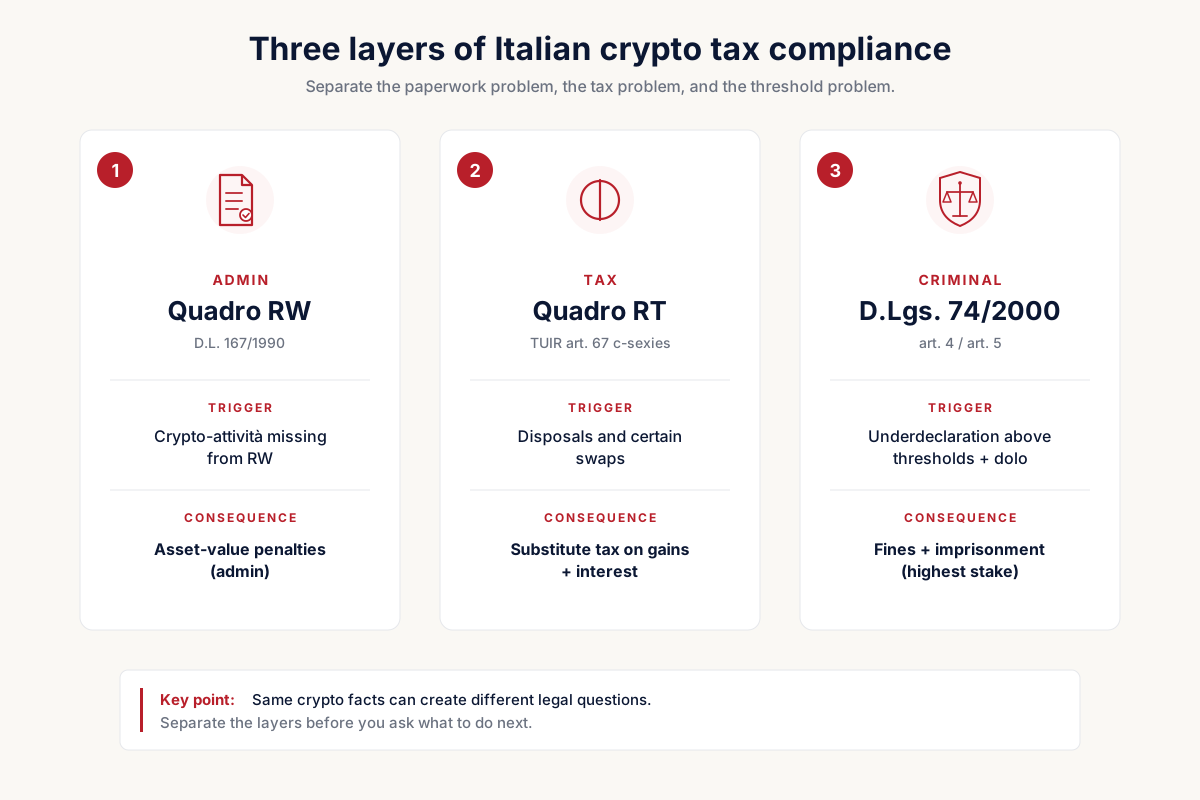
These are three separate problems, governed by different statutes, with different remedies and different stakes. Untangling them is the single most useful thing we can do for you in this reference.
Problem 1: Administrative monitoring (Quadro RW)
Italian residents are required to declare foreign-held assets and, since the 2023 Legge di Bilancio (L. 197/2022), crypto-attività in Quadro RW of their annual income tax return. This obligation comes from art. 4 of D.L. 167/1990 — the monitoraggio fiscale framework — and the position taken in Interpello AdE 181/2024 is that it applies regardless of where the assets are held: a Bitpanda account, a Coinbase wallet, a hardware wallet you keep in a drawer. If you’re an Italian tax resident and you hold crypto-attività, Quadro RW generally needs to be considered; your commercialista should confirm the filing position for your specific tax year and facts.
Quadro RW is not a stand-alone declaration. It’s a section inside the annual income tax return, which means an RW omission and an income-tax omission are technically different events that can co-exist or exist independently.
If you didn’t file Quadro RW for crypto in past years, what you have is an administrative violation under the monitoraggio fiscale framework. It’s penalized as a percentage of asset value, calculated year by year. It is not, by itself, a criminal matter. Case-law commentary post-2021 generally suggests that a Quadro RW omission alone, without underlying tax underdeclaration, does not automatically trigger the dichiarazione infedele offense under art. 4 D.Lgs. 74/2000. The administrative track and the criminal track are separate.
Problem 2: Tax assessment (Quadro RT and the ravvedimento mechanism)
Disposals — selling crypto for fiat, or making certain crypto-to-crypto exchanges — go in Quadro RT and may generate taxable capital gains under art. 67 c-sexies TUIR. If you had taxable disposals in past years that you didn’t declare in RT, you have a tax-assessment problem on top of (or instead of) the RW problem.
On rates: from 1 January 2026, capital gains and other income from crypto-assets are generally subject to a 33% substitute tax, up from 26% (art. 1, comma 24, L. 207/2024), and the €2,000 exemption threshold was abolished from 2025 (comma 25). There is an important exception: the 2026 Budget Law (art. 1, comma 28, L. 199/2025) introduces a reduced 26% rate for euro-denominated e-money tokens (EMT); non-euro tokens stay at 33%, converting non-euro tokens into euro EMT keeps the ordinary rate, and a mere conversion between euros and euro-denominated EMT is not a realization event. Income qualification, exceptions, and the treatment of specific assets should be confirmed with your commercialista. This doesn’t change the basic distinction: Quadro RW is about monitoring; Quadro RT is about capital gains and other taxable income.
Ravvedimento operoso, established by art. 13 D.Lgs. 472/1997, is Italy’s voluntary self-correction mechanism. It lets a taxpayer amend past returns and pay reduced administrative penalties before the Agenzia delle Entrate opens a formal assessment (accertamento). The reduction depends on how early in the procedural timeline you act and on which version of the penalty regime applies — Italy reformed the system with D.Lgs. 87/2024, applicable to violations committed from 1 September 2024 onward, so multi-year cases often involve both regimes.
A specific Italian rule worth flagging: not every crypto-to-crypto swap is a taxable disposal. The 2023 reform and Circolare AdE 30/E del 27 ottobre 2023 establish a same-characteristics-and-functions test that distinguishes exchanges between similar assets from exchanges between materially different ones. The test is contextual, applies regardless of where the swap happened (CEX, DEX, or cross-chain), and is something your commercialista applies pair-by-pair from your transaction history.
Two more things the same Circolare settles are easy to miss from the swap test alone. First, it answers one common pair directly: exchanging crypto into an e-money token — a stablecoin that gives you a claim to redeem face value from the issuer — sits on the taxable side of the line (the 2026 euro-EMT carve-out covers conversion between euros and qualifying euro EMT, not swaps like ETH into USDC). Second, the document also draws the outer boundary of the crypto category itself: tokens that qualify as MiFID II financial instruments are excluded from it entirely, because the category is residual — the question that decides how tokenized stocks are taxed, worked through in Tokenized Stocks in Europe.
Problem 3: Criminal exposure (D.Lgs. 74/2000)
Criminal tax offenses sit in their own statute and apply only when specific monetary thresholds are met.
Art. 5 (omessa dichiarazione) — the offense of omitting the entire income tax return — triggers when imposta evasa (the unpaid tax) exceeds €50,000 per single tax. The threshold was raised from €30,000 to €50,000 by D.L. 124/2019. This offense applies to people who didn’t submit a return at all for a given year, not to people who submitted one but underdeclared inside it.
Art. 4 (dichiarazione infedele) — the offense of submitting an untruthful return — has a cumulative double threshold: imposta evasa must exceed €100,000 and the elementi attivi sottratti all’imposizione must either exceed 10% of declared taxable income or exceed €2,000,000 in absolute terms. Both conditions must be met for the offense to apply.
The cumulative structure of art. 4 is important and frequently misread. A taxpayer with a Quadro RW omission of, say, €40,000 in crypto value is not anywhere near the art. 4 threshold, because the asset value isn’t the imposta evasa; the imposta evasa is the unpaid tax on undeclared income or gains. Many ordinary small-to-mid-size holder cases are not primarily criminal-threshold cases, but the threshold analysis is itself a professional question that requires examination of the specific facts.
Conflating the three problems is what creates the disproportionate panic. For many administrative-monitoring and tax-assessment cases, ravvedimento is the mechanism a commercialista will evaluate — but whether it fits, and which timeline it follows, depends on the specific configuration.
What DAC8 actually does (and what it doesn’t)
In our research, we repeatedly saw DAC8 described as if it were a punishment mechanism. That’s not what DAC8 does.
DAC8 — formally Directive (EU) 2023/2226, the eighth amendment to the EU’s Directive on Administrative Cooperation — is an information-sharing framework. Member states had to transpose it into national law by 31 December 2025. Italy transposed the framework through D.Lgs. 194/2025, published in late 2025 and in force from January 2026. The directive’s data-collection period began on 1 January 2026, meaning crypto-asset service providers (CASPs) operating in or serving EU residents began collecting reportable transaction data from that date. The first reporting cycle covers 2026 calendar-year data, with cross-border information exchange occurring in 2027.
There are three implications worth separating, because they get conflated in most coverage we’ve come across.
For activity from 2026 onward. In-scope CASPs — centralized exchanges, custodial wallet providers, broker-dealers, and potentially arrangements marketed as DeFi where an identifiable operator performs reportable crypto-asset services — are required, under the directive and within its scope and implementation rules, to collect identity, tax-residency, and transaction information on EU-resident users, and to report annually to tax authorities a standardized file of identity data plus aggregate transaction totals per crypto-asset — not balances, and not a computed gain. If a reporting CASP is registered or authorized in Italy, it reports directly to the Agenzia delle Entrate. If it’s registered or authorized in another EU member state and serves Italian residents, it reports to its home authority, which then exchanges the information with Italy under the directive’s framework.
For activity before 2026. DAC8 doesn’t directly cover past activity. It doesn’t create a retroactive reporting obligation for years before 2026. But it creates a mismatch surface: from 2027 onward, the Agenzia delle Entrate will receive standardized data on each Italian resident’s 2026 crypto activity, and that data can be cross-referenced against past filings. If your past filings don’t reflect crypto holdings that show up on 2026 reports, that gap becomes a question the tax authority can ask.
For self-custody. DAC8 doesn’t directly cover wallets you control yourself. There’s no reporting obligation imposed on a private key. But the bridge between regulated platforms and self-custody — your withdrawals from a CASP to self-custody — is visible on the CASP side and may be reportable; this does not mean every wallet address or on-chain hash automatically enters the DAC8 flow. Self-custody narrows the surface of automatic reporting going forward; it does not narrow your declaration obligations.
For stablecoin holders. In the observable on-chain market, USD-denominated stablecoins (USDT, USDC) dominate EUR-denominated ones (EURC, EURe, EURS) by a wide margin. This does not prove what Italian residents specifically hold, but it explains why many crypto portfolios a commercialista reconstructs include USD-denominated assets. Public on-chain dashboards put global EUR stablecoin supply at roughly $1.3B as of an April 2026 snapshot, against several hundred billion USD in USD stablecoins — a ratio of around 1 to 250 at that point in time. These dashboard figures are point-in-time market context, not tax inputs: they shift over time, and your commercialista uses platform-specific year-end values for Quadro RW, not aggregate market data. The Agenzia delle Entrate’s guidance (Circolare 30/E/2023) is that cripto-attività are valued at their euro equivalent on 31 December of the reference year, based on the value reported on the platform where they were acquired or on a comparable market venue. Exchange-held stablecoins on EU CASPs often display euro-denominated values directly. Self-custody wallets generally do not — which is one of several reasons your commercialista will want a complete records export, not just on-chain transaction hashes. The denomination of the stablecoin you hold isn’t a tax-planning decision; switching from USDT to EURC doesn’t change what’s reportable. But for record-keeping practicality, it’s useful to know which side of the line your holdings actually sit on.
At the time of writing, we have not seen reliable public evidence that 2026 produced a broad, documented wave of Italian CEX-to-self-custody migration specifically because of DAC8. Several public analyses of the directive note that withdrawals from in-scope reporting CASPs to self-custody addresses made in 2026 may themselves become reportable in the following reporting cycle — meaning there is no asymmetric advantage from rushing migrations as a reporting-avoidance strategy.
The practical implication for Italian holders considering ravvedimento: 2026 is not a year where bad outcomes are suddenly punished. 2027 is when the data shows up. That timeline matters for how you sequence your records preparation and your commercialista conversation.
DAC8 is an information-flow change, not a punishment mechanism.
Self-custody, honestly
Some part of the internet has been telling Italian crypto holders that moving to self-custody solves the tax problem. We make a self-custody wallet, so let us be the ones to tell you: it doesn’t.
We understand why this misconception is popular. Centralized exchanges generate visible reporting, self-custody feels like control, and “the wallet has no KYC” is a tempting simplification. But Italian law treats your declaration obligations as obligations of the taxpayer, not of the platform. They follow you, not your venue. Interpello AdE 181/2024 confirmed the position that self-custody does not create an exemption from monitoraggio fiscale obligations under art. 4 D.L. 167/1990.
It’s worth being precise about what self-custody does and doesn’t do, because the binary framing — “self-custody fixes everything” versus “self-custody fixes nothing” — is misleading in both directions.
What self-custody actually does help with. Counterparty risk: if your platform fails, your assets aren’t entangled in the bankruptcy estate. Direct control: you hold the private keys, and you don’t depend on the same kind of custodial account at a platform. Token-level, smart-contract, issuer, or applicable legal-obligation risks can still remain. On-chain transparency for your own records: every transaction is timestamped on a public ledger. Portability: your wallet works across protocols without needing to onboard to a new platform.
What self-custody does not solve. Past CEX history: it lives on the CEX side, and DAC8 backfill paths exist regardless of where the assets sit today. Quadro RW monitoring obligations: they apply to Italian residents holding crypto-attività, regardless of the holding venue. Quadro RT obligations on past disposals: they applied at the time of the disposal, irrespective of where the proceeds went afterward.
Custody choices should not be made for tax-reporting avoidance purposes.
Preparing your records before the commercialista appointment
A first commercialista appointment can be expensive enough that you don’t want it to end with “I need three more documents, come back next week.” Here’s what to bring.
Records you’ll need
Whether your activity has been on exchanges or in self-custody, the commercialista will work from the same kind of records, just sourced differently:
- From every exchange: full CSV exports of transaction history, account opening/closure dates, year-end balances, deposits and withdrawals (fiat and crypto), trades within the platform, staking/lending income, and KYC entity per account
- From your wallets: wallet addresses you’ve used, transaction hashes for CEX-to-wallet transfers, year-end token balances, and a note of any on-chain activity beyond holding
A list of questions, written down
Writing the questions down before the appointment is one of the most useful pieces of advisor-prep advice we’ve come across. Some get answered before you even ask. Others surface things the advisor didn’t think to ask you.
- Which years have unreported activity?
- Was the income tax return itself filed each year, or are some years entirely omitted?
- Are there RW-only years (holdings without disposals) versus RT-disposal years?
- Which swaps require same-characteristics analysis under Circolare 30/E?
- Has any AdE notice been received — invito al contraddittorio, schema d’atto, processo verbale di constatazione, accertamento, or similar AdE communication?
- Are there special configurations — AIRE registration, inheritance, defunct CEX records, cross-border residency?
How this looks in practice — M’s case
Let’s walk through a hypothetical that lines up with the kind of case we’ve come across in Italian crypto discussions and research. Call her M. She’s not a real person, but the configuration is.
M is an Italian resident who opened a Bitpanda account in 2021. Her position grew from about €2,000 to roughly €12,000 by the end of 2024. Over the years she made several BTC-ETH and ETH-altcoin swaps inside the platform. In 2023 she withdrew some assets to a self-custody Ethereum wallet. She filed her annual income tax return each year for her employment income but never filled in Quadro RW for her crypto holdings. April 2026: she reads about DAC8 and decides she wants to figure out where she stands.
Following the framework above, M assembles her exchange history, her wallet records, and a written question list. Then she walks into a commercialista appointment.
Here’s what M doesn’t try to figure out herself. Which years’ violations fall under the prior penalty regime versus the post-D.Lgs. 87/2024 regime. Which of her swaps the same-characteristics-and-functions test treats as taxable disposals. Whether her cumulative position approaches any threshold under D.Lgs. 74/2000 — her €12,000 position is well below criminal-exposure thresholds, but the analysis itself is for her commercialista, not for her. The order in which to file. Whether cumulo giuridico e continuazione applies under the post-reform regime. The euro cost.
M’s case is structurally manageable. The reason it feels overwhelming when she first reads about DAC8 is that she’s reading three problems as one. By the time she has her records together and her questions written down, she’s already done the hardest part — the rest is her commercialista’s analysis, not hers.
Mapping M’s case across the three layers from earlier:
| M’s fact | Layer | What M prepares | Who decides the analysis |
|---|---|---|---|
| Missing Quadro RW for past years | Administrative monitoring | Year-end balances per asset, per year | Commercialista |
| BTC-ETH and ETH-altcoin swaps inside Bitpanda | Tax assessment (Quadro RT) | Full transaction history | Commercialista applies same-characteristics test |
| 2023 self-custody withdrawal | Records consistency for DAC8-era reconciliation | Withdrawal tx hash, wallet address, on-chain history | M prepares; advisor reviews |
| €12,000 portfolio | Escalation risk | Threshold context for advisor review | Commercialista confirms; not central in this fact pattern |
This list is a starting point, not a complete checklist. Your specific situation may require additional records, and your commercialista will tell you what’s missing in the first appointment. And see the next section for cases where standard preparation may not be enough.
FAQ and Italian terms
Questions we get asked
Q: What is the crypto capital-gains tax rate in Italy in 2026?
A: From 1 January 2026, the ordinary substitute-tax rate on crypto-asset capital gains is 33% (up from 26%), and from 2025 the €2,000 exemption threshold no longer applies (art. 1, commi 24-25, L. 207/2024). The 2026 Budget Law (art. 1, comma 28, L. 199/2025) introduces a reduced 26% rate for euro-denominated e-money tokens (EMT), while non-euro tokens stay at 33% and a mere conversion between euros and euro-denominated EMT is not a realization event. Income qualification, exceptions, and the treatment of specific assets should be confirmed with a commercialista.
Q: Can I still use ravvedimento after receiving a PVC (processo verbale di constatazione)?
A: Often, a PVC alone may not automatically foreclose ravvedimento, but the available route and reduction band depend on the exact procedural status, the tax year, the type of violation, and whether a formal accertamento has already been issued. Key points your commercialista will work through:
- The misconception that “any tax-office contact closes ravvedimento” is incorrect — a formal accertamento is generally treated as the cutoff for ravvedimento availability for the year it covers, and your commercialista will confirm the procedural status before any filing.
- Between PVC and accertamento, ravvedimento may remain available at a reduced band (typically 1/5 of the minimum penalty under the prior regime; the post-reform regime introduces schema d’atto with a 1/6 band).
- Your commercialista should confirm the band before any filing action is taken.
Q: How much does ravvedimento operoso cost for crypto?
A: We can’t tell you, and anyone giving you a single figure without seeing your specific case probably can’t either. The total is a function of: the regime applicable to each violation (pre- or post-D.Lgs. 87/2024); the standard penalty rate for the specific filing type and asset jurisdiction; the reduction band achieved (1/10 through 1/5); the unpaid tax; statutory interest at the saggio legale rate per year. Your commercialista combines these inputs for your specific case.
Q: If I move crypto from a CEX to my wallet, can that transfer still be reported under DAC8?
A: If the exchange is an in-scope reporting CASP, your withdrawal from the CEX to your wallet may be visible to the CEX and reportable from the CASP side under DAC8. The wallet itself is not directly covered by DAC8, but the bridge between the two — your withdrawal transaction at the CASP — can become part of the reported data. This is one of the most common misreadings of DAC8 we’ve come across; “moving to self-custody after the fact” does not erase the on-CASP record.
Q: What happens if I receive a formal accertamento?
A: Once a formal accertamento is issued for a year, your commercialista will generally treat ravvedimento as no longer available for that year and will evaluate other response routes, such as administrative defense (challenging the accertamento) or acquiescenza (accepting it with a reduction in sanctions). Engage a commercialista immediately for response strategy and timing.
Q: Can I use ravvedimento for multiple years at once?
A: Yes, but with constraints:
- Each year is evaluated independently against the regime applicable to that violation.
- Pre-1 September 2024 violations fall under the prior regime; post-1 September 2024 violations under the post-D.Lgs. 87/2024 regime — multi-year cases often involve both.
- Cumulo giuridico e continuazione may aggregate multiple violations of the same tax in the same tax period under post-reform rules, but this is not automatic.
- Your commercialista sequences the filings, often starting from the year with the strongest band availability.
Italian terms you’ll see
| Italian term | English / plain-language gloss |
|---|---|
| Ravvedimento operoso | Voluntary self-correction mechanism under art. 13 D.Lgs. 472/1997, allowing a taxpayer to amend past returns and pay reduced administrative penalties before a formal tax assessment is issued. |
| Quadro RW | Section of the Italian income tax return for declaring foreign-held assets, IVAFE, and (since 2023) crypto-attività under monitoraggio fiscale obligations established by art. 4 D.L. 167/1990. Not a stand-alone declaration. |
| Quadro RT | Section of the Italian income tax return for declaring capital gains, including crypto disposals under art. 67 c-sexies TUIR. |
| Monitoraggio fiscale | Italian fiscal monitoring framework requiring residents to declare foreign-held and crypto assets in the income tax return. |
| Cripto-attività | Crypto-asset, as defined by art. 1, comma 126 of Legge di Bilancio 2023 (L. 197/2022) and elaborated in Circolare AdE 30/E del 27 ottobre 2023. |
| Dichiarazione integrativa | Amended/integrative tax return filed under ravvedimento to correct a prior return. |
| Dichiarazione infedele | Untruthful return — tax-criminal offense under art. 4 D.Lgs. 74/2000 when cumulative thresholds are met. |
| Dichiarazione omessa | Omitted return — tax-criminal offense under art. 5 D.Lgs. 74/2000 when imposta evasa exceeds €50,000 per single tax. |
| Accertamento | Formal tax assessment issued by the Agenzia delle Entrate. Once issued for a year, ravvedimento is generally treated as no longer available for that year. |
| Processo verbale di constatazione (PVC) | Formal verification report issued by tax authorities documenting findings; precedes accertamento. |
| Schema d’atto | Unified preliminary adversarial-procedure document introduced by D.Lgs. 219/2023 (in force from 30 April 2024). Triggers a 1/6 ravvedimento band under the post-reform regime. |
| Contraddittorio preventivo obbligatorio | Mandatory adversarial procedure between taxpayer and tax authority, required for certain assessments under L. 212/2000 art. 6-bis. |
| Cumulo giuridico e continuazione | Aggregation rule for multiple violations, available under post-D.Lgs. 87/2024 ravvedimento in limited cases (single tax, single tax period). |
| Saggio legale | Statutory legal interest rate, set annually by the Italian Ministry of Economy and Finance via decree. |
| Successione | Inheritance procedure. Crypto transfers via successione trigger separate analysis. |
| AIRE | Anagrafe degli Italiani Residenti all’Estero — registry of Italians resident abroad. |
| Commercialista / Penalista tributario | Italian certified accountant / tax-criminal lawyer. |
Reference: ravvedimento reduction structure
Ravvedimento under art. 13 D.Lgs. 472/1997 reduces administrative penalties by a fraction that depends on (a) when in the procedural timeline you correct, and (b) whether the violation falls under the prior regime or the post-D.Lgs. 87/2024 regime (1 September 2024 cutoff). Multi-year cases often span both. The reduction bands range from 1/10 (early correction) to 1/5 (after PVC, before accertamento); the post-reform regime introduces a 1/6 band for schema d’atto proceedings. Which band applies to your case requires your commercialista’s analysis of the specific violation date, filing type, standard penalty rate, and procedural status.
90-day cliff for omessa dichiarazione: under both regimes, an entirely omitted income tax return can typically be regularized within 90 days of its original deadline at favorable terms; after 90 days, the return is treated as omessa for purposes of ravvedimento under art. 13 D.Lgs. 472/1997, with substantially harsher consequences and a different remediation framework that your commercialista will navigate separately. This is one of the few hard cliffs in the system and worth verifying immediately if you have any year where the return itself was not filed.
Questions this reference answers
The specific questions this page is written to address — useful as a jump-off for what to look up next.
- How are Quadro RW, Quadro RT, and ravvedimento operoso different problems for Italian crypto holders?
- What does DAC8 actually do for Italian residents from 2026 onward, and what does it not do?
- Does moving crypto to self-custody resolve past-year Italian declaration obligations?
- Which crypto-to-crypto swaps are taxable disposals under Circolare AdE 30/E?
- How do criminal-threshold provisions under D.Lgs. 74/2000 actually apply to a typical retail crypto holder?
- What records and questions should an Italian crypto holder prepare before a commercialista appointment?
Sources
Primary statutes, official guidance, and dashboards cited above. Each links to the canonical source so you can verify what we’ve said.
Legislation & primary statutes
- D.Lgs. 472/1997, art. 13 (ravvedimento operoso mechanism)· IT
- D.Lgs. 87/2024 (2024 tax penalty system reform)· IT
- D.Lgs. 158/2015 (earlier ravvedimento reform — extended PVC stage)· IT
- D.Lgs. 74/2000 (criminal tax thresholds — art. 4 infedele, art. 5 omessa)· IT
- D.L. 167/1990, art. 4 (Quadro RW source statute)· IT
- L. 212/2000, art. 6-bis (contraddittorio preventivo)· IT
- EU Directive 2023/2226 (DAC8)· EU
- D.Lgs. 10 dicembre 2025, n. 194 (Italian implementing decree for DAC8)· IT · 2025-12-22
- Legge 30 dicembre 2024, n. 207 (2025 Budget Law) — art. 1 c. 24-25: 33% crypto substitute tax from 2026, €2,000 threshold abolished from 2025· IT · 2024-12-31
- Legge 30 dicembre 2025, n. 199 (2026 Budget Law) — art. 1 c. 28: 26% rate for euro-denominated EMT· IT · 2025-12-30
Administrative guidance
- Agenzia delle Entrate — Ravvedimento operoso portal· IT
- Circolare AdE 30/E del 27 ottobre 2023 (primary guidance on cripto-attività taxation)· IT · 2023-10-27
- Interpello AdE 181/2024 (AdE position on self-custody and monitoraggio fiscale obligations)· IT
- Fisco Oggi (Agenzia delle Entrate) — 2025 Budget Law: changes to crypto-assets (33% substitute tax from 2026, art. 1 c. 24-25 L. 207/2024; €2,000 threshold abolished from 2025)· IT
- Fisco Oggi (Agenzia delle Entrate) — 2026 Budget: reduced 26% rate for euro-denominated crypto-assets / EMT (art. 1 c. 28 L. 199/2025)· IT
Cross-border frameworks
On-chain data
Comparative jurisdictions
Last updated on August 13, 2026. Written by DeGate Editorial Team.
Corrections and primary-source updates welcome at corrections@degate.com .
Related references
Do Exchange Withdrawals to Self-Custody Get Reported Under DAC8?
A reference on DAC8 reporting and self-custody for European crypto-asset users moving funds off centralized exchanges in 2026.
Where Do European Crypto Exchanges Report Under DAC8?
A reference on DAC8 reporting paths — same member state, cross-border EU exchange, and non-EU CASPs — and why exchange location is not a loophole.