
Spanish Crypto Tax in 2026: Modelo 721, IRPF, Wealth Tax, and DAC8
DAC8 Compliance · Spain · Updated 2026-08-13 · 25 min read
Also available in: Español
On this page
- We made a wallet. Spain wrote a rule about the companies that hold your keys.
- What you’re probably here to figure out
- Lucía’s year
- What DAC8 actually changes in Spain (and what was already true)
- Self-custody, honestly
- Reference: the Modelo 721 two-condition test, walked through
- Filing Modelo 721: amounts, windows, and the re-filing trap
- The numbers, as of August 2026
- FAQ and Spanish terms
A note on us. We’re DeGate. We make a self-custody wallet, and Spain turns out to be the one country in this series where holding your own keys genuinely makes one tax form go away. You’d expect us to lead with that. We will — and then we’ll spend most of this reference on what it doesn’t make go away, because that’s the part that protects you. This is our research, not tax advice. The right answer for your situation belongs to your asesor fiscal, not to us.
TL;DR: Spain’s tax authority has said it in binding rulings: crypto you hold in a wallet whose private keys you control yourself doesn’t go on Modelo 721, the declaration of virtual currencies held abroad. That’s real, and it’s unusual among the countries we’ve examined in this series. But the same rulings leave everything else standing: whatever stayed on a foreign exchange is still declarable, every sale or swap still has to be worked out for income tax — it can realise a taxable gain or a loss — and the wealth taxes count what a Spanish resident owns on December 31, wherever the keys sit. The data your exchange already filed doesn’t un-file itself either. Self-custody can change which holdings you have to declare. It does not, by itself, change the tax you owe on a sale, a swap, or a year-end balance. And if you hold a tokenized stock, Spain has a twist the other countries don’t: “this isn’t a crypto-asset” may mean more declarations to check, not fewer.
We made a wallet. Spain wrote a rule about the companies that hold your keys.
Spain’s crypto declaration rules have one unusual feature: they are written around a specific kind of company — one that “safeguards private cryptographic keys on behalf of third parties.” In plain language: a business that holds your keys for you, the way an exchange does.
That wording turned out to matter enormously. Between 2022 and 2024, Spain’s Dirección General de Tributos — the office that issues binding answers to taxpayer questions — was asked three times what happens when there is no such company, because the holder keeps the keys personally. Three times, the answer was the same: no custodian, no Modelo 721 declaration for those coins.
We make a self-custody wallet, so we read those rulings closely. This reference is what we found when we followed them all the way through — including the places where they stop, and the obligations they never touched. It’s not tax advice. We’re not your asesor. Every conclusion below is something to bring to an asesor, with the ruling numbers attached.
What you’re probably here to figure out
Most people land on this page with some version of one money question: “I moved my crypto off the exchange — what does Spain still want from me?”
Here’s the shape of the answer before we work through it properly. Spain splits your year into four separate legal questions, each with its own form and its own logic:
| The question in your head | The form or rule that answers it |
|---|---|
| ”Do I have to tell Hacienda I hold crypto abroad?” | Modelo 721 — and this is the one self-custody can switch off |
| ”Do I owe tax because I sold or swapped?” | IRPF, your income tax return — custody is irrelevant here |
| ”Does my total wealth trigger anything?” | Wealth tax (Modelo 714) and the solidarity tax (Modelo 718) — custody is irrelevant here too |
| ”What does the tax office already know?” | Your exchange’s reporting: Spanish models 172/173 today, DAC8 arriving on top |
Where people lose money is in treating this as one big question — “is my crypto declared and taxed?” — and answering it once. Spain doesn’t work that way. Each row in that table is a separate rule, with its own form, its own test, and its own deadline. Moving your crypto to a wallet you control changes your answer to the first row only. The other three rows don’t notice the move at all.
The one-sentence version of this whole reference: in Spain, holding your own keys really does make one declaration go away — which is exactly why it’s worth being precise about everything that stays.
Thirty seconds of background the rest of this page leans on. Spain’s home-grown system splits crypto visibility between two routes, by who is in a position to do the telling. When your coins sit with a custodian inside Spain’s domestic reporting net — a Spain-based business, or a foreign one’s Spanish branch — the custodian reports information about your holdings and transactions to Hacienda: year-end balances on Modelo 172, transactions on Modelo 173, filed every January, no action from you. When your coins sit with a custodian outside that net — a typical foreign exchange — those domestic provider returns don’t cover it, so the law turns to you: Modelo 721 is your own declaration of crypto held abroad for you, due once year-end values cross a threshold. And since 2026 a third layer sits on top: DAC8, cross-border provider reporting that can make a foreign platform report you through its own member state — it arrives in addition to Modelo 721, not instead of it (it gets its own section below).
Two things follow. Neither form is a tax — both are pure information, and the actual taxes live in other laws (income tax when you sell or swap; the wealth forms if your totals are large), which then get checked against what these forms say. And “abroad” in Modelo 721 is not geography — the law defines it entirely through the custodian, which is why a wallet with no custodian is where the whole system runs out of words. That last case is Lucía’s.
Where do you start, given your situation?
- All of it still sits on a foreign exchange. Your two live questions: does the year-end value put you over the Modelo 721 threshold, and what does the exchange itself tell the tax office about you? Read “what the exchange was already telling Hacienda” in Lucía’s year, then the DAC8 section.
- All of it is already in a wallet you control. Modelo 721 is likely not your problem for those coins. What’s left: the tax when you sell or swap, and — only if your total wealth is large — the wealth-tax forms. Start with “Self-custody, honestly.”
- Some on an exchange, some in your own wallet — like most people. Lucía’s setup is exactly this one. Read her year from the top.
- You hold a tokenized stock (AAPLx, TSLAx and similar). Yours is the odd case out. Read the AAPLx part of Lucía’s year, then the companion EU reference. The question for your asesor is “which form applies, if either” — not “am I exempt.”
Lucía’s year
Lucía is made up, and nothing here is advice — every question below goes to her asesor fiscal. But her year covers, in order, almost everything Spain can throw at a crypto holder.
It’s 2026. Lucía is tax-resident in Spain. In January she holds about €68,000 of BTC and ETH on a foreign exchange — a business that holds the keys for her. In March she moves €50,000 of it into a self-custody wallet; €18,000 stays on the exchange. In June she swaps 1 ETH for SOL. She also holds one tokenized Apple stock — an AAPLx token — bought through the same exchange. By December, between crypto and everything else she owns, her net wealth is getting close to the range where her region’s wealth tax starts asking questions.
Five moments in that year trigger five different rules. None of them work the way she’d guess.
March: the move to self-custody — one form switched off, for part of her coins
In March, Lucía moves €50,000 of crypto off the exchange and into a wallet where only she holds the private keys. One form reacts to that move: Modelo 721, the declaration of virtual currencies held abroad for you by someone else. Its legal test — walked through fully in the reference section below — asks first whether a third party safeguards your private keys, and only then where that third party is.
For the €50,000 Lucía moved into self-custody, the first condition now fails. Nobody safeguards those keys on her behalf; she holds them. The DGT has confirmed the consequence in binding consultations three separate times: the earliest in late 2022 (V2616-22), the core ruling on mixed exchange/self-custody holdings in mid-2023 (V2290-23), and again for paper wallets in 2024 (V0941-24). Coins in wallets whose keys the holder controls are outside the declaration — and they don’t even count toward the filing threshold.
The part people miss is the other half of the sentence: the €18,000 still sitting on the exchange remains fully inside the rules. Those coins are still custodied abroad by a third party. In Lucía’s case they happen to fall below the €50,000 aggregate threshold on their own — so, checked at year-end values, she likely files nothing. But that’s arithmetic, not exemption: if market gains or new deposits pushed her in-scope year-end total above €50,000, or if she’d filed 721 in a previous year, the mechanics change (there’s a re-filing trap covered below).
→ What Lucía does: assesses 721 only for what’s still custodied abroad, using December 31 values — and keeps the three DGT ruling numbers in her notes for the asesor, because “my wallet, my keys, no 721” is much stronger as “V2290-23 says so.”
June: the ETH→SOL swap — taxable, and the opposite of Italy
Here’s the assumption that travels badly: “I swapped crypto for crypto, no euros touched my bank account, so nothing happened for tax.”
In Spain, something happened. Swapping one crypto for another is a permuta — a barter — and the tax authority treats it as a disposal that realises a gain or loss right there, at market values, even though no euros arrived. If you’ve read tax threads written for other countries, be careful: some jurisdictions have a rule that swapping assets with the same characteristics and function isn’t taxable. Italy is the well-known example. For an individual investor like Lucía, Spain has no such rule: a crypto-to-crypto swap is a taxable disposal that can realise a gain or a loss.
And when you sell or swap part of a holding you bought in batches, Spain tells you which batch you sold: the first ones you acquired go first — FIFO, first in, first out. You don’t get to pick the batch that flatters your tax bill.
Run Lucía’s swap: she bought 2 ETH at €1,500 each in 2023 and 1 ETH at €3,000 in 2025. In June she swaps 1 ETH for SOL when ETH trades at €3,400. She’d like to say she disposed of the €3,000 one — a €400 gain. FIFO says otherwise: the ETH that left is one of the €1,500 ones from 2023. Her taxable gain is €3,400 − €1,500 = €1,900, going into her savings-base income for the year. That one rule nearly quintupled the gain she has to declare — and it’s the single calculation in this reference most worth learning to run yourself: sale price minus the cost of your oldest remaining units.
→ What Lucía does: records the June swap as a disposal computed on FIFO — and stops trusting tax rules from foreign Reddit threads, because “crypto-to-crypto is tax-free” was never true in Spain.
All year: what the exchange was already telling Hacienda
While Lucía was deciding what to declare, reporting was already happening in the other direction — and moving coins in March didn’t reach backwards to erase any of it.
Spain has required crypto companies based in Spain to report since the 2023 tax year: year-end client balances on one form (Modelo 172) and every acquisition, transmission, exchange and transfer on another (Modelo 173), filed each January. Lucía’s exchange is foreign, so those two forms never covered it. Before DAC8, that gap was real: Spain’s domestic 172/173 regime did not routinely cover a foreign exchange with no Spanish presence.
That’s the gap DAC8 exists to close — the EU-wide reporting framework that applies from January 2026 and reaches crypto platforms across borders. Lucía’s 2026 activity on the exchange, including the March withdrawal itself, sits in the first reporting period; the first files land with tax authorities in 2027. The full mechanics — including the genuinely odd state of Spain’s own DAC8 law — get their own section below.
The practical point survives any legislative detail: the exchange’s record of Lucía’s account doesn’t get thinner because her balance did. What she can control is whether her own records match it.
→ What Lucía does: exports her complete exchange history — trades, deposits, the March withdrawal, fees — while the account is open and the export button still works. Hacienda’s copy and her copy should tell the same story.
The AAPLx token: possibly not a “virtual currency” at all
Everything so far assumed Lucía’s assets are crypto in the eyes of the rules. Her tokenized Apple stock may not be.
What the product is — decided elsewhere. AAPLx itself is issued as a tracker certificate — a structured debt instrument that follows the share’s price: not a coin, and not a share either. Whether such a product legally counts as a financial instrument is a product-by-product question — our EU-wide reference on tokenized stocks walks through how to read what your token legally is. This page takes the Spanish half: what happens to each of Spain’s forms if that’s what you hold.
Why the crypto form fits badly. Modelo 721 doesn’t define “virtual currency” itself — it borrows the definition from Spain’s anti-money-laundering law: a digital representation of value, not issued by a central bank, accepted as a medium of exchange. Now read that against what an AAPLx is designed to be: an issuer’s debt claim tracking a share price — a product that does not obviously fit the “accepted as a medium of exchange” limb of that definition. That poor fit is the textual reason Spanish practitioners doubt these products belong on 721 at all. Doubt, not certainty: no DGT answer addresses these products yet.
Why falling out of 721 isn’t an exemption. Spain has an older, broader declaration of foreign assets — Modelo 720 — and one of its three blocks covers securities, rights and similar instruments held or managed abroad. That block predates crypto entirely, and it comes with its own thresholds and its own mechanics. One reading we’ve encountered in Spanish practice is that a tokenized stock, if it isn’t a “virtual currency,” belongs there instead. No official ruling says so, and we flag that plainly: practitioner interpretation, not DGT doctrine. So for these two foreign-asset forms, the unresolved map has three possible outcomes — 721, 720, or neither — and no official signpost yet.
And one wrinkle to expect. Whatever Lucía’s asesor ultimately files, the platform that sold her the AAPLx may still treat it as a crypto-asset in its own reporting — the classification a platform applies for its obligations and the one that governs your filing are decided separately, and they can disagree without anyone being wrong. That mismatch, and how to handle it, is worked through in the EU reference.
→ What Lucía does: lists the AAPLx separately in her notes and asks the asesor one precise question: “721 or 720 — which of the two forms applies to this, if either?” Not “am I exempt.”
December: for a resident like Lucía, the wealth tax doesn’t ask where the keys are
In December, Lucía’s asesor asks about her total net wealth. Crypto included — all of it, the self-custodied part too.
Spain has two wealth-level taxes: the wealth tax proper (declared on Modelo 714, run largely by the regions) and the state solidarity tax on large fortunes (Modelo 718). For a Spanish tax resident like Lucía, both work from what she owns worldwide on December 31, valued at market price — for crypto, the tax authority’s own manual says to take the quoted price on the main trading platforms at year-end. Note what’s absent from that test: any mention of custody. Keys in your pocket or keys at an exchange, the December 31 value counts the same.
Whether Lucía actually files, and whether any tax comes due, depends on things this reference deliberately won’t put numbers on: her total assets, her debts, the exemptions and minimums, and above all her region — the autonomous communities set their own thresholds and reliefs, and they genuinely differ. Any specific figure you’ve seen quoted online may simply be another region’s rule, or last year’s.
→ What Lucía does: brings the full December 31 picture — including self-custodied crypto at market value — and asks whether 714 or 718 applies to her, in her region, this year. She does not assume the March move changed this answer, because it didn’t.
That’s the whole reference in one year: self-custody switched off one form, for part of her coins. Everything else — the tax on the swap, the exchange’s file, the tokenized-stock puzzle, the wealth taxes — didn’t move at all. Self-custody can change which holdings you declare. It does not, by itself, change the tax on a single sale, swap, or year-end balance.
What DAC8 actually changes in Spain (and what was already true)
DAC8 is the EU rule that makes crypto platforms report their users to tax authorities, country to country. Three time layers matter, and Spain adds a fourth twist of its own.
What was already true before 2026
Spain didn’t wait for Europe. Since the 2023 tax year, crypto businesses based in Spain (or operating here through a permanent establishment) have filed two annual information returns: Modelo 172, with each client’s year-end balances, and Modelo 173, with their transactions — acquisitions, sales, exchanges, transfers. Filed every January, name-attached.
So for Spanish platforms, “will they tell Hacienda?” has been answered for years: they already do. The open flank was foreign platforms — an exchange with no Spanish presence filed neither form.
What changes from 2026
DAC8 closes that flank at EU level. It applies from 1 January 2026 across the Union: in-scope crypto platforms collect standardised data on their users and transactions, file it with a tax authority in 2027 for the 2026 period, and the authorities then exchange it with the user’s country of residence. A platform authorised in another EU country reports under that country’s DAC8 law — and Spain receives the data anyway. Choosing an exchange with a different flag stops being a reporting difference.
The Spanish twist: the reporting period arrived before the Spanish law did
Here is the fact almost no guide mentions: as of August 2026, Spain has not finished writing DAC8 into Spanish law. The bill is still in the Cortes. The implementing royal decree and the ministerial order that would create the new forms exist only as published drafts. In January 2026 the European Commission formally put Spain on notice for missing the transposition deadline, along with eleven other member states. Meanwhile two foral territories — Navarra and Bizkaia — went ahead and enacted their own transpositions.
The drafts do tell you where the machinery is heading, and it’s worth knowing because today’s forms get reshuffled: Modelo 172 re-scoped from “virtual currencies” to the broader “crypto-assets,” Modelo 173 replaced, and a new Modelo 175 created as the DAC8 return itself, first covering 2026 with filings from 2027. All of that is draft until published in the BOE.
What should a holder do with this? Not much that’s comfortable. A late Spanish law does not move the calendar: DAC8’s EU timetable makes 2026 the first reporting period either way, a foreign platform may already answer to another member state’s implementing law that is in force today, Spain’s own 172/173 reporting never stopped — and Spain’s published drafts are themselves designed around 2026 data. The one thing still open is exactly how the final Spanish text will deal with its own lateness. That answer belongs to the law that eventually passes, not to this reference — which is why “Spain is late” is a poor thing to build a plan on: you’d be betting on the contents of a statute nobody has read yet.
What actually lands on Hacienda’s desk — and what it does with it
Concretely: identity plus yearly totals. A DAC8 file says who you are and, per crypto-asset, what you bought, sold and transferred — including withdrawals to your own wallet — in gross amounts. It does not contain your cost basis or a computed gain. So the file does not, by itself, hand Hacienda a finished tax calculation; what it delivers is proof that activity happened — data to lay next to everything you filed and check for gaps.
A useful way to picture the pieces: DAC8 delivers the flow video — what happened on platforms, name-attached. Modelo 721 is your own year-end photo — what you hold abroad and with whom. Your income and wealth returns are your version of the story. When the three agree, there is usually nothing to ask. When they don’t — the video shows disposals your return never mentioned, or this year’s photo is missing balances last year’s had, with no declared sale in between — those mismatches give the administration something concrete to question and reconcile. The cycle that follows is familiar: a letter or an information request first; an assessment with back tax, late-payment interest and penalties if the gap can’t be explained. Spain has run this cycle on its domestic 172/173 data for years; DAC8 plugs foreign platforms into the same machine.
Notice what this makes of a filed 721: not just a duty, but your own documented proof that the assets exist, since when, and at what value — the paper trail that makes a later transfer to your bank account explainable in one email instead of one audit. For the holder, the practical risk is having to reconstruct that history later, under questioning, rather than being able to explain it from records kept at the time. 2026 is the first year being recorded; 2027 is when the recording arrives. The time to make your own records match is now.
And self-custody?
A wallet whose keys only you hold has no platform behind it — nothing that files a DAC8 report about it. But the road into that wallet does: the exchange records the withdrawal that funded it, and where the applicable reporting rules require it, that transaction can be reported too. Self-custody changes the platform-reporting path; it does not erase the records the exchange created on the way in. We’ve written a full reference on exactly what a withdrawal does and doesn’t reveal, and won’t re-argue it here (see DAC8 and self-custody withdrawals).
Self-custody, honestly
This series has a standing rule: wherever self-custody helps, say so plainly, and wherever it doesn’t, refuse to imply otherwise. Spain is the most interesting case we’ve written, because here the help is real and official.
What self-custody actually gets you in Spain. The keys in your hands are the asset in your hands: no platform’s bankruptcy, freeze, or exit from the Spanish market stands between you and your coins. And — uniquely in this series — Spain attaches a declaration consequence to that fact: hold your own keys and Modelo 721 simply doesn’t reach those holdings, by the tax authority’s own repeated, binding account. That isn’t a loophole someone found. It’s the legal test working as written: the form’s scope is built around third-party custody, and that condition is simply absent when you alone hold the keys.
What it doesn’t get you. Every other line of Lucía’s year. The swap tax doesn’t care where the keys are. The wealth taxes don’t care. The exchange’s 172/173 filings and the DAC8 pipeline don’t retract. And we found no ruling suggesting that moving coins to self-custody erases earlier tax or reporting consequences — the withdrawal that takes you to self-custody is itself a recorded transaction, and one the applicable reporting rules can reach.
And one honest cost. When a custodian falls out of your setup, so does the custodian’s paperwork. There’s no annual statement coming; the transaction history that proves your cost basis — the €1,500 that saved Lucía from overpaying on a €3,400 disposal — exists only if you keep it. In self-custody, you are your own back office. (If you’re choosing a first wallet and want the responsibility framed properly, that has its own reference.)
One boundary, stated as plainly as we can: nothing here is a reason to move assets — it’s an account of what changes if you do. Moving to self-custody in pursuit of the 721 result, three days before year-end, may change the Modelo 721 analysis — and changes nothing about the tax already due on past gains or the value sitting in the year-end wealth picture, while leaving a recorded withdrawal in the exchange’s file. If self-custody is right for you, it’s right for the ownership reasons, with the declaration effect as a well-documented bonus.
Reference: the Modelo 721 two-condition test, walked through
This is the appendix behind Lucía’s March move — the part to reread before an asesor appointment. The test has an order, and the order is the point.
The two conditions, in sequence
Modelo 721’s scope clause asks two things about your virtual currencies, in this order:
Condition 1 — Is there a custodian? The rule covers currencies “custodied by persons or entities that provide services to safeguard private cryptographic keys on behalf of third parties.” A functional test, not a brand test: an exchange account passes it (the business holds keys for clients); a hardware or software wallet whose keys you alone control fails it; an app calling itself a “wallet” can land either way — what decides is who actually holds the keys, which its custody terms will say.
If your answer to condition 1 is “nobody — I hold my own keys,” the analysis ends right there. There is no second question to ask, because the second question is about the custodian, and you don’t have one. This is exactly what the DGT confirmed in V2616-22, V2290-23 and V0941-24, and what the AEAT’s own FAQ repeats for hot and cold wallets alike: coins in a wallet whose keys you control yourself don’t go on Modelo 721 — and they don’t count toward the €50,000 filing threshold either.
Condition 2 — only reached if there is a custodian: is it “abroad”? Here’s the detail that makes the sequence unbreakable: the rule’s definition of “situated abroad” is written about the custodian — broadly, the coins are abroad when the custodian isn’t one that files Spain’s domestic information returns. The location of the coins is defined through the custodian — and the operative question is not the company’s flag but whether it is subject to Spain’s domestic information-reporting rules (the Modelo 172/173 regime, which covers Spain-resident providers and Spanish permanent establishments of foreign ones). Subject to them → not “abroad” for this test; outside them → your 721 territory.
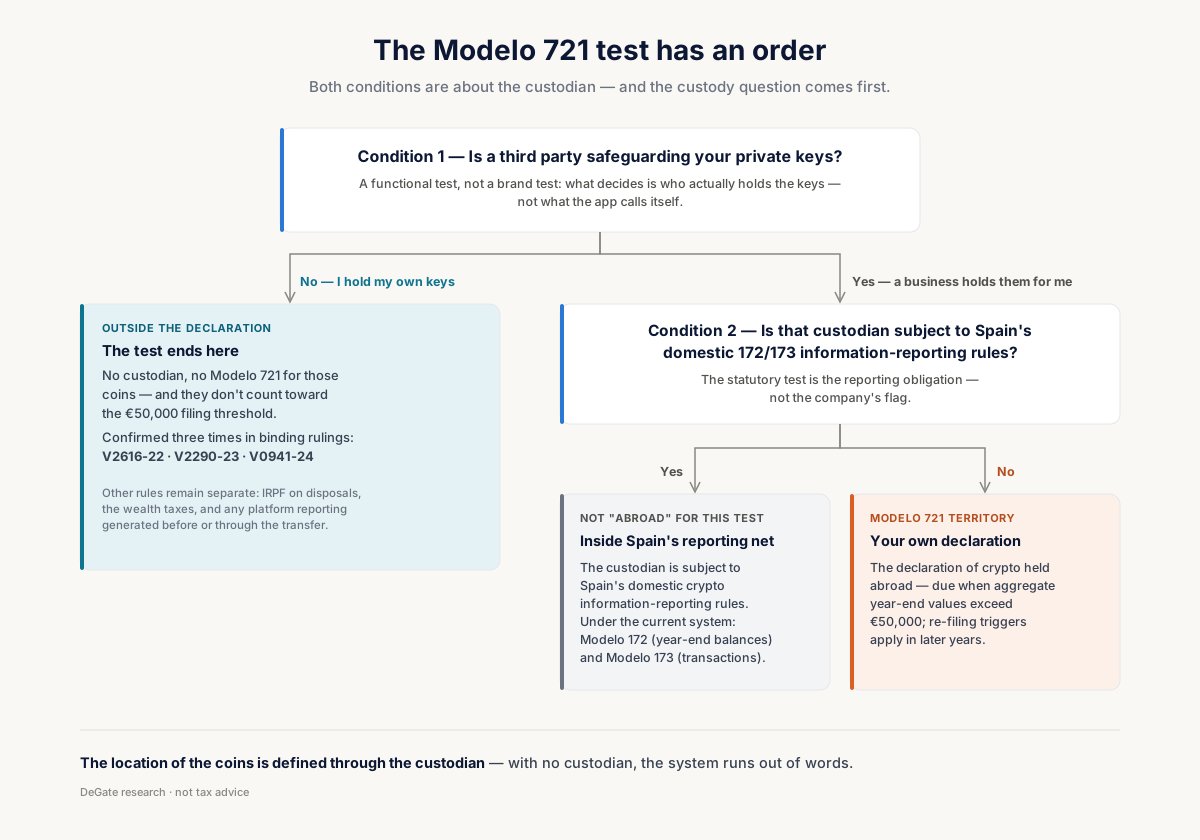
A question the DGT hasn’t needed to answer: where self-custodied crypto “is”
Notice what the structure implies: there is no rule saying where self-custodied crypto “is.” The only location rule speaks the language of custodians, and with no custodian it has nothing to grab. In the rulings we reviewed, the DGT never had to decide the point: each analysis ended at the custody condition — outside the scope — without ruling on whether keys in a drawer in Sevilla are assets “in Spain” or “abroad.”
We flag this as an open point rather than papering over it. If the DGT one day defines a location test for self-custodied assets, the analysis in this section would need rereading. We found no ruling that does so as of this writing — and analyses you may find online asserting self-custodied coins “count as located in Spain” are inference, not DGT wording.
Who files, when the test is met
The roles listed in the rule — holder, beneficiary, authorised signatory, anyone with powers of disposition, and the titular real (beneficial owner in the anti-money-laundering sense) — answer a different question than people think. They sort out who, among the people connected to an in-scope arrangement, must declare it. They do not widen the scope: being “the beneficial owner of your own wallet” doesn’t pull self-custody into a form whose first condition already failed. If you’ve seen that misreading — it circulates — the sequence above is the answer.
Three edge cases the roles do catch:
- Entities without legal personality — an undivided inheritance (herencia yacente), a co-ownership — are themselves obligated to file when in scope.
- Losing your status mid-year: if you were a holder (or authorised, or beneficial owner) at any point in the year and stopped being one by December 31, you still declare for that year, reporting the position when your status ended. Closing the account in November doesn’t skip the declaration — it shapes it.
- The foral territories: residents of the Basque Country and Navarra file under their own foral rules, not the state’s. The obligations rhyme but the details differ in practice — Gipuzkoa, for one, runs a different filing window. If you’re under foral normativa, check your own hacienda’s version of everything in this reference.
Filing Modelo 721: amounts, windows, and the re-filing trap
The mechanics, in institutional terms (the current figures are isolated in the next section):
First filing. You file when the aggregate year-end value of all your in-scope holdings — everything custodied abroad, across all currencies, valued at December 31 — exceeds the threshold. Below it, no filing, though the arithmetic is worth actually running in a year when prices moved.
The window. Filing happens in a fixed window early in the following year (state rule; Gipuzkoa differs).
Later years — the trap. Having filed once, you don’t automatically file forever. A new filing is due when the aggregate has grown by more than the increment amount since your last filed declaration — or in specified status-change cases, the clearest being a previously reported holder who stopped holding during the year. People remember the growth trigger and forget the status-change one. If Lucía had filed 721 for a previous year and then moved everything out in March, “nothing grew” wouldn’t end the analysis — the change in her position is itself the reportable event. This is the one place in the 721 mechanics where we most often see confident, wrong summaries online.
→ The asesor question that covers it all: “Given my last filed 721 and this year’s movements, does any trigger apply to me this year?” Bring the December 31 valuations and the transfer records; let the triggers be checked rather than assumed.
The numbers, as of August 2026
Everything volatile in this reference is quarantined here with a date, because thresholds, windows and rates change more often than the structures above. Verified against primary sources, August 2026.
- Modelo 721 filing threshold: €50,000 — aggregate year-end value of all in-scope (custodied-abroad) virtual currencies. Self-custodied holdings do not count toward it.
- Modelo 721 window (state): 1 January – 31 March of the following year. Gipuzkoa (foral): 1 April – 30 June.
- Re-filing increment: growth of more than €20,000 over the last filed declaration — plus the status-change triggers described above.
- IRPF savings-base scale (applies to crypto gains, including crypto-to-crypto swaps): 19% / 21% / 23% / 27% / 30% by bracket — the top band applies since 2025. Lucía’s €1,900 gain is taxed inside this scale.
- Wealth tax and solidarity tax: deliberately no figures here — thresholds, minimums and reliefs vary by autonomous community and change; the December 31 market-value rule is the stable part. Ask locally.
- DAC8 in Spain: directive applicable EU-wide since 1 January 2026; first reports filed in 2027 for 2026. Spain’s transposing law still in the Cortes as of August 2026 (Commission formal notice, January 2026); draft implementing texts would re-scope Modelo 172, replace 173, and create Modelo 175 as the DAC8 return. Navarra and Bizkaia have enacted foral transpositions.
FAQ and Spanish terms
Questions we get asked
I moved my crypto to a self-custody wallet. Do I still file Modelo 721?
Not for the coins whose keys you now hold — the DGT has confirmed this in binding rulings (V2616-22, V2290-23, V0941-24), and they don’t count toward the €50,000 threshold either. You still assess 721 for anything left with a foreign custodian, and if you filed 721 in a previous year, have the re-filing triggers checked — ceasing to hold previously reported currencies is itself a reportable change. And 721 was only ever one of the four questions: tax on disposals, wealth tax and the exchange’s own reporting are all still there.
Is swapping one crypto for another taxable in Spain?
For an individual investor, yes. A crypto-to-crypto swap is a permuta — a barter — and realises a gain or loss at market values even though no euros arrive, computed on FIFO against your oldest units. Spain has no “same kind, no tax” swap rule for individuals; that’s other countries. Lucía’s 1 ETH→SOL swap produced a €1,900 taxable gain despite her bank account never moving.
Spain hasn’t finished its DAC8 law. Does that mean my exchange won’t report me?
Don’t build on that. The directive applies from 2026 EU-wide; a platform authorised in another member state reports under that state’s law, and Spain receives the data through the exchange network. Spain’s own machinery is in draft, but drafts covering the 2026 period already exist — and Spanish platforms have filed Modelos 172/173 since 2023 regardless. The reporting period doesn’t move just because the local statute is late.
Do I pay wealth tax on crypto I hold in self-custody?
If wealth tax applies to you at all, yes — custody isn’t part of the test. Both Modelo 714 and the solidarity tax count what you own on December 31 at market value, self-custodied crypto included. Whether they apply to you depends on totals, debts and above all your autonomous community, which is why this reference gives no thresholds.
Is a tokenized stock covered by Modelo 721?
Possibly not — and that’s not the good news it sounds like. Modelo 721 borrows its “virtual currency” definition from the anti-money-laundering law, which is written around things accepted as a medium of exchange — an awkward fit for a debt instrument built to track a share price. One practitioner reading puts these products on Modelo 720 (the foreign-securities declaration) instead; there’s no official ruling either way yet. So for these two forms the map is 721, 720, or neither, and the question for your asesor is “which of the two forms, if either” — not “am I exempt.” How to work out what your token legally is — that argument lives in our EU-wide tokenized-stocks reference.
If I close my exchange account, does what it already reported disappear?
No. Filed 172/173 returns stay filed, transaction records survive account closure under record-keeping rules, and DAC8 reporting covers the period you were a user. Self-custody removes assets from the exchange’s control, not your historical records from its systems — that mechanism has its own reference.
Spanish terms you’ll see
| Term | What it means here |
|---|---|
| AEAT / Hacienda | The Spanish tax agency — the administration you file with |
| DGT | Dirección General de Tributos — issues binding answers to taxpayer questions |
| Consulta vinculante | A binding consultation: an official answer (numbered, e.g. V2290-23) the administration must honour for identical facts |
| Modelo 721 | Annual declaration of virtual currencies held abroad — the custodian-based form this reference walks through |
| Modelo 720 | The older declaration of foreign assets and rights — accounts, securities, real estate |
| Modelo 714 | The wealth-tax return (Impuesto sobre el Patrimonio) |
| Modelo 718 | The solidarity tax on large fortunes (ITSGF) — a state-level complement to the wealth tax |
| Modelos 172 / 173 | Information returns filed by Spain-based crypto businesses: client balances (172) and transactions (173) |
| IRPF | Personal income tax — where gains from sales and swaps land |
| Base del ahorro | The savings tax base: the bracket scale applied to investment income, crypto gains included |
| Ganancia / pérdida patrimonial | Capital gain or loss — the tax label for what a sale or swap realises |
| Permuta | A barter — the legal category that makes crypto-to-crypto swaps taxable |
| FIFO | First in, first out — the mandatory batch order when you dispose of part of a holding |
| Titular real | Beneficial owner (anti-money-laundering sense) — a who-files role, not a scope-widener |
| Poder de disposición | Power of disposition over assets — another who-files role |
| Normativa foral | The distinct tax rules of the Basque territories and Navarra |
| Moneda virtual / criptoactivo | ”Virtual currency” — today’s statutory term, defined in the AML law as a digital representation of value accepted as a medium of exchange / “crypto-asset” — the broader term Spain’s pending DAC8 law adopts |
| DAC8 / CARF | The EU and OECD frameworks under which crypto platforms report customer data to tax authorities |
A disclosure on completeness. The reading that a tokenized stock outside Modelo 721 may instead need testing under Modelo 720 is an interpretation we encountered in Spanish practice, not an official position — the Sources section lists primary sources only, so no secondary commentary is cited for it. And Spain’s DAC8 implementing texts are cited at draft stage because no final texts existed at verification date (August 2026); the draft-stage items are marked accordingly — check status before relying on them.
DeGate develops a multichain self-custody wallet. This is a reference, not tax advice: the right answer for your situation belongs to your asesor fiscal.
Questions this reference answers
The specific questions this page is written to address — useful as a jump-off for what to look up next.
- Do I have to declare crypto held in a self-custody wallet on Modelo 721 in Spain?
- Is swapping one cryptocurrency for another (like ETH to SOL) taxable in Spain?
- Has Spain implemented DAC8, and will my exchange report me for 2026?
- Do I pay Spanish wealth tax on crypto I hold in self-custody?
- Does a tokenized stock go on Modelo 721 or Modelo 720 in Spain?
- After filing Modelo 721 once, when do I have to file it again?
Sources
Primary statutes, official guidance, and dashboards cited above. Each links to the canonical source so you can verify what we’ve said.
Legislation & primary statutes
- Council Directive (EU) 2023/2226 (DAC8) — the platform-reporting framework: transposition deadline 31 December 2025, application from 1 January 2026· EU
- Ley 10/2010, art. 1.5, consolidated text — the statutory definition of "moneda virtual" that Modelo 721's scope borrows· ES
- Real Decreto 1065/2007, art. 42 quater (inserted by RD 249/2023) — the 721 obligation: the custodian condition, the who-files roles, the €50,000 and €20,000 figures· ES
- Real Decreto 1065/2007, consolidated text· ES
- Orden HFP/886/2023 (Modelo 721) — the form itself and the 1 January – 31 March window· ES
- Orden HFP/887/2023 (Modelos 172 and 173) — the domestic reporting forms for Spain-based crypto businesses, filed each January· ES
- Ley 35/2006 (LIRPF), arts. 37.1.h, 66 and 76, consolidated text — barter valuation and the savings-base scales· ES
- Ley 38/2022, art. 3, consolidated text — the solidarity tax: complementary to the wealth tax, extended until the regional-financing reform· ES
- Ley Foral 17/2025 (Navarra) — foral transposition of DAC8, per its preamble· ES
- Proyecto de Ley 121/000060, BOCG Congreso, Serie A, núm. 60-1 (draft — the state DAC8 transposition bill, in the Cortes as of August 2026)· ES · 2025-06-13
- Proyecto de Real Decreto DAC8, Ministerio de Hacienda, July 2025 (draft — due-diligence and reporting rules; would re-scope art. 39 bis and repeal art. 39 ter)· ES
- Proyecto de Orden Ministerial DAC8 and its impact memorandum, Ministerio de Hacienda, March 2026 (draft — Modelos 042, 172, 175; first application to the 2026 period, filings from 2027)· ES
Administrative guidance
- European Commission, January 2026 infringements package — letters of formal notice to twelve member states, Spain included, for failure to notify DAC8 transposition· EU
- DGT, consulta vinculante V2616-22 (23 December 2022) — the earliest self-custody ruling· ES · 2022-12-23
- DGT, consulta vinculante V2290-23 (28 July 2023) — the core ruling on mixed exchange/self-custody holdings· ES · 2023-07-28
- DGT, consulta vinculante V0941-24 (29 April 2024) — paper wallets under the same test· ES · 2024-04-29
- AEAT, Modelo 721 — preguntas frecuentes — the hot/cold-wallet answer, the threshold, the foral note, the loss-of-status rule· ES
- AEAT, Manual práctico Renta 2025 — monedas virtuales — permuta treatment and the FIFO criterion, in the agency's own words· ES
- AEAT, Manual práctico Renta 2025 — gravamen del ahorro (estatal y autonómico) — the savings-base scales behind the as-of figures· ES
- AEAT, Manual práctico Patrimonio 2025 — monedas virtuales — crypto in the wealth-tax base at 31 December market value, custody-blind· ES
- AEAT, Manual práctico Patrimonio 2025 — cesión del impuesto a las CCAA — why thresholds and reliefs are a regional question· ES
- DGT, consultas on IRPF classification — crypto-to-crypto swaps as permuta: V0999-18, V1149-18; FIFO for partial disposals: V1604-18, V0975-22 (index)· ES
- AEAT, Modelo 172 — procedure page· ES
- AEAT, Modelo 173 — procedure page· ES
- AEAT, Modelo 714 — procedure page· ES
- AEAT, Modelo 718 — procedure page· ES
- AEAT, Modelo 720 — procedure page· ES
- Hacienda Foral de Gipuzkoa, Modelo 721 — the foral form with its own window· ES
Last updated on August 13, 2026. Written by DeGate Editorial Team.
Corrections and primary-source updates welcome at corrections@degate.com .
Related references
Tokenized Stocks in Europe: How EU Reporting and National Tax Rules Classify the Wrapper
Are tokenized stocks crypto or financial instruments? How MiCA, MiFID II, DAC8/CARF and national tax rules in Italy, France and Spain classify the wrapper.
Italian Crypto Tax in 2026: A Reference on Quadro RW, Quadro RT, and DAC8
A pre-commercialista reference for Italian crypto holders: the 2026 capital-gains rate, Quadro RW, Quadro RT, ravvedimento operoso, DAC8, and records.
Do Exchange Withdrawals to Self-Custody Get Reported Under DAC8?
A reference on DAC8 reporting and self-custody for European crypto-asset users moving funds off centralized exchanges in 2026.
Where Do European Crypto Exchanges Report Under DAC8?
A reference on DAC8 reporting paths — same member state, cross-border EU exchange, and non-EU CASPs — and why exchange location is not a loophole.
What Happens to Your Exchange Data After You Move Crypto to Self-Custody?
KYC records, DAC8 reporting, and the limits of what self-custody changes.
How to Choose Your First Self-Custody Wallet
Choose your first self-custody wallet by recovery model, intended use, amount, and activity level before comparing brands.