
French Crypto Tax in 2026: The 31.4% Flat Tax, What Counts as a Sale, Foreign Accounts, and DAC8
DAC8 Compliance · France · Updated 2026-08-13 · 22 min read
Also available in: Français
On this page
- We made a wallet. France rewired its crypto tax twice in one year.
- What you’re probably here to figure out
- Camille’s year
- What DAC8 actually changes in France (and what it doesn’t)
- Self-custody, honestly
- Reference: the taxable-disposal boundary, walked through
- Filing: which form does what
- The numbers, as of August 2026
- FAQ and French terms
A note on us. We’re DeGate. We make a self-custody wallet, and France is the country in this series that rewired its crypto tax twice in one year — once in December 2025, once in mid-2026. We read the new texts so you can bring the right questions to your expert-comptable. That’s all this is: our research, not tax advice. The answers for your situation belong to your adviser.
TL;DR: France changed three things about crypto tax for 2026: the rate, the scope, and the declarations. The flat tax on crypto gains now runs at 31.4% — and by the statute’s own application clause, the increase reaches back to 2025 disposals, the very ones being declared in spring 2026, even though the old 30% figure still appears in many guides. The crypto regime’s scope is now keyed to MiCA, the EU’s crypto rulebook — which can move some “tokenized stock” products out of it, if they qualify as financial instruments. And the declaration of foreign crypto wallets was rewritten in July 2026, in ways that matter if you hold your own keys. Meanwhile, the most popular tax claim on the French internet — you only pay tax when you convert to euros — is wrong, and was wrong before any of this: paying for a laptop with ETH is a taxable sale. What didn’t change: what you owe is decided by what you disposed of, and what you declare is decided by separate laws with their own tests.
We made a wallet. France rewired its crypto tax twice in one year.
In December 2025, France’s social-security financing law raised the social-levy component of the flat-rate treatment that applies to crypto gains. In June and July 2026, a second wave rewrote what the crypto tax regime covers, anchoring it to MiCA, the EU’s crypto regulation, and rewrote the rule on declaring foreign crypto wallets in the same stroke.
Two changes in seven months is a lot of movement for rules most people learned from a 2023 blog post. The internet has not caught up: one of the most repeated claims — “in France you only pay tax when you cash out to euros” — has been wrong for as long as the current regime has existed, and several of the new details are still described incorrectly on pages that otherwise look current — often by collapsing categories that now run on different timelines into one.
We make a self-custody wallet, so the boundary questions — what a wallet changes, what it doesn’t — are questions we had to answer for ourselves. This reference is the result. It’s not tax advice; it’s the map we’d want before a paid hour with an expert-comptable.
What you’re probably here to figure out
Most people arrive here with one money question: “I hold crypto — what does France actually want from me this year?”
France splits that into four separate questions, each with its own law, form and logic:
| The question in your head | The rule that answers it |
|---|---|
| ”Do I owe tax because I sold or swapped?” | The crypto capital-gains regime (the flat tax) — and “sold” is wider than you think |
| ”Do I have to report my foreign accounts and wallets?” | A separate declaration law with its own per-account fines |
| ”Does my total wealth trigger anything?” | For crypto in 2026: no — the wealth tax covers real estate, and the 2025 crypto proposal died in parliament |
| ”What does the tax office already know?” | DAC8 platform reporting — in force in France since January 2026 |
These are four different laws. Answering one of them tells you nothing about the other three — and the mistakes that cost money usually come from letting one answer stand in for all four.
Thirty seconds of background the rest of this page leans on. France’s watch over crypto runs on three separate tracks, and none of them is a tax by itself. Track one, your own declarations: foreign accounts ride along with the income return — bank and securities accounts on one form (3916), crypto accounts on its crypto sibling (3916-bis) — pure information, with per-account fines for staying silent. Track two, platform reporting: since January 2026, in-scope platforms report their users’ transactions to the tax administration under DAC8 — also pure information, filed by the platform rather than by you, and neither track discharges the other. Track three, the taxes themselves: computed on your return when you dispose of something, and checkable against everything the first two tracks delivered. Keep the three apart and most of 2026’s confusing headlines sort themselves.
Where do you start, given your situation?
- All of your crypto sits on a foreign exchange. Your live questions: what you owe on anything you disposed of, whether that account goes on this year’s declaration (spoiler: using it once is enough), and what the platform now reports. Read Camille’s November and account sections, then the DAC8 section.
- All of it is in a wallet you control. The foreign-account declaration is written around providers, and you don’t have one — but the edges of that boundary moved in July 2026, so read “Self-custody, honestly” and the account section before relaxing. Tax on anything you disposed of is untouched.
- Some on an exchange, some in your own wallet — like most people. Camille’s setup is exactly this. Read her year from the top.
- You hold a tokenized stock (AAPLx, TSLAx and similar). Yours is the odd case out: the 2026 scope rewrite matters most for you. Read the AAPLx section, then the companion EU reference.
Camille’s year
Camille is made up, and nothing here is advice — every question below goes to her expert-comptable. But her year, which starts with a tail from 2025, walks through everything France changed and everything it didn’t.
It’s 2026. Camille is tax-resident in France, an ordinary private investor — she buys and sells occasionally, nothing resembling a professional trading operation. In November 2025 she sold some BTC. In 2026 she pays for a laptop with ETH, swaps some ETH for SOL, and sells one tokenized Apple stock — an AAPLx token. She has an account at a foreign exchange that she used exactly once this year, and a self-custody wallet where only she holds the keys.
Six moments, six different rules. Almost none of them work the way the internet told her.
November 2025, filed in spring 2026: the sale — and the rate that changed after she sold
Camille sold her BTC in November 2025 expecting the flat tax everyone quoted that autumn: 30%. Then, in late December 2025, the social-security financing law raised the social-levy component of that flat tax — and wrote, in its application clause, that for investment income of this kind the higher levy applies starting with the taxation of 2025 income. Camille’s November sale is 2025 income. It gets declared in spring 2026 — under the new combined rate of 31.4%, not the 30% she budgeted.
The decisive text is the application clause the December law wrote for itself — and it explains why so many guides get this wrong. France’s social levies on capital run on two calendars, and the law moved them separately. The source-levied kind — interest, dividends, the income a bank withholds on — switched to the higher rate on 1 January 2026. The declared kind, the revenus du patrimoine that go through your annual return — where crypto gains sit — switched starting with 2025 income. Camille’s November sale rides the second calendar. Confusing the two — quoting the placements calendar for a declared-income gain — is one reason a 30% figure still circulates for 2025. The administration’s own filing guidance for the spring campaign confirms the result: the higher combined rate, on the return that declares 2025 disposals. If your adviser reads it differently, have that conversation before the return goes in — and bring the application clause, because it distinguishes the two calendars expressly.
One more thing for high earners, stated once and then quarantined in the numbers section: two separate additional mechanisms exist on top of the flat tax for large incomes — a surcharge that applies to slices of income above certain thresholds, and, newer, a differential minimum tax. They are different machines and they don’t add up into one quotable “rate on your crypto.”
→ What Camille does: refuses to let her tax software — or a 2025 blog post — choose the rate. She takes the current campaign’s official figures, applies them to each disposal by its year, and asks the expert-comptable to confirm which levy attaches to the November sale.
The laptop and the swap: “selling” is wider than “cashing out”
Here’s one of the most repeated errors on the French crypto internet: you only pay tax when you convert to euros. It has not been the rule at any point since the current regime was created in 2019.
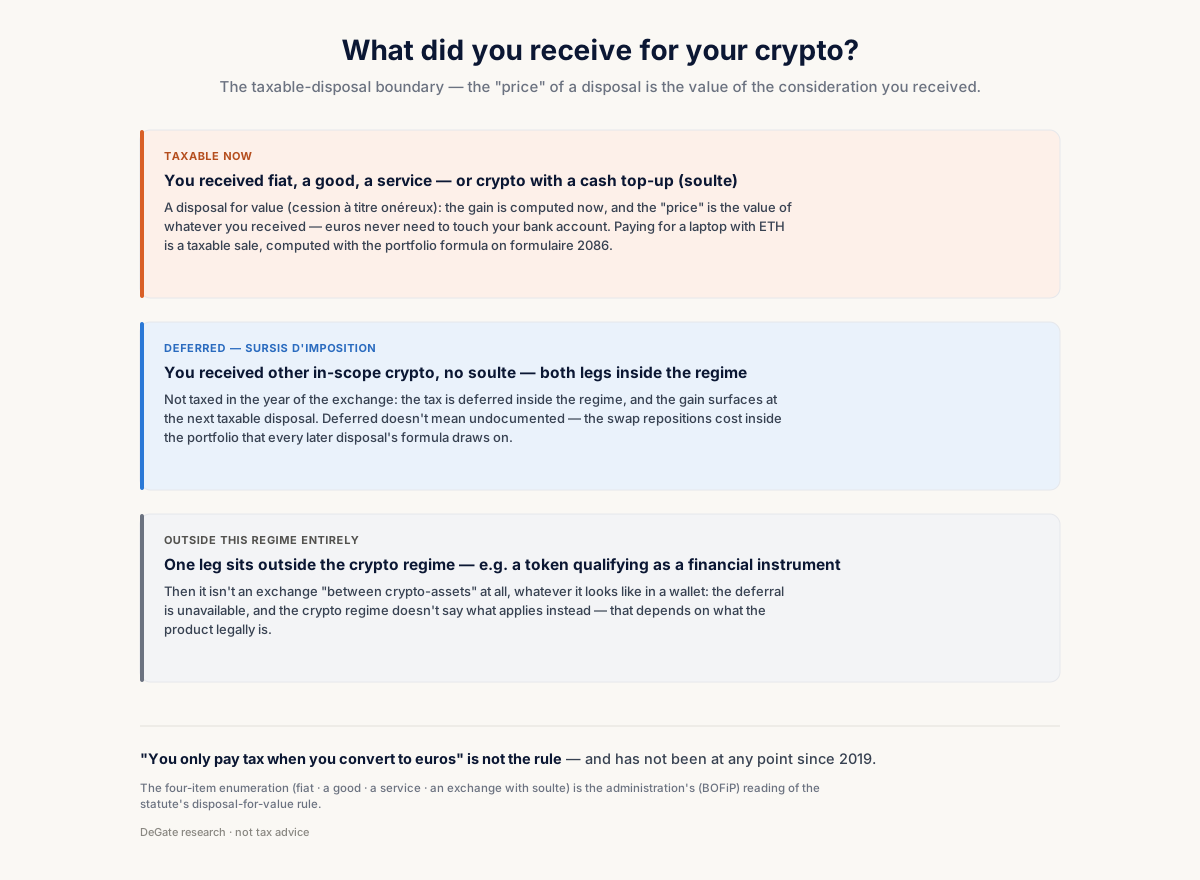
The statute taxes any disposal for value of in-scope crypto. The tax administration’s own list of taxable events spells out what that includes: exchanging crypto for official currency, yes — but also exchanging it for a good, for a service, or for other crypto with a cash top-up (a soulte). One carve-out sits alongside: a crypto-for-crypto exchange without a soulte isn’t taxed in the year of the exchange — the tax is deferred inside the regime until a taxable disposal finally happens.
So Camille’s two 2026 trades split cleanly. The ETH→SOL swap, no soulte: not taxable this year. The laptop, paid in ETH: a taxable disposal — the “price” is the laptop’s value, and the gain is computed with the portfolio formula walked through in the reference section below. Run on her numbers, the laptop alone crystallises a €750 taxable gain. She bought a computer and owes capital-gains tax; that is the rule working as designed, not an edge case.
Her neighbours would be treated differently: Spain taxes every crypto-to-crypto swap for individual investors, Italy runs its own same-kind rule. France sits in the middle — swaps deferred, spending taxed. Rules don’t travel between countries, and neither should tax threads.
→ What Camille does: records the laptop purchase as a disposal — date, the laptop’s value, the portfolio figures the formula needs — and files the ETH→SOL swap under “deferred, keep records” rather than “invisible.”
€305: a disposal-total line, not a tax-free allowance
There is a real small-amounts exemption in the statute, and almost everyone describes it backwards.
The text exempts people whose total disposal prices for the year — the sum of what all their taxable disposals were worth, not the gains on them — stay within €305. It is a line you’re either under or over, not an allowance you subtract: the statute grants the exemption to those under the line, and stops describing you the moment your year crosses it. It isn’t “your first €305 of gains are free.”
Camille’s laptop alone was a disposal of well over €305, so her year is over the line and the exemption has nothing to say about her. If instead your entire year of taxable disposals was one €200 sale, you’d be inside it — deferred swaps don’t count toward the total.
→ What Camille does: computes her year’s total disposal value first, before computing any gain — and stops thinking of €305 as a deduction, because it never was one.
The AAPLx token: it may sit outside the crypto regime
Everything above assumed Camille’s assets are in-scope crypto. Her tokenized Apple stock may not be — and 2026 is the year the boundary became explicit.
France’s crypto capital-gains regime now defines its scope through MiCA, the EU’s crypto regulation: the tax article points at the monetary code, and the monetary code now says, in one sentence, that crypto-assets are those within MiCA’s scope. MiCA, by its own terms, does not cover products that qualify as financial instruments. AAPLx itself is issued as a tracker certificate — a structured debt instrument that follows the share’s price — and whether such a product crosses the financial-instrument line is a product-by-product question; our EU-wide tokenized-stocks reference walks through how to read what your token legally is.
The French consequence, said plainly: the “swap now, pay later” treatment may not exist for this token. The deferral Camille used in June is one sentence inside the crypto tax article, and that sentence only describes exchanges between two in-scope crypto-assets. ETH→SOL fits: both sides are crypto, so the tax waits. An exchange involving AAPLx may not fit: if that token counts as a financial instrument, the trade isn’t an exchange “between crypto-assets” at all — there is no deferral to claim, and what Camille learned from her ETH-to-SOL swap doesn’t carry over. Which tax applies instead depends on what the product legally is; that’s the classification question above.
→ What Camille does: keeps the AAPLx trade in its own ledger, separate from her crypto disposals, and tells the expert-comptable explicitly: these two piles may run under different rules — including on the swaps I assumed were deferred.
The account used once — and why the self-custody wallet is different
France requires residents to declare foreign accounts alongside the income return — and the trigger is generous: an account opened, held, used, or closed during the year. “Used” means one credit or one debit. Camille’s foreign exchange account, touched exactly once this year, is squarely in: it goes on the crypto-account form, with real per-account fines for silence (amounts in the numbers section).
Her self-custody wallet is a different animal. The declaration’s text attaches to crypto wallets opened, held, used or closed with an enterprise, legal person, institution or organisation established abroad — it is written around a provider. A wallet where Camille alone holds the keys has nobody on the other side of that “with.” On the current text, it isn’t what the declaration describes.
Two honesty notes before anyone relaxes. First, the wording was rewritten in July 2026 — the obligation is now keyed to MiCA, and the provider hook survived for ordinary wallets, but the new text has open edges (including a newly added clause for NFTs that is worded differently and has no provider hook at all), and no administrative commentary has settled them yet. Second, this is a declaration boundary, not a tax boundary: nothing about where the keys sit changes the tax on anything Camille disposed of.
→ What Camille does: declares the used-once exchange account without debate — the fine costs more than the form — and, for the wallet, asks the expert-comptable to confirm the current position under the rewritten text rather than assuming a 2024 answer still holds.
December: why the wealth-tax line is empty
Camille’s year-end review has a line for wealth tax, and for her crypto it’s empty. That’s not an oversight.
France’s wealth tax is an annual tax on real-estate assets — directly held crypto is not part of its base. What makes 2026 worth a paragraph is how close that came to changing: in autumn 2025, both chambers of parliament adopted versions of an amendment converting the wealth tax into a tax on “unproductive wealth” whose base explicitly included crypto-assets. It made headlines; some of those headlines are still ranking. But the measure did not survive into the final 2026 budget law: the promulgated text contains no such tax, and the wealth tax remains what it was — a tax on real-estate assets. (The final law did create a separate tax on the non-operating assets of family holding companies — its list of assets doesn’t include crypto, and it doesn’t touch individuals holding coins directly.)
So: in 2026 there is no wealth tax on crypto in France. Articles from late 2025 describing one are describing a proposal, not a law.
→ What Camille does: spends zero energy preparing for a tax that doesn’t exist — and redirects it to the declarations that do: the disposal computations and the account forms above.
That’s Camille’s year: the rate changed after she sold, “selling” turned out to include a laptop, the small-amounts line measured the wrong thing, her tokenized stock may play by different rules, her once-used account needs a form her wallet doesn’t — and the scary wealth tax was never enacted. France changed the rate, the scope anchor, and the wallet-declaration wording in 2026. It did not change the grammar: what you owe follows what you disposed of, and what you declare follows separate laws with their own tests. Changing category or custody can change one declaration test — it does not erase the obligations that run on their own rules.
What DAC8 actually changes in France (and what it doesn’t)
DAC8 is the EU rule that makes crypto platforms report their users to tax authorities, country to country. France’s version of the story is short, because France did the homework.
France transposed on time
Unlike some of its neighbours — Spain’s implementing law was still in parliament as of this writing, and the Commission put twelve member states on notice in January 2026 for missing the deadline; France is not among them — France wrote DAC8 into its tax code with effect from 1 January 2026, and the implementing decree was published in December 2025. The mechanics: in-scope crypto service providers collect standardised data on their users’ transactions; the first declarations, covering 2026 activity, are filed with the French administration before 15 June 2027; tax authorities then exchange the data across borders. A platform authorised elsewhere in the EU reports under its own member state’s law, and the French administration receives the data anyway.
What platforms report is not what you declare
The platform’s DAC8 declaration and your own obligations are separate laws with separate tests. Nothing in the platform-reporting article discharges your account declaration, and nothing in the account-declaration article waits for the platform. The practical consequence runs in one direction: from 2027, the administration holds a platform-generated picture of your 2026 activity — so the version you file should be the version your own records can back.
What actually lands on the administration’s desk in 2027 — and what happens next
Concretely: identity plus yearly totals. A platform’s declaration says who you are and, per crypto-asset, what you bought, what you sold and what you transferred — including withdrawals to your own wallet — in gross amounts. Two things it does not contain: your cost basis, and any computed gain. That shapes everything that follows. The file does not, by itself, hand the administration a finished tax calculation — what it delivers is proof of activity, which the administration can lay next to your return and see that one mentions what the other doesn’t. Then comes the standard cycle: a letter or an information request first; an assessment with back tax, late-payment interest and penalties if the gap can’t be explained. Notice who carries the work in that cycle: you — reconstructing costs, dates and the deferred swaps, under questioning, possibly years after the account closed. That is a far heavier version of the same job than exporting your history while the account is alive. 2026 is the first year being recorded; 2027 is when the recording reaches the tax office. The time to make your own copy match is now, not then.
And self-custody?
A wallet whose keys only you hold has no provider behind it — nothing that files a DAC8 report about it. But the road into that wallet does: the exchange records the withdrawal that funded it, and where the applicable reporting rules require it, that transaction can be reported too. Self-custody changes the platform-reporting path; it does not erase the records the exchange created on the way in. The full walk-through of what a withdrawal does and doesn’t reveal has its own reference (see DAC8 and self-custody withdrawals); we won’t re-argue it here.
Self-custody, honestly
This series has a standing rule: where self-custody helps, say so plainly; where it doesn’t, refuse to imply otherwise. France’s version of the ledger has one real entry on each side.
What self-custody actually gets you in France. Self-custody removes a custodial platform’s control over your keys — and with it, the custody-specific counterparty risk: a platform’s bankruptcy, freeze or market exit no longer sits between you and those assets. (What custody never removed: any risk living inside a token’s own issuer, where one exists.) And on the current text of the foreign-account declaration, a boundary that follows from how the law is written: the obligation attaches to wallets held with a foreign provider, and a wallet where you alone hold the keys has no provider on the other side of that word. That’s the statute’s own architecture — with the July 2026 edges flagged above, and worth one confirmation from your adviser rather than an assumption.
What it doesn’t get you. Everything else in Camille’s year. The tax on a disposal is decided by the disposal, not by where the keys were. The exchange’s records and DAC8 reporting cover the road your assets travelled before they reached your wallet. And one cost lands squarely on you: the portfolio formula that computes every French crypto gain needs the total acquisition cost of your entire portfolio — and without a custodian-generated statement, keeping the complete portfolio ledger becomes your job. In self-custody, you are your own back office — and France’s portfolio-wide formula makes that job bigger than a per-batch system would.
One boundary, stated plainly: nothing here is a reason to move assets — it’s an account of what changes if you do. Moving coins to your own wallet changes nothing about the tax on disposals already made, and leaves a recorded withdrawal in the exchange’s file. If self-custody is right for you, it’s right for the ownership reasons; the declaration boundary is a consequence of the law’s wording, not a strategy.
Reference: the taxable-disposal boundary, walked through
This is the appendix behind Camille’s laptop — the part to reread before an expert-comptable appointment. It also separates what the statute says from what the administration’s guidance adds, because they’re not the same document.
What the statute actually says
The law taxes gains realised on a cession à titre onéreux — a disposal for value — of in-scope crypto. It doesn’t enumerate scenarios; instead it defines the price of any disposal as the real price received or the value of the consideration you obtained in return, adjusted for any soulte paid or received. That pricing rule is why “I never touched euros” doesn’t help: a laptop is consideration with a value.
Alongside sits the carve-out: the taxing provision does not apply, for the year of the exchange, to exchanges without soulte between in-scope crypto-assets. The administration characterises this as a deferral (sursis d’imposition) — the exchange is treated as intercalary, and the gain surfaces only at the next taxable disposal.
The administration’s list
The four-item enumeration everyone quotes — fiat, a good, a service, an exchange with soulte — is the administration’s (BOFiP’s) reading, not the statute’s own words. It’s a faithful reading, and it’s the operational checklist to use; just cite it for what it is. One dating caveat belongs here: the relevant BOFiP pages predate the 2026 scope rewrite — they still describe the old asset definition and the old levy figure. Where BOFiP and the current statute diverge, this reference phrases per the statute.
Why the deferral can’t leave the regime
The carve-out’s own words require an exchange between crypto-assets defined in the taxing provision — both legs in scope. An exchange in which one leg is a product outside the regime (a token that qualifies as a financial instrument, say) is not an exchange the carve-out describes, whatever it looks like in a wallet. That is the full extent of what the text supports: it tells you the deferral is unavailable, and it does not tell you what applies instead.
The portfolio formula, on Camille’s numbers
France doesn’t compute crypto gains sale-by-sale against the specific coins you sold. Each taxable disposal takes a proportional slice of your whole portfolio’s cost:
gain = disposal price − (total acquisition cost of the portfolio × disposal price ÷ portfolio value at disposal)
Camille’s laptop: the laptop is worth €2,000. Her entire crypto portfolio cost her €10,000 to build and is worth €16,000 on the day she pays. Her gain on the laptop disposal is 2,000 − (10,000 × 2,000 ÷ 16,000) = 2,000 − 1,250 = €750 — taxed at the default flat rate unless she validly opts for the progressive scale — even though she “only bought a computer.” This is the one calculation in this reference worth learning to run yourself — and note what it requires: the whole portfolio’s cost and value, on every single taxable disposal, with deferred-swap acquisitions carried correctly. That’s the record-keeping burden the self-custody section was pointing at.
Deferred doesn’t mean undocumented
A deferred swap is invisible to this year’s tax but not to the arithmetic: it repositions cost inside the portfolio that every later disposal’s formula will draw on. The practical rule is unglamorous — export everything, keep everything, date everything — and it’s cheaper than reconstructing a portfolio history the spring before an audit.
Filing: which form does what
Institutional map only — figures live in the next section. Each taxable disposal of the year is computed on the dedicated annexe (formulaire 2086) and the year’s net result carries into the income return: gains into their box, losses into theirs (losses offset only same-year crypto gains). Taxpayers who prefer the progressive scale to the flat rate can opt — expressly and irrevocably for the year — via the return. Foreign accounts ride along with the same filing: bank and securities accounts on their form, crypto accounts on the crypto variant (3916-bis), one per account, “used once” included.
The numbers, as of August 2026
Everything volatile in this reference is quarantined here with a date — France changed these twice in seven months, and this block is the only place in this reference where the figures live. Verified against primary sources, August 2026.
- Flat tax on crypto gains: 31.4% = 12.8% income tax + 18.6% social levies (CSG 10.6% + CRDS 0.5% + solidarity levy 7.5%).
- Which years it touches: for declared patrimoine-class income — where crypto gains sit — the rise applies from the taxation of 2025 income, so 2025 disposals declared in spring 2026 are included (statute’s application clause; administration’s crypto filing FAQ, updated July 2026, showing 31.4%). Source-levied placement income (interest, dividends) switched only on 1 January 2026 — confusing the two calendars is one reason a 30% figure still appears for 2025.
- High-income add-ons, kept separate: the CEHR surcharge — 3% on the slice of reference income above €250,000 and 4% above €500,000 (thresholds doubled for couples; the percentages apply to the slices, so “34.4%/35.4% total” is exact only within a band). The CDHR — a differential minimum tax of 20% on high reference incomes, extended to 2026 income — is a separate mechanism and is not additive with those figures.
- Small-amounts exemption: total disposal prices ≤ €305 in the year (deferred swaps excluded from the total).
- Foreign crypto-account declaration fines: €750 per undeclared wallet (or in-scope NFT) / €125 per omission or inaccuracy, capped at €10,000 per declaration; doubled to €1,500 / €250 where values exceeded €50,000 at any point in the year. Foreign bank/securities accounts: €1,500 per undeclared account (€10,000 for accounts in non-cooperative jurisdictions).
- DAC8 in France: in force since 1 January 2026; platforms’ first declarations, covering 2026, are filed before 15 June 2027. France is not among the twelve member states the Commission put on notice in January 2026 for late transposition.
FAQ and French terms
Questions we get asked
Is swapping one crypto for another taxable in France?
For an occasional individual investor, generally not in the year of the swap — a crypto-to-crypto exchange without a soulte (cash top-up) is deferred inside the regime, and the gain surfaces at the next taxable disposal. The moment the exchange involves fiat, a good, a service, or a soulte, it’s taxable now. And if one side of the “swap” is a product outside the crypto regime — some tokenized stocks — the deferral isn’t available at all.
I sold in November 2025 — do I pay the old rate or the new one?
Check the current campaign’s figures rather than 2025 articles: the December 2025 law raised the social-levy component with application from the taxation of 2025 income for declared patrimoine-class income — crypto’s category — and the administration’s filing guidance for spring 2026 shows the higher combined rate. Pages saying otherwise are often quoting the calendar of a different levy category — the source-levied one, which changed only in 2026. If your adviser hesitates, point them at the law’s application clause: it distinguishes the two expressly.
Do I have to declare a foreign exchange account I only used once?
Yes. The trigger is an account opened, held, used, or closed during the year, and “used” means a single credit or debit. One transaction is enough; the per-account fine costs more than the form.
Is my self-custody wallet a “foreign account” I have to declare?
On the current text, the declaration attaches to crypto wallets held with a provider established abroad — a wallet where you alone hold the keys has no provider, so it isn’t what the text describes. But the wording was rewritten in July 2026 and has unsettled edges (including a differently worded new clause for NFTs), so confirm the current position with your adviser rather than relying on a pre-2026 answer.
Do I pay wealth tax on crypto in France?
No. The wealth tax is an annual tax on real-estate assets; directly held crypto is not part of its base. The 2025 parliamentary proposal to tax “unproductive wealth” including crypto did not survive into the final 2026 budget law — late-2025 articles describing it are describing a proposal, not a law.
Will my exchange report me under DAC8 in France?
If it’s an in-scope provider, that’s the design: French rules have been in force since January 2026, first declarations covering 2026 are filed before 15 June 2027, and platforms authorised elsewhere in the EU report under their own state’s law with the data exchanged to France. Platform reporting doesn’t replace your own declarations — they’re separate laws.
French terms you’ll see
| Term | What it means here |
|---|---|
| Flat tax / PFU | The combined single rate on investment income: an income-tax slice plus social levies |
| Prélèvements sociaux | The social-levy component (CSG, CRDS, solidarity levy) inside the flat tax |
| Cession à titre onéreux | A disposal for value — the taxable event; the “price” is the value of the consideration you received |
| Soulte | A cash top-up in an exchange; its presence makes a crypto-for-crypto exchange taxable |
| Sursis d’imposition | The deferral: a no-soulte crypto swap isn’t taxed in its year; the gain surfaces later |
| Formulaire 2086 | The annexe where each taxable disposal’s gain or loss is computed |
| Cases 3AN / 3BN / 3CN | The income-return boxes: year’s gain, year’s loss, and the progressive-scale option |
| Formulaires 3916 / 3916-bis | The foreign-account declarations: bank/securities accounts, and crypto accounts |
| Expert-comptable | The accountant/adviser these questions ultimately belong to |
| CEHR | The high-income surcharge, computed on slices of reference income |
| CDHR | The newer differential minimum tax on high reference incomes — separate from CEHR |
| RFR (revenu fiscal de référence) | The reference-income figure the high-income mechanisms key on |
| BOFiP | The administration’s published doctrine — its crypto pages currently predate the 2026 rewrite |
| IFI | The wealth tax — an annual tax on real-estate assets; directly held crypto is not in its base |
| Impôt sur la fortune improductive | The 2025 parliamentary proposal that would have added crypto to a wealth tax — not enacted |
| BNC / à titre professionnel | The separate regime for professional-style trading — outside this reference’s scope |
| Crypto-actif (MiCA) | The asset category the regime now keys on: crypto-assets within the EU regulation’s scope |
| DAC8 | The EU framework under which crypto platforms report customer data to tax authorities |
A disclosure on completeness. The claim that the raised social levy reaches 2025 disposals rests on the statute’s application clause and the administration’s crypto filing guidance for the spring 2026 campaign. General-audience pages showing the old rate for 2025 concern the separately timed, source-levied category of the same levies — crypto is not mentioned on them, and their placement tables are consistent with the statute once the two categories are kept apart. BOFiP’s crypto doctrine pages predate the 2026 rewrite throughout; where they diverge from the current statute, this reference phrases per the statute and cites BOFiP only for its administrative enumerations. Verified as of August 2026 — the French provisions changed twice during 2026, and Légifrance keeps one URL per version: the dated links in Sources point at the version each claim relies on; check the version banner before reusing them.
DeGate develops a multichain self-custody wallet. This is a reference, not tax advice: the answers for your situation belong to your expert-comptable.
Questions this reference answers
The specific questions this page is written to address — useful as a jump-off for what to look up next.
- Is swapping one cryptocurrency for another taxable in France, and when is it deferred?
- Do I pay tax if I buy something with crypto in France without ever converting to euros?
- What rate applies to my 2025 crypto disposals declared in 2026 — 30% or 31.4%?
- What does the €305 threshold actually exempt?
- Do I have to declare a foreign exchange account I only used once — and is a self-custody wallet a declarable "account"?
- Are tokenized stocks taxed under France's crypto capital-gains rules?
- Is there a wealth tax on crypto in France in 2026?
Sources
Primary statutes, official guidance, and dashboards cited above. Each links to the canonical source so you can verify what we’ve said.
Legislation & primary statutes
- Code général des impôts, art. 150 VH bis, version in force from 1 July 2026 — the crypto capital-gains regime: disposal-for-value scope, the no-soulte deferral, the €305 exemption, the portfolio formula· FR
- Code monétaire et financier, art. L. 54-10-1, version in force from 1 July 2026 — the one-sentence definition keying "crypto-actifs" to MiCA's scope· FR
- Loi n° 2026-534 du 25 juin 2026, art. 91 — the mid-2026 rewrite wave: scope re-keying and the foreign-wallet declaration amendments, with application of specified items to disposals from 1 January 2026· FR · 2026-06-25
- Loi n° 2025-1403 du 30 décembre 2025 (LFSS 2026), art. 12 — the social-levy increase and its application clause: from the taxation of 2025 income for patrimoine-class income· FR · 2025-12-30
- Code général des impôts, art. 200 C — the 12.8% income-tax component and the progressive-scale option· FR
- Code de la sécurité sociale, art. L136-8, current version — the CSG rate on patrimoine income after the increase· FR
- Code général des impôts, art. 223 sexies — the CEHR surcharge: slices and thresholds· FR
- Code général des impôts, art. 224 (current version) — the CDHR differential minimum, extended to 2026 income· FR
- Code général des impôts, art. 1649 bis C (section, version from 1 July 2026) — the foreign crypto-wallet declaration: the provider hook and the new NFT clause· FR
- Code général des impôts, art. 1649 A — the foreign bank/securities account declaration· FR
- Code général des impôts, art. 1736 (X and IV) — the per-account fines for both declarations· FR
- Code général des impôts, annexe III, art. 344 G decies — "used" = at least one credit or debit in the year· FR
- Loi n° 2025-127 du 14 février 2025, art. 54 — the French DAC8 implementation: in force from 1 January 2026· FR · 2025-02-14
- Décret n° 2025-1276 du 19 décembre 2025 — DAC8 implementing decree: 2026 transactions, declarations before 15 June 2027· FR · 2025-12-19
- Loi n° 2026-103 du 19 février 2026 de finances pour 2026 — the final budget law: no crypto wealth tax; art. 7's holding-company tax with a crypto-free base· FR · 2026-02-19
- Regulation (EU) 2023/1114 (MiCA), art. 2(4)(a) — the financial-instrument exclusion the French scope chain ends on· EU
- Assemblée nationale, amendement I-3379 to PLF 2026, adopted 31 October 2025 — the "impôt sur la fortune improductive" with crypto-assets in its base (not enacted)· FR · 2025-10-31
- Sénat, amendement I-381 to PLF 2026, adopted 28 November 2025 — the Senate variant, same crypto-inclusive base (not enacted)· FR · 2025-11-28
Administrative guidance
- impots.gouv.fr, "Comment déclarer les plus ou moins-values sur cessions d'actifs numériques" (updated July 2026) — the campaign's flat-tax figure and the 2086/3AN/3BN mechanics· FR
- impots.gouv.fr, formulaire n° 2086 (millésime 2026) — the per-disposal computation annexe· FR
- impots.gouv.fr, formulaire 3916 / 3916-bis — the foreign-account declarations· FR
- impots.gouv.fr, modalités de déclaration des comptes d'actifs numériques détenus à l'étranger — the crypto-accounts notice· FR
- BOFiP, BOI-RPPM-PVBMC-30-10 (2 September 2019) — the administrative enumeration of taxable events and the sursis characterisation; publication predates the 2026 scope rewrite· FR · 2019-09-02
- BOFiP, BOI-RPPM-PVBMC-30-20 (2 September 2019) — the portfolio-formula mechanics and worked examples; same dating caveat· FR · 2019-09-02
- BOFiP, BOI-CF-CPF-30-20 (26 May 2021) — the "used once" doctrine for foreign accounts and the distinction between the two declaration regimes· FR · 2021-05-26
- European Commission, January 2026 infringements package — DAC8 transposition letters of formal notice to twelve member states; France is not among them· EU
Last updated on August 13, 2026. Written by DeGate Editorial Team.
Corrections and primary-source updates welcome at corrections@degate.com .
Related references
Tokenized Stocks in Europe: How EU Reporting and National Tax Rules Classify the Wrapper
Are tokenized stocks crypto or financial instruments? How MiCA, MiFID II, DAC8/CARF and national tax rules in Italy, France and Spain classify the wrapper.
Spanish Crypto Tax in 2026: Modelo 721, IRPF, Wealth Tax, and DAC8
A pre-asesor reference for Spanish crypto holders: Modelo 721 and self-custody, the permuta and FIFO rules, wealth taxes, and DAC8's arrival in Spain.
Italian Crypto Tax in 2026: A Reference on Quadro RW, Quadro RT, and DAC8
A pre-commercialista reference for Italian crypto holders: the 2026 capital-gains rate, Quadro RW, Quadro RT, ravvedimento operoso, DAC8, and records.
Do Exchange Withdrawals to Self-Custody Get Reported Under DAC8?
A reference on DAC8 reporting and self-custody for European crypto-asset users moving funds off centralized exchanges in 2026.
Where Do European Crypto Exchanges Report Under DAC8?
A reference on DAC8 reporting paths — same member state, cross-border EU exchange, and non-EU CASPs — and why exchange location is not a loophole.
How to Choose Your First Self-Custody Wallet
Choose your first self-custody wallet by recovery model, intended use, amount, and activity level before comparing brands.