
Where Do European Crypto Exchanges Report Under DAC8?
DAC8 Compliance · Updated 2026-06-25 · 7 min read
Also available in: Italiano Español Français
On this page
TL;DR: Under DAC8, users should not only ask whether an exchange reports “directly” to their local tax authority. The more important question is which reporting path the exchange uses. A crypto exchange may report directly to the user’s tax-residence country, or it may report first to its EU registration or authorization country, which then exchanges the information cross-border under DAC8. In other words, using an exchange “outside your country” does not necessarily keep the data away from your tax authority. The reporting path is determined by the CASP, the user’s tax residence, and DAC8’s information-exchange mechanism — not by the user. Users should treat this as general information and confirm their own position with a qualified tax adviser.
Why “which exchange reports me?” is not the right first question
We’re DeGate. We make a multichain self-custody crypto wallet. When DAC8 transposition into EU member-state law became concrete in late 2025, a specific version of the broader DAC8 question started appearing in public crypto discussions:
“Does Bitpanda report me to the Agenzia delle Entrate? Does Coinbase? Does Binance? Does Kraken? Does Young Platform?”
The shortest useful answer is that this is not quite the right question. The better question is: where does the report start, and how does it reach the user’s tax-residence authority?
For an in-scope reporting CASP serving EU-resident reportable users, the baseline expectation is that reportable activity is reported. What varies is the path the report takes — which tax authority receives it first, and how the data reaches the user’s tax-residence authority. This reference explains the path mechanism in plain terms, gives illustrations across several major exchanges, and notes why the picture is still moving in 2026.
We’re not your commercialista, your Steuerberater, or your asesor fiscal. We work on a self-custody wallet, and want to be straight about what changes — and what doesn’t — when readers focus on “which exchange.”
The three reporting paths users should understand
DAC8 reporting flows through a CASP’s reporting member state — the EU member state through which the CASP fulfils its DAC8 reporting obligation. From there, the information reaches the user’s tax-residence authority either directly or through cross-border exchange.
Path A — same member state. The CASP’s reporting member state is the same as the user’s tax-residence member state. The report reaches that authority directly.
Path B — cross-border within the EU. The CASP’s reporting member state differs from the user’s residence. The CASP’s reporting authority exchanges the information with the user’s tax-residence authority under DAC8.
Path C — non-EU CASPs. Non-EU CASPs serving EU residents should not be assumed to sit outside the DAC8/CARF reporting perimeter. Depending on their structure and jurisdiction, they may be brought into reporting through an EU registration route or through CARF-equivalent reporting in a partner jurisdiction whose exchange arrangement covers EU member states.
For EU CASPs, the user-side practical consequence is similar across the two EU paths: the tax-residence authority can receive the automatic data, as either the first reporting authority or via cross-border exchange, and the path mainly affects timing and procedure. For non-EU CASPs, whether the data reaches the residence authority depends on the CASP’s structure, the applicable jurisdiction, and whether an equivalent CARF regime is operational.
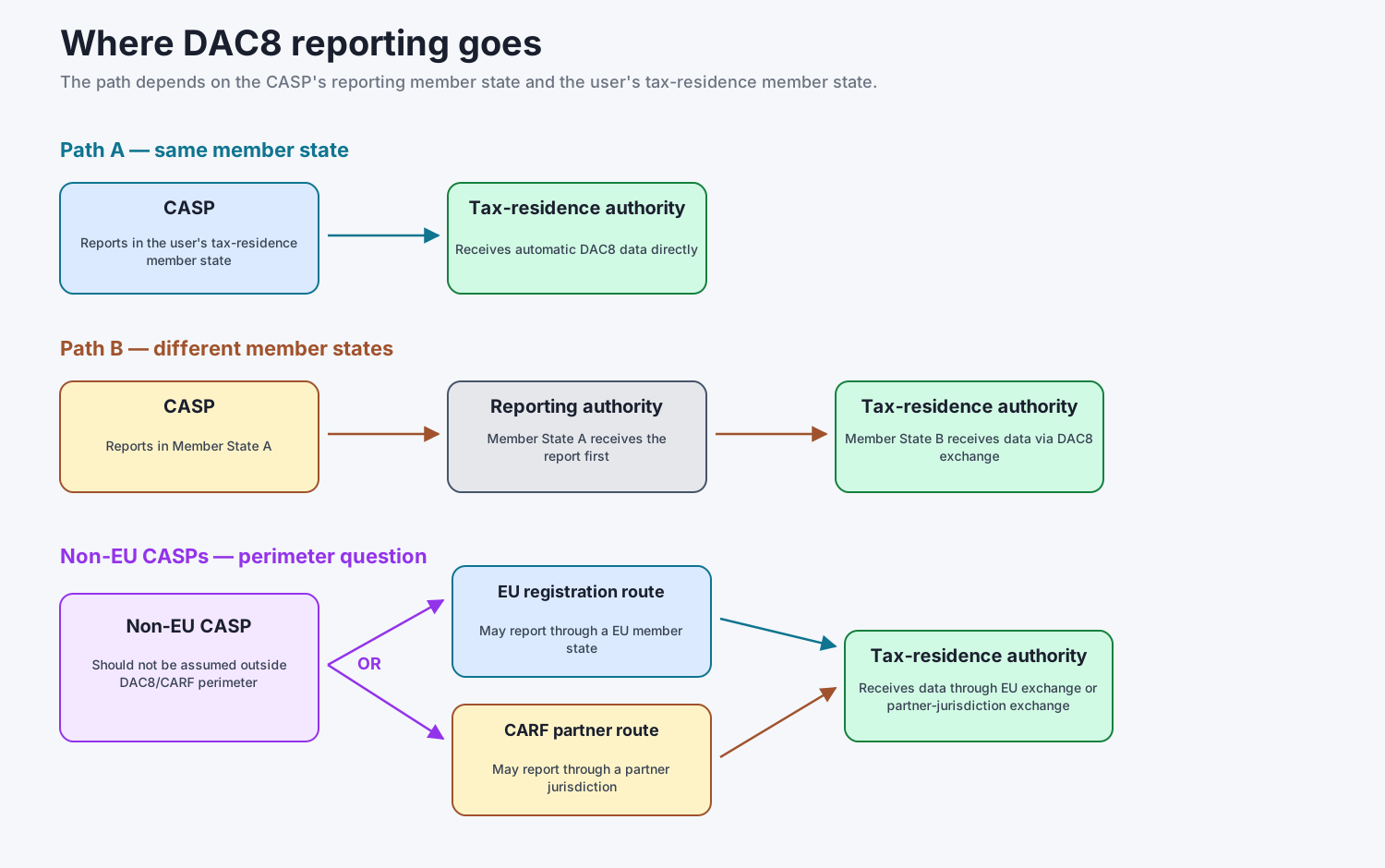
A user does not choose the reporting path by choosing an exchange with a different country label. The path follows the CASP’s reporting member state and the user’s tax residence.
If your question is specifically about what happens when assets leave an exchange for a self-custody wallet, see our companion reference: Do Exchange Withdrawals to Self-Custody Get Reported Under DAC8?
Examples: how major exchanges illustrate the paths
The examples below are illustrations of the path mechanism, not a ranking and not a comparison on safety, reliability, or tax exposure. Authorization landscape and corporate structures change. Treat these examples as illustrations of the mechanism, not as a current-state map to act on. These examples reflect the public picture available as of this reference’s update date and can change.
Coinbase, Kraken, Bitpanda, Young Platform, and Binance are useful examples not because they form a ranking, but because they illustrate different path problems:
- Coinbase illustrates how a major exchange may use a single EU member state as its MiCA hub, with cross-border reporting to other member states’ tax-residence authorities.
- Kraken illustrates how another major exchange may use a different EU member state as its authorization and reporting base.
- Bitpanda illustrates why one brand may involve more than one authorized entity, with the contracting entity for a given user depending on the corporate structure.
- Young Platform illustrates the Italy-linked transition path, where Italian-incorporated VASPs progress toward MiCA CASP authorization through the Italian transition window.
- Binance illustrates why “in application” or transition status should not be read as “outside the perimeter.”
The mapping above is not exhaustive — many other CASPs operate in the EU. The point is the central one: same-state vs cross-border is the path distinction, and the path is determined by the CASP’s reporting member state and the user’s tax residence — not by the country label a user associates with the exchange brand.
Why this can change over time
The picture above is mid-transition. Three things keep it moving. MiCA transition is still settling, with the EU-wide transitional period ending on 1 July 2026 under ESMA’s guidance, and national windows closing at different times before that. Exchanges can change the entity serving EU users — moves between EU member states, consolidation of national authorizations into a single MiCA license, or the opposite, are all in play. And one brand can involve more than one legal entity, with the contracting entity for any given EU-resident user depending on the corporate structure and the service provided. ESMA’s April 2026 statement also expects unauthorised CASPs to implement orderly wind-down plans where authorisation is not obtained. Those plans may include client offboarding by transferring crypto-assets held on clients’ behalf to an authorised CASP or to a self-hosted wallet; that offboarding expectation is about client protection and market order, not about changing a user’s DAC8 or national reporting obligations.
For a user, this means: assuming an exchange’s reporting path is stable over time is a fragile assumption. The mechanism (Path A vs Path B vs Non-EU) is stable. The path of any specific exchange, in any specific year, can move.
FAQ
Q1: Does my exchange report me to my tax authority under DAC8?
A: For an in-scope reporting CASP serving EU-resident reportable users, the baseline expectation is that reportable activity is within the reporting framework. What varies is which authority receives the report first, and whether the data reaches your tax-residence authority directly or via cross-border DAC8 exchange.
Q2: If I move to an exchange that reports somewhere other than my country, am I safer?
A: You should not treat that as safer. The point of DAC8 cross-border exchange is that reportable data can still reach your tax-residence authority. This is the misreading the path mechanism is most often used to support. For EU paths it affects timing and procedure, not the destination; for non-EU CASPs, coverage depends on the CASP’s structure, the applicable jurisdiction, and whether an equivalent CARF regime is operational. Choosing an exchange on the basis of its current registration nexus, in the belief that this prevents the data from reaching your tax authority, is a misreading of the regime.
Q3: Are smaller or non-EU exchanges outside DAC8?
A: Not by default. Non-EU CASPs serving EU residents should not be assumed to sit outside the reporting perimeter. Depending on their structure and jurisdiction, they may be brought into reporting through an EU registration route or through CARF-equivalent reporting in a partner jurisdiction. The category of “outside the perimeter” is narrower than commonly assumed.
Q4: As an Italian resident, do I only need to worry about CASPs authorized in Italy?
A: That is too narrow. Many CASPs serving Italian residents may report through other EU member states, with reportable data reaching the Agenzia delle Entrate via cross-border DAC8 exchange. The cross-border path is part of the regime, not an exception to it.
Q5: If my exchange’s authorization status changes, does that affect my historical data?
A: Not in the way users often assume. Authorization changes do not erase the CASP-side record of past transactions. The CASP retains its records of accounts it serviced, regardless of where its current MiCA authorization sits. National tax authorities may have separate information-request powers, outside automatic DAC8 reporting, that apply to data CASPs hold.
Q6: Can I see which path my exchange takes for DAC8 reporting?
A: Not directly from the user side, and not in a stable way. The reporting member state for a given CASP can change as MiCA authorization migrates and as corporate structures shift. What is stable is the mechanism: same-state vs cross-border vs non-EU. The specific path for your exchange in a given year may require checking the exchange’s contracting entity, regulatory disclosures, or asking a qualified advisor.
Q7: Does DAC8 reporting include the value of my crypto holdings, or just transactions?
A: DAC8/CARF-style reporting is mainly built around reportable crypto-asset transactions, reported in aggregated form by crypto-asset type. That can include aggregate fair market value, units, transaction counts, and transaction classifications. It should not be read as a full wallet-balance statement, but it can still give a tax authority useful information about activity connected to a user. For more on what flows automatically versus what a CASP may retain internally, see our companion reference: Do Exchange Withdrawals to Self-Custody Get Reported Under DAC8?
Q8: Does DAC8 mean every EU exchange reports directly to my country?
A: It depends on the CASP’s reporting member state. Some reports may go first to the CASP’s reporting member state and then reach your tax-residence authority through DAC8 cross-border exchange. The important point is not whether the first authority is your country, but whether reportable data can reach your tax-residence authority.
If the exchange’s records are no longer fully accessible
If an exchange has been closed, gone bankrupt, or restricted access to historical records, that is a records-preparation problem on the user side, separate from the DAC8 reporting question. Where possible, download complete transaction history exports before access is restricted, preserve emails and transaction confirmations, preserve any wallet-side records of inbound transactions, and note explicitly to an advisor any data that is unavailable rather than reconstructing from memory. Missing platform records should be treated as an advisor-review issue, not as a reason to guess the tax treatment.
Questions this reference answers
The specific questions this page is written to address — useful as a jump-off for what to look up next.
- Does my exchange report me to my tax-residence authority under DAC8?
- Am I safer if I move to an exchange that reports somewhere other than my country?
- Are smaller or non-EU exchanges outside the DAC8 reporting perimeter?
- Do non-Italian CASPs reporting to other EU member states still reach the Agenzia delle Entrate?
- Does an exchange's authorization-status change affect historical reporting?
- Does DAC8 reporting cover holdings, or just transactions?
Sources
Primary statutes, official guidance, and dashboards cited above. Each links to the canonical source so you can verify what we’ve said.
Legislation & primary statutes
Administrative guidance
- European Commission — DAC8 information page (Taxation and Customs Union)· EU
- ESMA — Markets in Crypto-Assets Regulation (MiCA) and register of authorized CASPs· EU
- ESMA — Statement on the End of Transitional Periods under MiCA (17 April 2026)· EU · 2026-04-17
- CONSOB — MiCA / CASP supervisory page· IT
- OAM (Organismo Agenti e Mediatori) — Italian VASP register and crypto operator portal· IT
Last updated on June 25, 2026. Written by DeGate Editorial Team.
Corrections and primary-source updates welcome at corrections@degate.com .
Related references
Do Exchange Withdrawals to Self-Custody Get Reported Under DAC8?
A reference on DAC8 reporting and self-custody for European crypto-asset users moving funds off centralized exchanges in 2026.
Italian Crypto Tax in 2026: A Reference on Quadro RW, Quadro RT, and DAC8
A pre-commercialista reference for Italian crypto holders: the 2026 capital-gains rate, Quadro RW, Quadro RT, ravvedimento operoso, DAC8, and records.