
Tokenized Stocks Issuer Failure: Recovery Paths for xStocks, Ondo, and Dinari
On-chain Stocks · Updated 2026-07-10 · 22 min read
On this page
- Opening
- Why this comparison matters
- Comparison: the five variables across the issuer models
- xStocks: the Jersey SPV path
- Ondo Global Markets: the BVI SPV path
- Dinari dShares: the SEC transfer agent path
- Binance bStocks: the exchange-affiliated certificate path, with less public detail
- Robinhood Stock Tokens: a second Jersey debt path, with a described security agent
- Shared limits and concentration points
- What this means for a holder, in practice
- What changes for self-custody holders specifically
- Closing
- FAQ
TL;DR: Tokenized stocks issuers don’t fail like centralized exchanges do, and neither of the two most common framings of that failure is accurate: “fully backed 1:1” is not the end of the analysis, and “issuer gone, token worthless” is not automatic either. The real question is who controls the collateral when the issuer cannot act. Three of the self-custody-accessible issuers in 2026 — Backed Finance’s xStocks, Ondo Global Markets, and Dinari dShares — answer it through three distinct recovery paths. Two operate through offshore SPVs (Jersey, BVI) intended to be bankruptcy-remote, issuing Swiss-law-governed debt instruments with independent Security Agents over the collateral; the third (Dinari) operates through US transfer agent recordkeeping under SEC oversight, with broker-dealer activity in an affiliated entity. Binance bStocks, launched June 2026, are covered as a less-documented exchange-affiliated variant: an ADGM certificate issued by BTech Holdings, a Binance group affiliate, described as 1:1 backed through a regulated custodian and a bankruptcy-remote issuing entity, but with no custodian, independent enforcement agent, or default procedure identified in the public materials reviewed — and with the issuer, trading venue, and conversion broker concentrated in one corporate group. Robinhood’s July 2026 Stock Tokens add a second Jersey debt path: a Robinhood-affiliated Jersey issuer, 1:1 backing with a US-based licensed custodian, and an independent security agent described for the insolvency case, though neither the custodian nor the agent is named in the materials reviewed. Self-custody changes which entity holds the token; it does not change which entity holds the collateral, or which legal procedure governs recovery. Tax, securities, and insolvency treatment varies by jurisdiction; holders should confirm specifics with a qualified adviser.
Opening
Tokenized stocks issuers don’t disappear in the same way a centralized exchange disappears.
When a CEX fails, holders face a custody dispute: assets may be frozen, restructured, or claimed across creditor classes that include the platform’s other customers. When a tokenized stock issuer fails, holders face a different problem — the token already sits in their own wallet, but the legal claim it represents depends on the issuer’s structuring documents, collateral control arrangements, the role of any security agent, and the jurisdictional procedure that governs the issuer entity. Two failures, two mental models.
The harder question is not whether the token is fully backed. It is who can act on the collateral when the issuer cannot.
This reference does not judge whether any specific issuer is safer than another, and it does not promise that recovery is guaranteed under any structure. What it does is map the legal paths that token holders’ claims would follow if xStocks, Ondo Global Markets, or Dinari dShares issuers were to fail — and what each path would mean in practice for a self-custody holder. The two newer programs, Binance bStocks and Robinhood’s July 2026 Stock Tokens, are covered in their own sections. For the broader risk framing — including market, custodian, DEX/bridge, wallet, tax, and regulatory layers — see the On-chain Stocks for Self-Custody Wallet Users pillar.
Tokenized stocks issuer failure is a different question from CEX failure, and requires a different mental model.
Why this comparison matters
Public answers to “what if Backed goes bankrupt” tend to settle in one of two places. The first treats “fully backed 1:1” as the end of the analysis — if the underlying shares exist, the holder is safe. The second treats issuer failure as binary: the issuer is gone, the token is worthless. Neither is accurate.
Recovery in practice depends on five variables that differ across issuers: the legal form of the issuer entity, who controls the collateral, the role of any independent agent at the collateral layer, the governing law of the token instrument, and how holder records are maintained. Each variable produces a different answer to the same failure question.
Three of the self-custody-accessible issuers in 2026 — Backed Finance’s xStocks, Ondo Global Markets, and Dinari dShares — answer those questions through three distinct recovery paths. Two paths (xStocks, Ondo) operate through offshore SPVs intended to be bankruptcy-remote, issuing Swiss-law-governed debt instruments. The third (Dinari) operates through US transfer agent recordkeeping under SEC oversight, with broker-dealer activity in an affiliated entity. Binance bStocks, launched June 2026, are covered separately as a less-documented exchange-affiliated variant — an ADGM-framework certificate from a Binance group affiliate, whose recovery-relevant detail is thinner than the three primary models and whose distinctive feature is counterparty concentration within one group. Robinhood’s July 2026 Stock Tokens, a second Jersey debt program from a Robinhood-affiliated issuer, are covered in their own section as well: they state a security-agent mechanism for insolvency, which bStocks do not, while naming neither the custodian nor the agent in the materials reviewed. The differences sit inside a narrower design space than the surface labels suggest, but they remain consequential when an issuer cannot act.
Three primary structures with documented recovery paths, plus two newer programs (bStocks and Robinhood’s Stock Tokens) with thinner public detail — different answers to the same question.
Comparison: the five variables across the issuer models
The table below compares the five variables that shape each issuer’s intended recovery path.
| xStocks (Backed) | Ondo Global Markets | Dinari dShares | Binance bStocks | Robinhood Stock Tokens (July 2026) | |
|---|---|---|---|---|---|
| Issuer entity | Backed Assets (JE) Limited — Jersey SPV intended to be bankruptcy-remote, fully owned by Backed Finance AG (Switzerland) | Ondo Global Markets (BVI) Limited — BVI SPV intended to be bankruptcy-remote, 90.01% owned by Flux Finance Inc. | Dinari, Inc. — SEC-registered transfer agent under Section 17A(c); affiliated broker-dealer registration through Dinari Securities, LLC (FINRA / SIPC member) | BTech Holdings Limited — Binance group affiliate; issuer prospectuses approved by the ADGM FSRA; described as a bankruptcy-remote issuing entity | Robinhood Assets (Jersey) Limited — Jersey private limited company (registration 162428), Robinhood-affiliated; acts as both issuer and tokenizer under its Base Prospectus |
| Token instrument | Tracker certificate (bearer debt instrument) under Liechtenstein FMA-approved prospectus; Swiss law applicable | Structured note (debt instrument) governed by Swiss law under the Issuer’s Sales Terms; sold under Regulation S | Tokenized US securities under Regulation S | Certificate representing certain financial instruments under ADGM FSMR (para 92, Schedule 1); offered only via approved prospectus in the ADGM, no US persons | Tokenized debt security providing economic exposure, with no legal or beneficial rights in the underlying; offered under Regulation S, no US persons |
| Collateral custodian | Alpaca Securities LLC (US shares, FINRA-regulated, SIPC member); InCore Bank (cash leg); Lloyd’s of London $175M aggregate supplemental coverage | Alpaca Securities (US shares) + BitGo Bank & Trust (cash and stablecoin balances); 100.5% minimum collateralization | Alpaca appears in Dinari’s documented issuance/redemption flow; backing assets are described as held with brokers / third-party brokerage accounts | Described as 1:1 with a regulated custodian / broker-custodian, ring-fenced, segregated, daily Proof of Collateral; specific broker-custodian not named in materials reviewed | Described as backed 1:1 by the corresponding underlying equity, held by a US-based licensed custodian and monitored daily; the custodian is not named in the materials reviewed |
| Independent agent | Security Agent under a three-party Account Control Agreement, with authority to take control of collateral accounts if token holders’ rights are not upheld | Ankura Trust Company — both Verification Agent (daily attestation) and Security Agent (first-priority perfected security interest) | Transfer agent recordkeeping function under SEC Section 17A(c) framework | No equivalent independent security agent or control-agreement role is named in the public materials reviewed; daily Proof of Collateral is described as a verification mechanism | An independent security agent is described for the insolvency case in Robinhood’s FAQ; the agent’s identity and any control-agreement machinery are not named in the materials reviewed |
| Failure path (intended) | Security Agent takes control of segregated collateral accounts; proceeds distributed under prospectus terms; Jersey insolvency law applies to issuer entity | Under specified default procedures, token holders may be able to direct Ankura Trust to take possession of collateral, exchange it for cash, and distribute proceeds; BVI insolvency law applies to issuer entity | Transfer agent records maintained under SEC transfer-agent rules; underlying held with brokers; broker-dealer custody protections may become relevant at the broker-dealer layer, including SIPC only if the relevant statutory conditions are met | Not detailed in the public materials reviewed; recovery would likely depend on the issuer’s governing documents, the ADGM offering framework, and the applicable custody arrangements — these should be checked in issuer / venue documentation | Per Robinhood’s FAQ, in an issuer insolvency the independent security agent would sell the underlying shares and pay cash proceeds to token holders, under the prospectus terms; Jersey insolvency law applies to the issuer entity |
| What this does not mean | Not a direct shareholder claim against the underlying companies; Lloyd’s $175M is aggregate, not per-holder retail protection | Not equivalent to direct US brokerage account ownership; Swiss-law debt instrument under BVI issuer is a claim on the SPV’s collateral, not on the underlying companies | Not automatically a direct broker-dealer customer relationship; SIPC at the broker-dealer layer is not the same as a token holder’s direct SIPC claim | Not a direct shareholder claim against the underlying companies; “ring-fenced” and “bankruptcy-remote” are issuer-level descriptions to verify against the prospectus, not independently documented here | Not a direct shareholder claim against the underlying companies; no voting or shareholder rights; the described recovery form is cash proceeds, not share delivery |
| Main unresolved risk | Timing and document interpretation in Jersey insolvency proceedings; coordination across Switzerland (Backed AG) and Jersey (issuer SPV) | BVI insolvency timing; enforcement coordination between Ankura, custodians, and any Swiss-law adjudication; collateral sufficiency under stress liquidation | Record reconciliation in stress conditions; Regulation S boundary in any redistribution scenario; cross-broker custody coordination | Counterparty concentration — issuer, trading venue, and conversion broker affiliated within one group; plus the absence of a publicly documented security-agent / default-enforcement procedure of the kind the SPV paths publish | Custodian and security agent unnamed in the materials reviewed; Jersey insolvency timing and document interpretation; issuer, network, and primary interface sit near one brand group while custody sits with a third-party custodian |
The “failure path” row is not a ranking of robustness. It describes the documented legal mechanics, and flags where public recovery detail is thinner: bStocks publish no default procedure in the materials reviewed, and the Robinhood path states one without naming its agent or custodian. The “what this does not mean” row is where most public misreadings concentrate. The “main unresolved risk” row is what the structure cannot eliminate by design.
xStocks: the Jersey SPV path
In plain English, the xStocks path is a Security Agent path: the token holder does not directly hold the underlying share, but has a claim routed through the SPV, its collateral accounts, and the Security Agent’s control rights.
The issuer is Backed Assets (JE) Limited, a Jersey private limited company fully owned by Backed Finance AG (Switzerland). The SPV’s activities are narrow by design: issuance and redemption of xStocks, maintenance of its own bank and collateral accounts, AML onboarding under Jersey law. The structure is intended to be bankruptcy-remote, insulating the SPV’s collateral from any insolvency of Backed Finance AG or other group entities.
Underlying US shares are held by Alpaca Securities LLC (FINRA-regulated, SIPC member). InCore Bank serves as secondary custodian for the cash leg. A Lloyd’s of London policy provides supplemental coverage up to $175M in aggregate — a policy held at the issuer/custodian level, not a per-holder retail protection.
The agent layer is where the Jersey path becomes specific. A three-party Account Control Agreement involves the SPV, the custodian, and an independent Security Agent. Per Backed’s documentation, the Security Agent may take control of the collateral accounts if it determines that token holders’ rights under the prospectus are not being upheld. Kraken’s xStocks FAQ summarizes the intended outcome: token holders are designed to retain a claim against the underlying value held with Alpaca even in a Kraken or Backed insolvency.
What this path does not provide: a direct shareholder claim against the underlying companies; a per-holder retail SIPC protection; or any specific guarantee about Jersey insolvency timing.
Ondo Global Markets: the BVI SPV path
In plain English, the Ondo path is a secured-collateral path: token holders rely on the issuer’s collateral, Ankura’s security interest, and enforcement under the governing arrangements if the issuer cannot act.
The issuer is Ondo Global Markets (BVI) Limited, an SPV organized in the British Virgin Islands and 90.01% owned by Flux Finance Inc.; the structure is intended to be bankruptcy-remote. The legal form is structurally similar to xStocks: an offshore SPV issuing a Swiss-law-governed debt instrument. Ondo’s documentation describes the token as a “structured note” whose payoff tracks the underlying security including dividends and corporate actions. Tokens are sold under Regulation S to non-US persons only.
Collateral sits at Alpaca Securities (US shares) and BitGo Bank & Trust (cash and stablecoin balances), with 100.5% minimum overcollateralization at all times — a buffer above 1:1 backing.
Ankura Trust Company plays a dual role: Verification Agent (daily attestation that collateral matches outstanding tokens) and Security Agent (first-priority perfected security interest). Under specified default procedures — for example, inability to service redemptions or maintain full collateralization — token holders may be able to direct Ankura to take possession of the collateral, exchange it for cash, and distribute the proceeds. The two-job consolidation is distinctive: the entity that verifies daily is the entity that enforces in a failure.
What this path does not provide: equivalence to a US brokerage account. The token holder’s claim is against OGM BVI Limited under Swiss law, with Ankura’s security interest as the enforcement mechanism. BVI insolvency procedure and cross-border coordination with Swiss-law adjudication are real-world constraints on timing.
One further layer now exists for these tokens: since July 2026 they can also be posted as collateral for perpetual futures on Ondo Perps, a separate platform. A token posted as margin has two systems with claims on it, the issuer structure described here and the platform’s liquidation mechanism; that stacking is mapped in Ondo Perps: What Changes When Tokenized Stocks Become Collateral.
Dinari dShares: the SEC transfer agent path
In plain English, the Dinari path is a regulated-records path: the recovery question starts with transfer agent records, then moves to broker-dealer custody and US securities procedures.
Dinari is not another offshore SPV path; it is a transfer-agent-record path. There is no Jersey or BVI SPV. The structure uses two related US entities: Dinari, Inc. is registered with the SEC as a transfer agent under Section 17A(c) of the Exchange Act; Dinari Securities, LLC, an affiliated broker-dealer entity, is registered with the SEC as a broker-dealer and is a member of FINRA and SIPC. dShares are distributed under Regulation S to non-US investors. Dinari’s own documentation names Alpaca in the dShare issuance and redemption flow. Other public materials describe the backing assets as held with brokers or in third-party brokerage accounts, without consistently naming the full custody stack.
Transfer agent records — the registry of who holds what — are maintained under SEC transfer-agent rules. The backing assets are described as held with brokers or in third-party brokerage accounts. If Dinari were unable to act, the recovery path would likely follow US securities law procedures: transfer agent records maintained under SEC requirements, broker-dealer custody protections at the broker-dealer layer, and SIPC procedures only if the relevant statutory conditions are met. (The SIPC nuance for token holders is addressed in the next section.)
What this path does not provide: automatic equivalence to direct brokerage shareholding, or unrestricted redistribution given the Regulation S boundary. The SEC framework supplies a recordkeeping backbone the SPV paths do not have, but it does not, by itself, collapse the distinction between a tokenized security distributed under Regulation S and a directly held share.
Binance bStocks: the exchange-affiliated certificate path, with less public detail
In plain English, the bStocks path is a certificate claim against a Binance group affiliate, where the most distinctive feature is how concentrated the parties are — and where the recovery procedure itself is the least publicly documented of the issuers covered here.
The issuer is BTech Holdings Limited, described as a Binance group affiliate, with issuer prospectuses approved by the ADGM Financial Services Regulatory Authority (FSRA). The token is documented as a certificate representing certain financial instruments under ADGM’s FSMR (paragraph 92, Schedule 1) — the same broad certificate-style family as xStocks, though not an identical legal instrument. Binance’s materials describe each bStock as backed 1:1 by an underlying share held with a regulated custodian (or broker-custodian), ring-fenced, segregated, reconciled daily with a daily Proof of Collateral, and issued through a bankruptcy-remote issuing entity.
Those are meaningful disclosures. One clarification matters for a recovery reading: the daily Proof of Collateral supports transparency over the backing; it is not, by itself, an enforcement mechanism, so it should not be read as a guarantee that holders can recover. What the public materials reviewed here do not provide, in contrast to the other three paths, is the recovery-relevant detail this reference is built around:
- No publicly named custodian found in the materials reviewed. The other three name their custody stack (Alpaca, InCore, BitGo); the bStocks materials reviewed describe a “regulated custodian / broker-custodian” without naming the specific entity.
- No independent security-agent or control-agreement role identified in the public materials reviewed. xStocks has a Security Agent under a three-party Account Control Agreement; Ondo has Ankura Trust with a first-priority security interest. No equivalent independent agent or enforcement role was identified in the bStocks materials reviewed; the daily Proof of Collateral is described as a verification mechanism, not an enforcement one.
- No documented default / failure procedure found in the materials reviewed. The bStocks materials reviewed do not lay out an equivalent failure path; recovery would likely depend on the issuer’s governing documents, the ADGM offering framework, and the applicable custody arrangements — all of which should be checked in issuer / venue documentation.
The feature that does distinguish the bStocks recovery picture is counterparty concentration. In the SPV models, the issuing entity sits outside the venue you trade on; with bStocks, the issuer (BTech Holdings), the trading venue (Nest Exchange Limited), and the broker-dealer used for conversion (Nest Trading Limited) are closely affiliated within the Binance group. The underlying shares are described as held with a regulated custodian whose documentation is a separate matter from that group affiliation. A single group-level event could therefore touch issuance, trading, and conversion at once — which is a concentration consideration, not a different legal claim type. The claim remains a certificate; what changes is how many of the surrounding roles sit inside one group.
What this path does not provide: a direct shareholder claim against the underlying companies, and — on current public information — the same level of documented, independent enforcement machinery that the SPV paths publish. “Ring-fenced” and “bankruptcy-remote” are issuer-level descriptions to verify against the prospectus and product terms, not arrangements independently documented in this reference.
Robinhood Stock Tokens: a second Jersey debt path, with a described security agent
In plain English, the Robinhood path is a debt claim against a Robinhood-affiliated Jersey issuing company, with an independent security agent described for the insolvency case. It publishes more of a failure mechanism than bStocks does, and less named-entity detail than xStocks or Ondo.
The issuer is Robinhood Assets (Jersey) Limited, a Jersey private limited company (registration number 162428) that acts as both issuer and tokenizer, under a Base Prospectus and Final Terms that Robinhood publishes. The product launched in July 2026 with the Robinhood Chain rollout: each Stock Token is a standard ERC-20 giving economic exposure to a specific US stock or ETF, offered under Regulation S and not available to US persons. Robinhood’s definition is explicit that the token grants no legal or beneficial rights in the underlying securities; the claim is against the Jersey issuer under its prospectus documents.
Robinhood states that every Stock Token in circulation is backed 1:1 by the corresponding underlying equity, with the underlying shares held by a US-based licensed custodian and the collateral monitored daily. The custodian is not named in the materials reviewed here, which places this path between the fully named custody stacks (xStocks, Ondo) and the unnamed bStocks arrangement in terms of what a holder can verify from public documents.
The failure path is stated at the FAQ level: in the event of the issuer’s insolvency, an independent security agent would sell the underlying shares and arrange for the cash proceeds to be paid to token holders. That is a real difference from the bStocks materials, which describe no equivalent default procedure. It is also thinner than what the SPV paths publish: neither the security agent’s identity nor any control-agreement machinery equivalent to xStocks’ three-party Account Control Agreement or Ankura’s first-priority security interest is named in the materials reviewed. Jersey insolvency law applies to the issuer entity, and the specifics are governed by the prospectus terms.
What this path does not provide: a direct shareholder claim against the underlying companies, voting or shareholder rights, or delivery of the underlying shares in a failure; the described recovery form is cash proceeds. Robinhood’s own risk statement is direct that investors should be prepared for the possibility of losing some or all of their investment. The holder-level treatment of the product, including how the two Robinhood products differ, is in Robinhood Stock Tokens: What You Hold and What You Can Withdraw.
Shared limits and concentration points
The SIPC misunderstanding. None of these structures should be simplified into “SIPC protects the tokenholder.” SIPC may become relevant at the broker-dealer layer in some structures — but only if the relevant statutory conditions are met, and even then the tokenholder’s recovery path is not the same as holding a normal brokerage account directly. This is the most common misreading in public discussion of tokenized stocks, and it survives across the issuer models because the token holder is one structural layer removed from the broker-dealer customer relationship that SIPC protects. (For bStocks and Robinhood Stock Tokens, no SIPC-style protection is described at all — an ADGM certificate and a Jersey debt security respectively, not US broker-dealer customer relationships.)
Shared limits. Each of the three primary structures defines its recovery mechanism in advance through documents — prospectus, security agent appointments, control agreements, transfer agent registrations — rather than ex-post negotiation. Each depends on jurisdictional procedure (Jersey courts, BVI insolvency, US securities law) that takes time and produces outcomes shaped by document interpretation. Each carries unresolved operational risk: whether the agent can actually act when needed. bStocks share the first feature only partially — the recovery procedure is defined by the issuer’s documents, but those documents are less publicly detailed, and no independent enforcement agent is named. The Robinhood path sits between: its default mechanism is stated (a security agent selling the collateral for cash proceeds), but the enforcement roles are not named in the materials reviewed.
Infrastructure concentration. Alpaca Securities appears in the documented infrastructure of the three primary issuers: explicitly as a custodian for xStocks and Ondo, and in Dinari’s issuance and redemption flow. The form of involvement differs across issuers, but the claim chain remains issuer-specific while the underlying broker-dealer infrastructure is less diverse than the issuer labels suggest. bStocks present a different concentration question — not the shared Alpaca layer (its custodian is not named in public materials, so it cannot be placed in that pattern), but concentration within the Binance group, where issuer, venue, and conversion broker are affiliated. The Robinhood custodian is likewise unnamed in the materials reviewed, so it cannot be placed in the Alpaca pattern either; its concentration question is closer to the bStocks one, with issuer, network, and primary interface sitting near one brand group while custody sits with a third-party custodian.
The common feature is not guaranteed recovery. It is that each structure routes recovery through pre-defined legal and collateral arrangements.
What this means for a holder, in practice
The structural mapping above describes how the legal mechanics are designed to work. What it does not yet answer is the question most holders actually have: if the issuer of my tokens were to fail, what would I, as a holder of these tokens in my own wallet, actually experience?
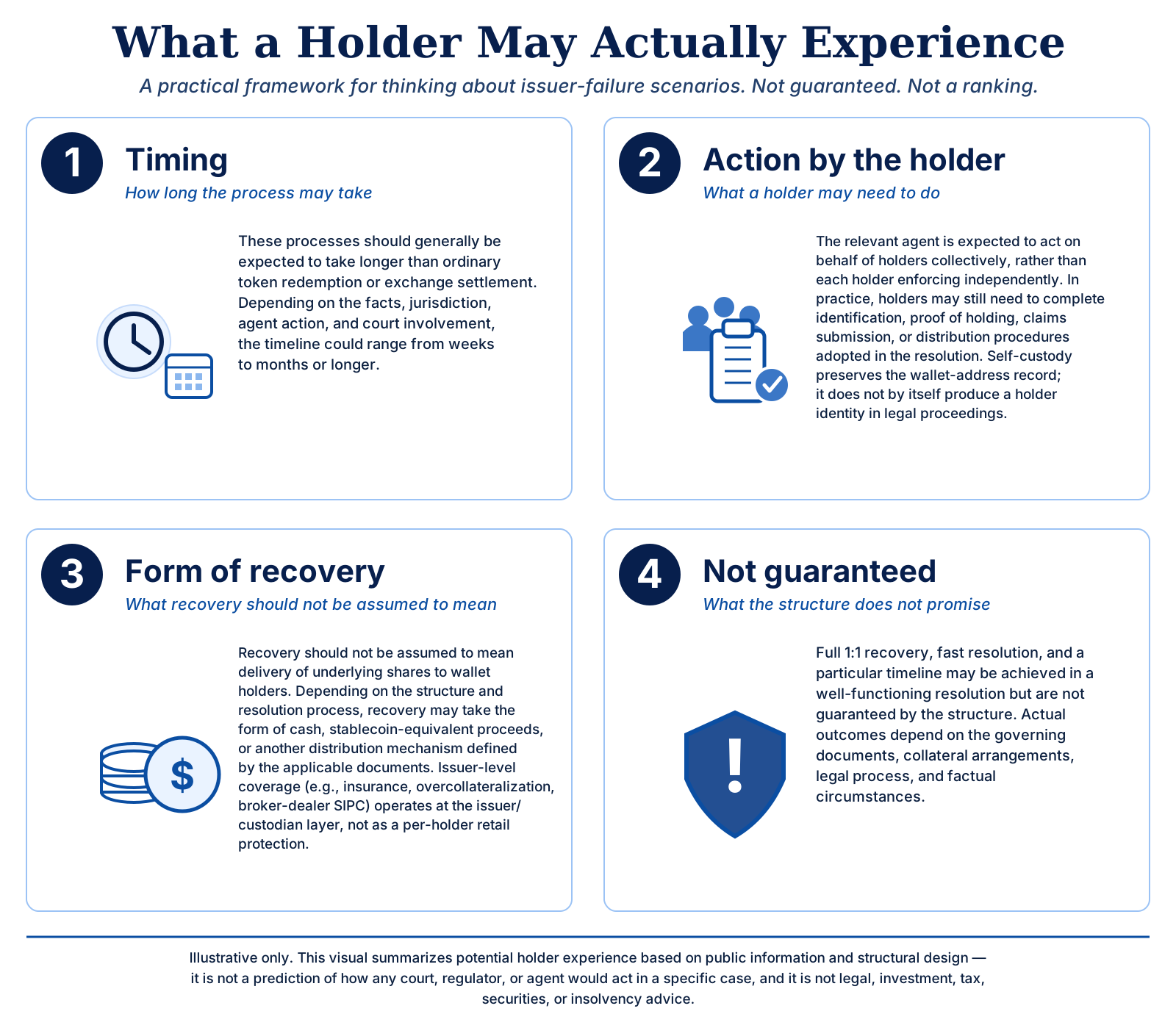
The four practical dimensions below frame what a holder would face. These are hypothetical — no large tokenized-stock issuer of this type has gone through a real failure under public observation, so the description below reflects how the structures are designed to operate, not how they have been tested in practice. This section is not a prediction of how any court, regulator, security agent, transfer agent, broker-dealer, or insolvency official would act in a specific case.
1. Timing. Jersey insolvency proceedings, BVI insolvency proceedings, and SEC-supervised resolution processes should generally be expected to take longer than ordinary token redemption or exchange settlement. Depending on the facts, jurisdiction, agent action, and court involvement, the timeline could range from weeks to months or longer.
Separately from the legal recovery path, market access could also change during that window. Secondary market liquidity for the affected token may thin or disappear — DEX pools may drain as LPs withdraw, CEX listings may halt, and the on-chain token may continue to exist as a transferable asset whose price reflects uncertainty rather than reference NAV.
2. Action by the holder. In the intended design of the three documented paths, the relevant agent (Security Agent for xStocks, Ankura for Ondo, transfer agent function for Dinari) is expected to act on behalf of token holders collectively, rather than each holder independently enforcing against collateral from the start. (bStocks materials reviewed do not name an equivalent agent, which is itself part of the gap noted above; Robinhood’s FAQ describes an independent security agent for its Stock Tokens without naming it.) In practice, holders may still need to complete identification, proof-of-holding, claims-submission, or distribution procedures adopted in the resolution. Self-custody preserves the wallet-address record; it does not by itself produce a holder identity in legal proceedings.
3. Form of recovery. Recovery should not be assumed to mean delivery of underlying shares to wallet holders. Depending on the structure and resolution process, recovery may take the form of cash, stablecoin-equivalent proceeds, or another distribution mechanism defined by the applicable documents. The Lloyd’s $175M aggregate coverage for xStocks is supplemental insurance at the issuer/custodian level, not a per-holder fund. Ondo’s 100.5% overcollateralization buffer is a backing margin, not an additional retail protection layer. Dinari’s broker-dealer SIPC exposure sits at the broker-dealer layer (Dinari Securities, LLC and underlying broker-dealer custodians), not directly at the token holder layer. For bStocks, the public materials describe a 1:1 backing and daily Proof of Collateral but do not detail a comparable per-holder protection layer or a documented enforcement route. For Robinhood Stock Tokens, the FAQ makes the cash form explicit: the security agent would sell the underlying shares and pay cash proceeds, not deliver shares.
4. What is not guaranteed. Full 1:1 recovery in value. Fast resolution. A particular timeline. Any of these may be achieved in a well-functioning resolution; none is guaranteed by the structure. The collateral is intended to be there; the legal process to convert it into proceeds for token holders is what introduces variance.
The token in a self-custody wallet may serve as evidence of the holder’s claim, but it is not, on its own, the recovery mechanism.
What changes for self-custody holders specifically
Self-custody reduces platform-custody risk. It does not remove issuer-structure risk.
What self-custody changes: the token is in the holder’s own wallet, not held by an exchange that might itself become a counterparty in any failure scenario. If a CEX restricts withdrawals during stress, a self-custodied token is not trapped inside that exchange account. That does not mean the token is unaffected by issuer-level restrictions, transfer controls, liquidity loss, or recovery procedures. The holder’s address is the holder’s record on chain, which can support identification under any process that recognizes blockchain records.
What self-custody does not change: the documents and recordkeeping systems that govern recovery — SPV prospectuses, security agent appointments, transfer agent registrations — live off-chain, in legal systems that don’t read wallet addresses by themselves and don’t accelerate because the holder is self-custodied. Collateral sufficiency and procedure timing are determined by the same factors regardless of where the token is held.
For the broader framework on how this risk layer sits alongside the other six dimensions a tokenized stock holder faces, see our pillar reference: On-chain Stocks for Self-Custody Wallet Users.
Closing
The right question is not only whether tokenized stocks are fully backed, but who controls the backing, under what documents, and what happens if the issuer cannot act. Each of the three primary issuers covered here answers that question through a specific legal and collateral architecture, and Binance bStocks add a less-documented exchange-affiliated variant whose recovery detail is thinner and whose distinctive feature is group-level concentration. Robinhood’s July 2026 Stock Tokens add a second Jersey debt path that states its insolvency mechanism while leaving its enforcement roles unnamed. None of these answers reduces to a single word — “safe,” “unsafe,” “protected,” “unprotected.”
This reference is intended to map the architecture, not to recommend any specific issuer or product. Tax, securities, and insolvency treatment of tokenized stocks varies by jurisdiction; holders should confirm specifics with a qualified adviser in their jurisdiction of residence.
FAQ
If a tokenized stocks issuer fails, is my token automatically worthless? Not automatically — but recovery is not automatic either. The token sits in your own wallet, but the claim it represents depends on the issuer’s structuring documents, who controls the collateral, the role of any security agent, and the insolvency procedure that governs the issuer entity. The practical question is not whether the underlying is “fully backed 1:1,” but who can act on that collateral when the issuer cannot, and how long the legal process takes.
Does SIPC protect tokenized stock holders? Generally not in the way the phrase suggests. SIPC protects a broker-dealer’s customers, and a token holder is usually one structural layer removed from that relationship. SIPC may become relevant at the broker-dealer layer in some structures (Dinari’s path involves a FINRA/SIPC-member broker-dealer), but only if the statutory conditions are met, and even then it is not the same as a token holder holding a normal brokerage account directly. For bStocks and Robinhood Stock Tokens, no SIPC-style protection is described at all — an ADGM certificate and a Jersey debt security respectively, not US broker-dealer customer relationships.
How do the recovery paths differ across issuers? xStocks routes recovery through a Jersey SPV and a Security Agent under a three-party Account Control Agreement. Ondo routes through a BVI SPV with Ankura Trust holding a first-priority security interest and acting on default. Dinari routes through US transfer-agent recordkeeping under SEC rules, with broker-dealer custody at an affiliated entity. Each defines its mechanism in advance through documents and depends on a jurisdictional procedure that takes time. Binance bStocks are treated separately below because the public materials reviewed do not identify the same level of recovery-path detail. Robinhood’s July 2026 Stock Tokens add a second Jersey debt path, with an independent security agent described for insolvency (selling the shares, paying cash proceeds) but neither agent nor custodian named in the materials reviewed.
Where do Binance bStocks fit, and why is their recovery path less documented? bStocks are an ADGM-framework certificate issued by BTech Holdings, a Binance group affiliate, described as backed by a regulated custodian and a bankruptcy-remote issuing entity with daily Proof of Collateral. What the public materials reviewed here do not provide — in contrast to the other three — is a named custodian, an independent security agent or control agreement, or a documented default/failure procedure. Their distinctive feature is counterparty concentration: issuer, trading venue, and conversion broker are affiliated within one corporate group, so a single group-level event could touch several roles at once. That is a concentration consideration, not a different legal claim type, and the recovery specifics should be checked in current issuer / venue documentation.
What happens to Robinhood Stock Tokens if the issuer fails? Per Robinhood’s FAQ, the underlying shares are held 1:1 with a US-based licensed custodian, and in an issuer insolvency an independent security agent would sell the shares and arrange cash proceeds to token holders. That is a stated default mechanism, which the bStocks materials do not publish; what it lacks relative to the SPV paths is a named agent and published control-agreement machinery, and the custodian is also not named in the materials reviewed. Jersey insolvency law applies to the issuer entity, recovery specifics depend on the prospectus terms and the process itself, and the described form is cash proceeds, not share delivery.
Does holding the token in self-custody improve my position if the issuer fails? It changes one risk and not another. Self-custody means the token is not trapped inside a centralized exchange that could itself become a counterparty in a failure — your address is your on-chain record. It does not change the off-chain documents and recordkeeping systems that govern recovery, which don’t read wallet addresses by themselves and don’t accelerate because you self-custody. Collateral sufficiency and procedure timing are the same regardless of where the token is held.
Will recovery mean I get the underlying shares delivered to my wallet? Should not be assumed. Depending on the structure and resolution, recovery may take the form of cash, stablecoin-equivalent proceeds, or another distribution mechanism defined by the applicable documents — not delivery of the underlying shares. Full 1:1 recovery in value, fast resolution, and a particular timeline are none of them guaranteed by the structure; the collateral is intended to be there, but the legal process of converting it into proceeds for holders is what introduces variance.
Questions this reference answers
The specific questions this page is written to address — useful as a jump-off for what to look up next.
- What happens to xStocks if Backed Finance or the Jersey SPV fails?
- How is the Ondo Global Markets recovery path structured under BVI law and Ankura's security interest?
- How does Dinari's SEC transfer-agent + broker-dealer structure shape recovery if the issuer fails?
- Does SIPC actually protect tokenized stock holders?
- Where do Binance bStocks fit, and why is their recovery path less documented than the others?
- What happens to Robinhood Stock Tokens if the issuer fails, and what does the security-agent description cover?
- What would a self-custody holder of tokenized stocks practically experience during issuer insolvency?
Sources
Primary statutes, official guidance, and dashboards cited above. Each links to the canonical source so you can verify what we’ve said.
Legislation & primary statutes
Administrative guidance
- SEC Joint Staff Statement on Tokenized Securities (Corp Fin, IM, TM)· US · 2026-01-28
- xStocks Product Legal Overview (Backed Finance / xStocks Docs)
- Backed Finance legal documentation (Liechtenstein FMA prospectus and product terms)
- Ondo Global Markets — Trust & Transparency
- Ondo Global Markets — Legal & Regulatory
- Ondo Finance — No-Action Request to SEC: Broker-Dealer Support of Customers' Use of a Public Blockchain for Recordkeeping· US · 2026-04-13
- Dinari — Transparency (Dinari, Inc. transfer agent registration)
- Dinari — What are dShares? (issuance and redemption flow)
- Dinari Securities, LLC — Form CRS (FINRA BrokerCheck)
- Dinari — dShares page
- Kraken xStocks FAQ
- Kraken xStocks Risk Disclosure
- Binance — bStocks launch announcement (BTech Holdings as issuer; ADGM FSRA-approved prospectuses; certificate under FSMR para 92, Schedule 1; 1:1 backing; bankruptcy-remote issuing entity language)· ADGM
- Binance Support — Introducing bStocks: Tokenized Securities 1:1 Backing with 24/7 Trading (regulated custodian, Proof of Collateral, ADGM availability and US-person exclusion)· ADGM
- bStocks.finance — bStocks overview (1:1 backing; ring-fenced, segregated, daily Proof of Collateral; bankruptcy-remote issuing entity)
- Robinhood — Invest with Stock Tokens (issuer definition; 1:1 backing; US-based licensed custodian, monitored daily; insolvency FAQ: independent security agent, cash proceeds)
- Robinhood — Base Prospectus and Final Terms (RHJ legal documents)
Last updated on July 10, 2026. Written by DeGate Editorial Team.
Corrections and primary-source updates welcome at corrections@degate.com .
Related references
On-chain Stocks for Self-Custody Wallet Users: A 2026 Reference
A 2026 reference on tokenized stocks in self-custody — issuer structures (xStocks, bStocks, Ondo, Dinari), the wallet-native path, risk layers, and reporting.
Robinhood Stock Tokens: What You Hold and What You Can Withdraw
Robinhood has two stock-token products: Classic EU app contracts and Jersey-issued onchain Stock Tokens. What you hold and what you can withdraw.
What Is the Tokenized Stock in Your Wallet? Four Issuance Models Compared
What a tokenized stock legally is depends on its issuer, not the ticker: xStocks, Ondo, Dinari, Binance bStocks, and Robinhood Classic compared.
How Tokenized Stocks Enter Self-Custody Wallets: Secondary Markets, Exchange Withdrawals, and Direct Minting
How tokenized stocks reach a self-custody wallet — secondary-market swaps, exchange withdrawals, and direct minting — and what each route changes.
How Tokenized Stock Dividends Work: xStocks Rebasing, Ondo Total-Return Pricing, and Dinari Stablecoin Distributions
How dividends from xStocks, Ondo, Dinari, bStocks, Robinhood Stock Tokens, and Coinbase Tokenized Stocks show up in a self-custody wallet.
How Arbitrage Keeps Tokenized Stock Prices in Line — and Why It Can't Work Perfectly 24/7
Who keeps tokenized stock prices close to the underlying — the arbitrage loop, what it needs to run, and the structural limits that cap 24/7 alignment.
Italian Crypto Tax in 2026: A Reference on Quadro RW, Quadro RT, and DAC8
A pre-commercialista reference for Italian crypto holders: the 2026 capital-gains rate, Quadro RW, Quadro RT, ravvedimento operoso, DAC8, and records.